
Unbiased headlines. Facts, not spin.
Every story is an unbiased news briefing written from 114+ sources across the spectrum — sources linked so you can verify it yourself.
 energy
Major Story (8/10)
Event date: October 3, 2026
energy
Major Story (8/10)
Event date: October 3, 2026
G7 Emergency Oil Release Equals About One Day of Global Demand as Stockpiles Shrink
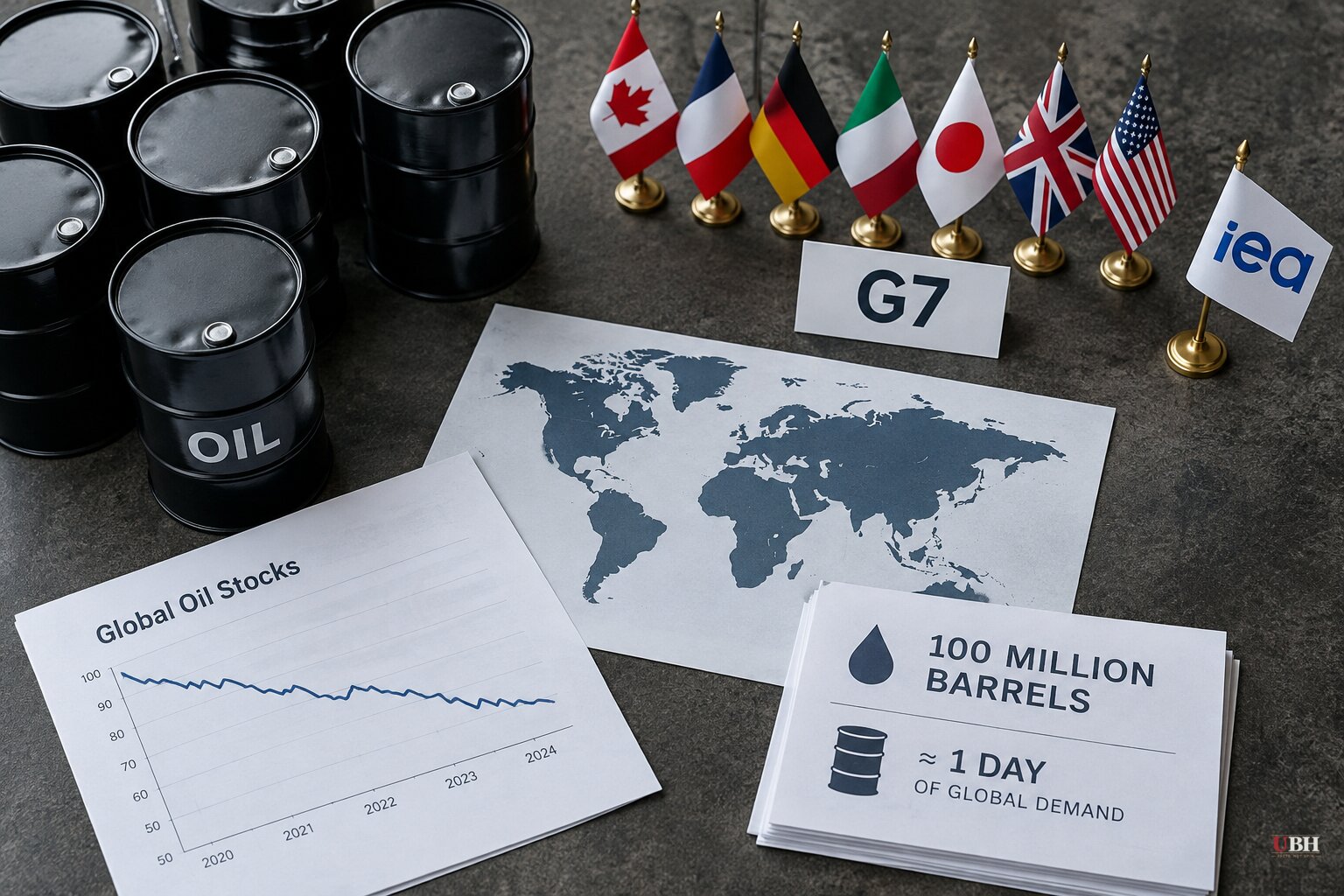
Since the International Energy Agency launched its record 400-million-barrel emergency release in March, the world has burned through most of the cushion it was meant to rebuild. The new 100-million-barrel release, announced last week, lands on a much thinner base.
The size of the cushion
Saudi Aramco CEO Amin Nasser laid out the numbers at the Energy Intelligence Forum in London on Oct. 5. When the U.S.-Iran war began, the world held about 10 billion barrels of oil in stocks. That is now under 6 billion, and only about 10% of it is practically available because of technical and political restrictions, he said.
More than 1 billion barrels have been released since the war began, Nasser said. "The system is already straining," he told the forum. "The supply resilience cushion is scarily thin."
The IEA's September monthly report shows the same trend. Global inventories fell 95 million barrels in August, bringing total draws since February to 507 million barrels, or about 2.8 million barrels a day. OECD commercial stocks did rise 23 million barrels in August, offsetting a 19-million-barrel draw in strategic reserves.
The IEA says more than 80% of the March release has already reached the market. The agency's own figure for the new release puts it near one day of global consumption, which runs about 102 million barrels a day.
IEA chief Fatih Birol said member governments still hold roughly 1.1 billion barrels of publicly held emergency stocks, including more than 200 million barrels of diesel. "The IEA stands ready to release more," he said.
The U.S. reserve
The Strategic Petroleum Reserve is at its lowest level since 1982. The Energy Department put it at 283.8 million barrels last week. An earlier count had it at 331.2 million barrels at the start of October. Both are far below the 500 million to 600 million barrels it typically holds, and the 714-million-barrel maximum capacity.
The draw comes from the 172-million-barrel release President Donald Trump ordered in March after Iran restricted exports through the Strait of Hormuz.
Nasser said refilling depleted stocks could take up to two years, and only after Hormuz reopens. Governments rebuilding inventories would add at least 2 million barrels a day of demand, he said, and more if they decide to hold bigger stockpiles.
Crude is moving. Diesel is not.
Gulf crude exports have largely recovered. Kpler data show exports outside Iran above 81% of prewar levels in September, and Saudi Arabia's East-West Pipeline is back to 5.8 million barrels a day after a September attack knocked it out. Nasser said all of Aramco's upstream capacity remains intact.
Brent has still hovered around $100 a barrel for a month. It settled at $100.58 on Tuesday, Oct. 6, after dipping below $98 on news of the release. WTI settled at $89.44.
The weak link is refined fuel. The Wall Street Journal reported crude moving through Hormuz at about 76% of prewar levels, while refined products make up only 11% of cargoes, down from more than 20% before the war. Missile strikes have knocked Middle East diesel refineries offline. JPMorgan analysts say "the crude market has largely normalized even as refined product supplies remain constrained."
AAA put the U.S. diesel average at $6.315 a gallon on Oct. 6, down from a record $6.53 on Sept. 22 but 72% above a year ago. Regular gasoline was $4.369, up 39%.
Andy Lipow of Lipow Oil Associates told NBC News the G7 release could cut diesel prices by about 25 cents a gallon temporarily but "does little to increase refinery capacity to produce more."
The administration's position
The White House had been preparing a 90-day diesel export ban, Politico reported, then dropped it once the G7 agreed to release diesel. Trump defended that call last week. "Europe has a lot of diesel, and they're going to be making a major world contribution, and so are we," he said. "And we're not going to be doing the export ban."
The administration has also opened tax-free dyed diesel to highway trucks to lower transportation costs. The G7 plan calls for the 100 million barrels to flow over four months, with a large share of the diesel going out in the first 20 days.
The EIA has raised its oil-price outlook again.
Tankers and a storm
The attacks have not stopped. Nearly 20 commercial ships have come under fire around Hormuz in the past month. A projectile hit the tanker On Peace on Oct. 6 and injured 12 crew members, and Kuwait's Kazimah III caught fire after being struck Oct. 1. The International Maritime Organization counts at least nine sailors dead since July.
Richard Meade of Lloyd's List put it this way: "The oil market is not becoming more secure. It is becoming more efficient at operating under sustained insecurity."
Now a weather risk is stacked on top. Hurricane Isaias was moving toward the Gulf Coast this week. As of midday Thursday, Oct. 8, about 1.3 million barrels a day of Gulf of Mexico oil output, roughly 63% of the region's production, had been shut in, according to the federal Marine Minerals Administration.
Forecasts called for landfall east of New Orleans, which should spare the heart of the refining complex. Even so, Lipow said about 2.7 million barrels a day, or 14% of U.S. refining capacity, sits within or near the projected path.
"There is no slack in the system to make up for lost refinery capacity," Lipow wrote. "Lost production will have to come out of already low commercial inventories."
Robert Yawger of Mizuho Securities called the timing "the worst time something like this could happen in 25 years." The storm's actual impact depends on its final track and strength.
The open question is the one Nasser flagged: the stockpiles can only be refilled after Hormuz fully reopens, and there is still no date for that.
Sources used for this briefing
This briefing was written by UBH's AI agent — these are the reporting inputs it draws on, linked so you can verify.


