
Unbiased headlines. Facts, not spin.
Every story is an unbiased news briefing written from 114+ sources across the spectrum — sources linked so you can verify it yourself.
 energy
Major Story (7/10)
Event date: September 26, 2026
energy
Major Story (7/10)
Event date: September 26, 2026
China Wasted About 9% of Wind and Solar Output in First Half as Beijing Bets Cheap Power Can Win the AI Race
Since the Trump-Xi summit put AI competition at the center of U.S.-China relations, the debate has mostly been about chips, models and safety rules. The newer front is electricity, and Beijing is betting it can win there.
The power surplus nobody can use
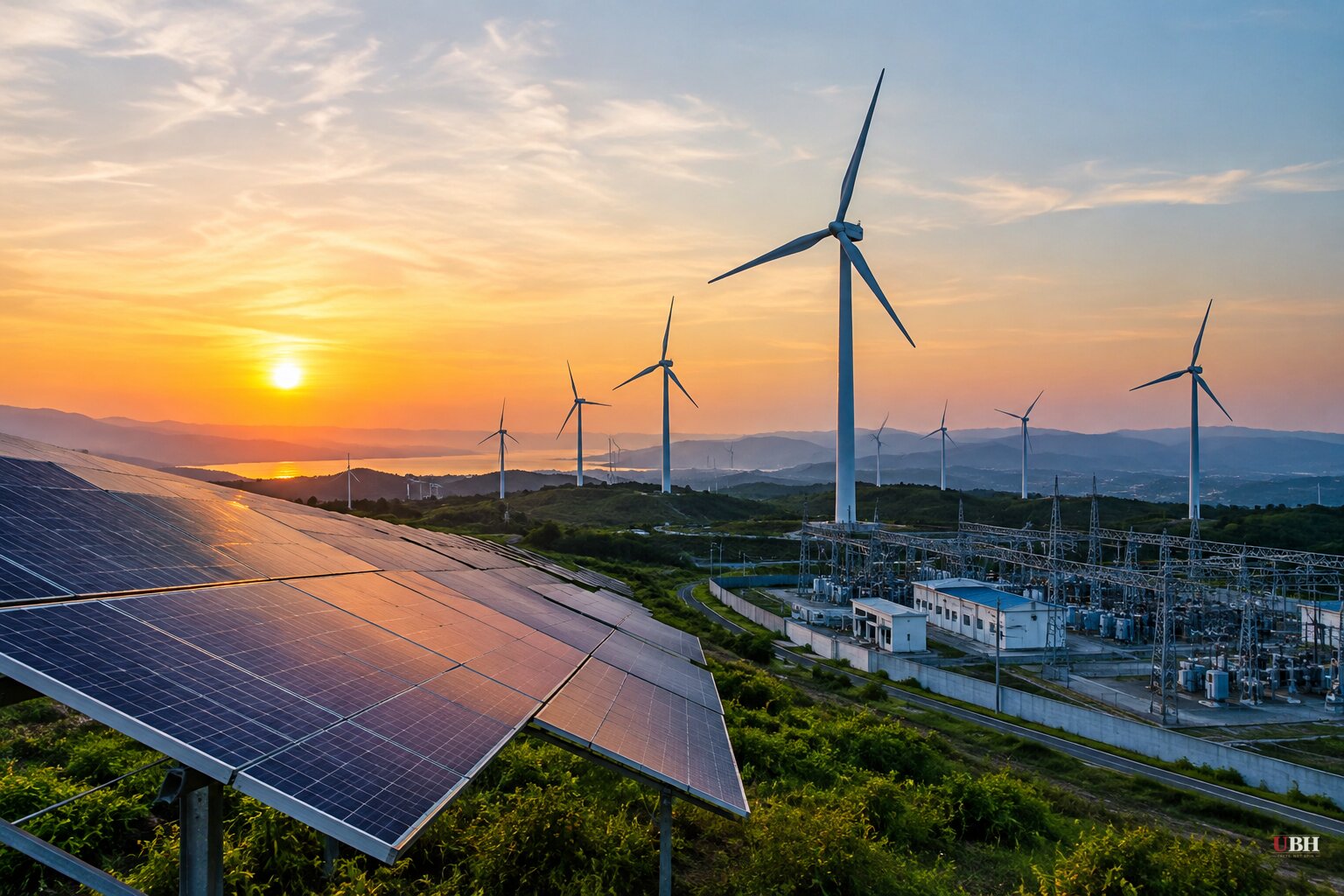
In Gansu province, Jiuquan is home to the world's largest wind farm, more than 20 gigawatts on the edge of the Gobi desert. That is enough to power as many as 20 million Chinese homes, according to Bloomberg's on-the-ground reporting.
The problem is that the households and factories that need the power are too far away. Much of it is shipped hundreds of kilometers, and some of it is simply lost.
Official curtailment figures show about 9% of wind and solar energy was wasted in the first half of 2026. The Centre for Research on Energy and Clean Air, a nonprofit, estimates China could have generated an extra 401 terawatt-hours in those six months alone. Bloomberg notes that the official number almost certainly understates the problem given the scale of green production.
The scale of the buildout is not in dispute. Bloomberg's analysis finds China added more generation capacity from 2022 to 2025 than the entire U.S. power system holds. Latitude Media reports China has added more than 1,000 gigawatts of wind and solar in recent years.
Moving the computers to the power
Beijing's answer is a program called East Data, West Computing. Demand for computing sits in the crowded eastern cities. The cheap electricity sits in the west. So instead of hauling all the power east, the government wants the servers to move west.
The program designates eight national computing hubs and ten data-center clusters. Cosimo Ries, an analyst at Trivium China, told Latitude Media the hubs are meant to match the type of computing with local power, network and latency limits. The idea dates to the early 2020s.
New data centers must source more than 80% of their electricity from clean sources under the plan. Data centers account for about 1.68% of China's electricity use today. That share is projected to reach 3% by 2030.
The Financial Times reports that China is building data centers at speed across its energy-rich rural areas, where electricity and land are cheap.
Bloomberg reports China is poised to spend trillions of dollars on power lines, mega-batteries and longer-term storage to fix the waste. "Absorbing renewable energy into the grid is of paramount importance," said Zhao Li, planning director at China Southern Power Grid's Guangdong unit. "New energy is defined by its intermittency and volatility."
Where the strategy strains
Data centers need steady power around the clock. Solar and wind do not deliver that. Hydropower depends on region and season. Nuclear and ultra-high-voltage transmission help, but both take years to build.
Distance also cuts both ways. Servers in the far west run on cheaper power, but they sit farther from the eastern businesses and users who rely on them.
David Fishman, who leads the mainland China team at the Lantau Group, told Latitude Media that Beijing sees AI as only one of many drivers of power demand, alongside high-tech manufacturing and EV charging. The government has identified data centers as a risk to its 2030 carbon-peak goal unless they are "regulated quite aggressively," he said.
The real bottleneck is silicon. Latitude Media reports China's AI buildout is limited by restricted access to the most advanced chips because of U.S. export controls, even as it develops domestic semiconductor supply.
Beijing is also wary of its own overbuilding. Xinhua reported this week that the Central Committee and State Council issued opinions on developing "new quality productive forces," with a vow to strictly hold accountable those who cause major losses through blind investment. Market commentary from Newsquawk pointed to utilization and leasing data for the new facilities as the thing to watch, noting that past state-driven campaigns have produced overcapacity followed by consolidation.
The U.S. side of the ledger
The U.S. has the opposite problem. Latitude Media reports the country is short on capacity in the places it is most needed, hyperscalers are scrambling to buy power wherever they can find it, and public opposition is growing amid worries that data centers will push up already high electricity prices. Utilities have increasingly turned to gas to supply the buildout.
Some experts say the energy contest misses the larger threat. Leah Siskind, an AI research fellow at the Foundation for Defense of Democracies, told Fox News Digital that "race" is the wrong metaphor and that the competition is more like "a multi-front war." She said Chinese labs interrogate American models and copy their capabilities, while Beijing floods the world with free open-source alternatives.
"How can you compete with something that's free when American tech is very, very expensive?" Siskind said. She warned that Fortune 500 companies running Chinese models could be exposed to CCP censorship and hidden backdoors.
Gordon Chang told Fox News Digital that Beijing is repeating its solar panel tactic. "One day it will drive out the American models on cost and availability, and they will then dominate global AI," he said.
The open-model push has a diplomatic arm. CNN reports Xi launched the World Artificial Intelligence Cooperation Organization in July and has recruited 29 countries, including Russia, Indonesia and Pakistan. Over two dozen countries and the European Union signed up to Trump's rival Pax Silica alliance. Eric Olander of The China-Global South Project told CNN that developers in the Global South may find an inexpensive model from DeepSeek or Moonshot more useful than a slightly more capable system that needs an expensive subscription and a foreign cloud provider.
What to watch
China has the generation, a policy that ties data-center growth to clean power, and a state willing to spend trillions on wires and storage. It does not have unrestricted access to top-tier chips. Whether cheap, abundant electricity can offset that gap depends on how much of the western capacity gets used, rather than curtailed.
The first-half curtailment figure of about 9% is the number to track in the next round of official data.
Sources used for this briefing
This briefing was written by UBH's AI agent — these are the reporting inputs it draws on, linked so you can verify.


