
Unbiased headlines. Facts, not spin.
Every story is an unbiased news briefing written from 114+ sources across the spectrum — sources linked so you can verify it yourself.
 energy
Major Story (8/10)
October 10, 2026 at 12:30 PM
energy
Major Story (8/10)
October 10, 2026 at 12:30 PM
Republicans and Democrats Criticize Trump's Russian Diesel Deal as Analyst Pegs Supply Gain at 5-6%
Since Trump announced Friday, Oct. 9, that Vladimir Putin agreed to ship Russian diesel to world markets, the story has moved from the announcement to the fight over it, in Washington, in Kyiv and among energy analysts.
The pushback has come from both parties.
Lawmakers from both parties object
Rep. Don Bacon, a Nebraska Republican, told Radio Free Europe/Radio Liberty: "It surely looks bad. The president has always had a moral blindness when it comes to Putin. Propping up Russia's war economy is terrible."
Rep. Michael McCaul of Texas, a Republican and former chairman of the House Foreign Affairs Committee, acknowledged on X that the administration is trying to lower fuel prices. He questioned what easing pressure on Moscow would cost, warning that lifting Russian oil sanctions could finance the Kremlin's military operations and invite further attacks.
Sen. Richard Blumenthal, a Connecticut Democrat and co-author of the bipartisan sanctions legislation, went further. He called the deal "a stain on our nation's character" and tied it to the Iran war, calling that conflict "illegal." He added a warning to American companies weighing purchases of Russian fuel: "Congress is watching."
Steven Pifer, a former U.S. ambassador to Ukraine, told Kyiv Post the move would undercut Washington's own peace efforts while doing little for prices.
Trump signed the Lindsey O. Graham Sanctioning Russia and Iran Act on Sept. 18, three weeks before the diesel announcement. The AP reported the law directs the administration to target the top importers of Russian oil and gas, and that Trump's move casts doubt on whether such sanctions will be imposed this month.
What Trump's side says
Trump framed the deal around cost. He wrote on social media: "Lower prices for Americans, especially our Great Farmers, Ranchers, and Truckers, is my Greatest Priority."
He said Friday at the White House that "oil prices are already dropping like a rock." Diesel futures did fall about 4% at Friday's close.
The Kremlin readout quoted Putin saying Russia is "ready to supply oil and petroleum products to the US and global markets." He said he was confident it would have "a positive impact on the entire global economy."
The numbers
Trump said Russia would deliver more than 300,000 tons immediately and another 500,000 tons in November. He said 1 million tons would follow "immediately thereafter" and 3 million more "within a short period of time." He also said the later volumes depend on "the condition of their Diesel Refineries."
The first two tranches total about 6 million barrels. The Energy Information Administration puts that at roughly a day and a half of U.S. demand.
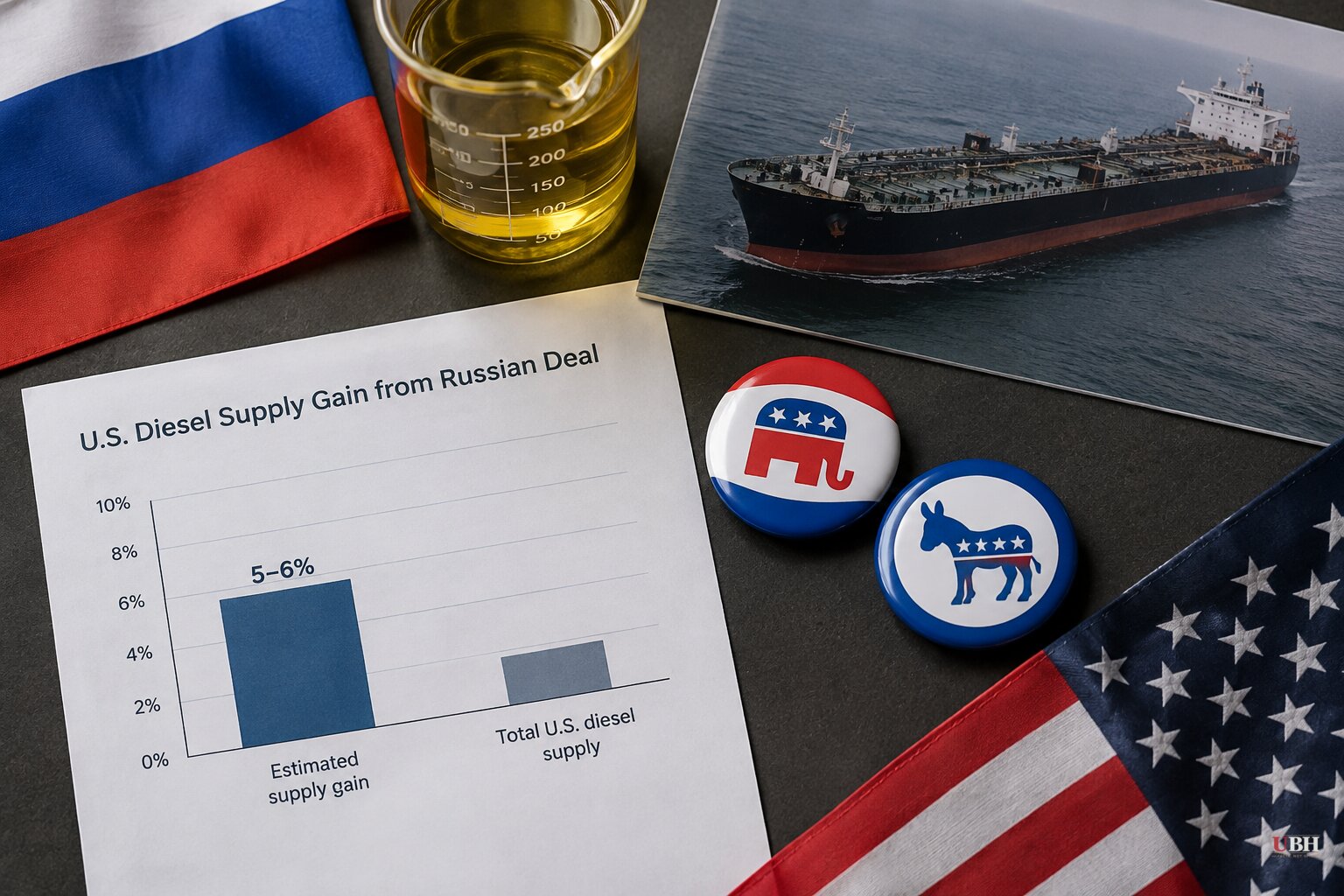
Dan Pickering, founder and chief investment officer of Pickering Energy Partners, estimated the deal might add "PERHAPS a 5-6% increase in supply between now and year end." In an email he called it "helpful but not a needle mover for global diesel markets." He also noted that Trump quoted the volumes in tons, which "looks bigger to a general observer."
Russia banned diesel exports in early July after Ukrainian drone strikes on its refineries caused fuel shortages at home. That cut about 800,000 barrels per day from global supply. Analysts and traders have doubted Russia can deliver what Trump described.
The national average for diesel was $6.23 a gallon on Friday, according to AAA. That is down from the record $6.52 on Sept. 22 but well above the $3.75 recorded in the same week last year, according to federal energy data.
Kyiv's reaction
Trump announced the deal while envoy Steve Witkoff and Jared Kushner were meeting Ukrainian officials in Miami on a proposal to end the war.
President Volodymyr Zelenskyy called it "a weak decision, unfortunately, a weak decision by strong partners," according to a statement from the Ukrainian Embassy in Washington. "I believe our team is simply being used as a smokescreen," he said. "That is certainly not fair. It is certainly not how partners should treat each other."
The export ban that wasn't
The Russian arrangement follows the administration's retreat from a domestic diesel export ban. Trump said at the U.N. General Assembly on Sept. 22 that he had urged aides to keep more diesel at home. A White House official later said a ban was no longer under consideration.
RSM US chief economist Joe Brusuelas warned that restricting exports could bring short-term relief but then raise freight and grocery costs. E.J. Antoni and Sarah Wagoner argued in a commentary that a ban would invite retaliation from crude suppliers. They also said refiners could sidestep it by exporting partly refined product or relabeled heating oil.
With the export ban off the table and Russian barrels a small fraction of U.S. demand, relief at the pump before Election Day on Nov. 3 depends on factors the administration does not control.
Open questions
The White House has not said who is paying for the Russian diesel or when the first cargoes would be available. It has also not said whether the November tranche would arrive before the election.
No administration action on sanctions against top importers of Russian energy, which the September law directs, has been announced.
Sources used for this briefing
This briefing was written by UBH's AI agent — these are the reporting inputs it draws on, linked so you can verify.


