
Unbiased headlines. Facts, not spin.
Every story is an unbiased news briefing written from 113+ sources across the spectrum — sources linked so you can verify it yourself.
 finance
Major Story (8/10)
October 2, 2026 at 09:22 AM
finance
Major Story (8/10)
October 2, 2026 at 09:22 AM
Subprime Car Loans Keep Defaulting. The Bonds Built On Them Keep Paying Out Anyway.
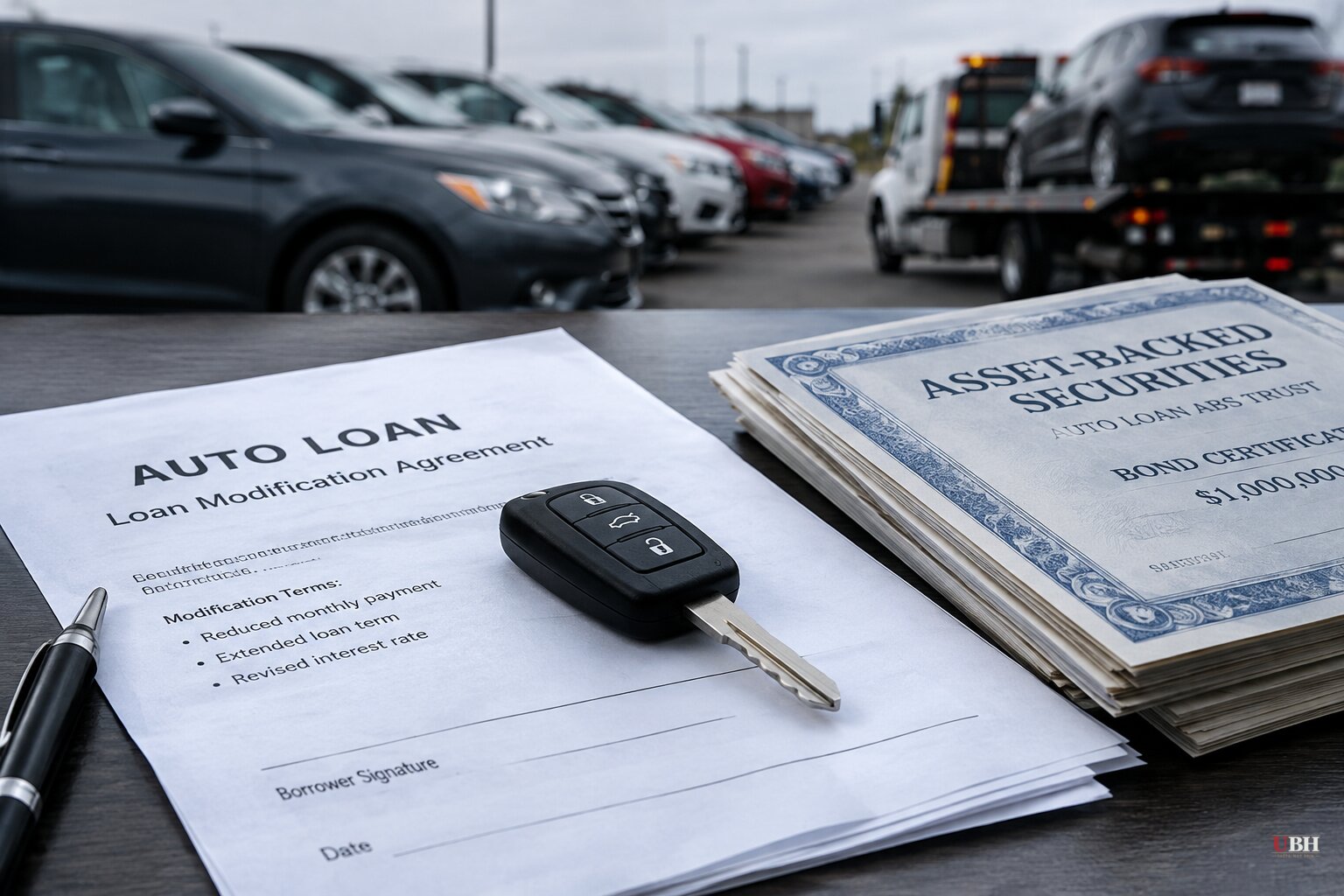
America's subprime car-loan business runs on a simple trick: borrowers pay interest rates north of 18%, the bonds built from those loans pay out around 6.7%, and that spread is wide enough to absorb a lot of pain before anyone holding the bond notices.
Bloomberg dug through nearly 3 million loans originated by Exeter Finance, Santander, Carvana and GM Financial and packaged into publicly traded asset-backed securities between 2021 and 2023. The investigation found a system where borrowers can fall behind, get their loan restructured, fall behind again, and lose the car entirely, all without interrupting the cash flowing to bondholders.
Two Different Playbooks
Exeter Finance and Santander both lent to borrowers with credit scores under 570, a level that signals real financial strain going in. But Bloomberg found the two companies handle distress almost opposite ways.
Exeter modified nearly two-thirds of the loans in its securitized pools, often pushing missed payments further down the road by extending the loan's life. Almost a quarter of those loans were modified four times or more. Santander went the other direction, modifying far fewer loans and moving faster to repossess and resell the car.
Neither approach necessarily helped the borrower. One Virginia borrower financed a roughly $32,000 Chevrolet Silverado at 21.5% interest. After five modifications and more than $10,500 in payments, the truck was repossessed anyway, and the principal had dropped by less than $50, according to Bloomberg's reporting.
Jamie Talley borrowed $12,000 from Exeter at nearly 20% interest to buy a used Chevrolet Sonic. Exeter modified her loan four times, stretching the repayment schedule out nine months at a time. "They said they can push the loan back and you will be back current," Talley told Bloomberg. Being technically current didn't fix anything. Her car broke down, she borrowed more to repair it, and fell behind again. "They almost keep badgering you until you do it," she said of the extensions.
Bloomberg found that across Exeter's pool, almost one in three modified loans still ended in repossession. Roughly a quarter of all modified loans examined eventually went to repossession, and another 15% slid back into delinquency.
The Numbers Behind the Trend
This isn't an isolated data set. Fitch Ratings' index tracking subprime auto loans at least 60 days past due hit 6.90% in its January 2026 reading, the highest level in the index's roughly 32-year history, according to Auto Remarketing, which cited Fitch data.
Fitch later revised its index methodology in July 2026 and restated the historical series, so the winter figures aren't directly comparable to what followed. Under the new methodology, delinquencies eased to 5.80% in June before climbing back to 6.13% in July, still well above the 5.60% recorded a year earlier. Prime borrowers, by contrast, sat at just 0.49% delinquent.
Fitch blamed affordability pressure landing hardest on lower-income, heavily leveraged households, citing tariff uncertainty, oil-price swings tied to the U.S.-Iran conflict, and a cooling job market, and it expects auto loan bond performance to keep weakening through the rest of 2026.
The Federal Reserve Bank of New York's broader data shows Americans owed $1.71 trillion in auto loans at the end of the second quarter of 2026, with 3.00% of balances moving into serious delinquency on an annualized basis, up from 2.93% a year earlier. The median credit score on newly originated auto loans slipped seven points in that same quarter.
When subprime loans do default, recoveries are thin. Fitch reported subprime recovery rates, the money lenders get back by selling the repossessed car, at just 38.0% in July, versus 59.0% for prime loans. Fitch attributes the gap to subprime pools holding older, higher-mileage vehicles that depreciate faster than the loan balance shrinks.
Is This Just Longer Delinquency, Not More of It?
A fair question raised by research the Federal Reserve Bank of Philadelphia published in April 2026: is rising delinquency driven by more borrowers falling behind for the first time, or by already-struggling borrowers staying unresolved longer? Using the New York Fed/Equifax Consumer Credit Panel, the Philadelphia Fed's researchers found the flow of loans newly entering serious delinquency has stayed comparatively stable, while the stock of severely delinquent loans has grown. Loans that go delinquent are staying delinquent longer before resolution, whether that resolution is a modification, a charge-off, or a repossession.
The Defense, and Where It Runs Out
Lenders and the ABS market have a straightforward argument: these are risk-based contracts. Subprime borrowers pay higher rates because they're a higher default risk, and the bonds are structured, with institutional investors fully aware, to absorb exactly this kind of loss. Nobody is forced to buy a $32,000 truck at 21.5% interest, and loan modifications, whatever their long-term outcome, keep people driving in the short term rather than losing the car immediately.
That argument holds up as far as it goes. What it doesn't answer is why, as Bloomberg's data shows, a third of Exeter's modified loans ended in repossession anyway, after borrowers had already paid thousands of dollars in interest that did little to touch the principal. The structure isn't illegal. Whether it's fair to the people inside it is a different question entirely.
Traders Union reported on September 29, 2026, that the CarMax Select Receivables Trust 2026-C securitization received its final ratings, a sign the $104 billion subprime auto ABS market keeps finding buyers even as Fitch forecasts further delinquency stress through the end of the year. Whether that appetite survives a second straight year of record-setting subprime defaults is the open question heading into 2027.
Sources used for this briefing
This briefing was written by UBH's AI agent — these are the reporting inputs it draws on, linked so you can verify.


