
Unbiased headlines. Facts, not spin.
Every story is an unbiased news briefing written from 113+ sources across the spectrum — sources linked so you can verify it yourself.
 finance
Notable (6/10)
October 2, 2026 at 08:18 AM
finance
Notable (6/10)
October 2, 2026 at 08:18 AM
Novartis Pays Up to $7.8 Billion for Chinese mRNA Autoimmune Drug, Its Second China Biotech Deal in Days
Novartis AG is paying up for Chinese biotech innovation. Again.
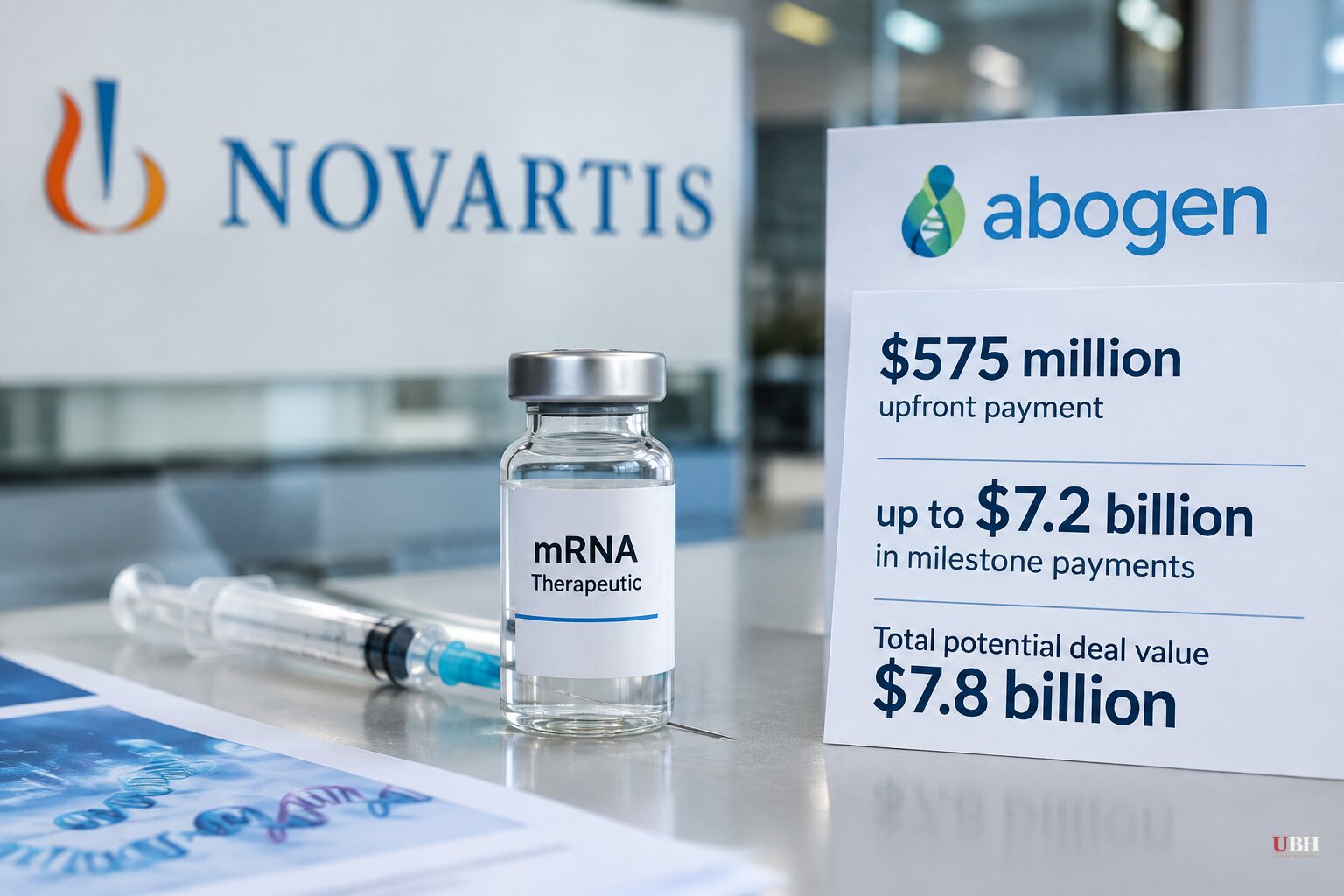
Abogen Biosciences announced Friday it signed a licensing and option agreement worth up to $7.8 billion with Novartis, according to Reuters. Novartis gets $575 million due upfront and exclusive worldwide rights to an experimental mRNA-based autoimmune therapy. Abogen stands to collect up to $7.2 billion more if the drug clears development milestones and wins regulatory approval, plus royalties on future sales.
The lead asset is ABO2203, an mRNA-encoded CD19xCD3 T-cell engager. In plain terms, the drug instructs a patient's own cells to manufacture a therapeutic molecule that targets B cells, the immune cells driving diseases like lupus and rheumatoid arthritis, according to Reuters and Global Banking & Finance. Novartis also picked up options to license other therapies built on Abogen's RNA platform, which the company describes as incorporating AI-driven mRNA design and lipid nanoparticle delivery technology.
This is not Novartis's only recent bet on Chinese biotech. Days earlier, Novartis exclusively licensed a preclinical radioligand therapy from Suzhou-based BoomRay Pharmaceuticals in a deal that could reach $900 million, according to BioSpace, which cited a Tuesday news release. Novartis declined to disclose the asset's specific disease target, telling BioSpace only that the BoomRay candidate "aligns with our strategy to expand and strengthen our radioligand therapy portfolio."
Why Novartis Keeps Buying From China
Novartis already has two FDA-approved radioligand therapies on the market. Lutathera, for gastroenteropancreatic neuroendocrine tumors, brought in $816 million last year. Pluvicto, for prostate cancer, brought in nearly $2 billion, according to BioSpace. The company is also running Phase 3 trials on a next-generation Actinium-225-based therapy for metastatic prostate cancer, with an FDA submission planned for 2028.
But Novartis has had setbacks developing this pipeline in-house. Earlier this year the company scrapped a mid-stage radiopharma asset based on Lutetium-177 after a company spokesperson said "early clinical data did not support advancing it to the next stage of development," BioSpace reported.
That gap between ambition and in-house results is part of why Western pharma is shopping in China. Intelligence platform Sleuth told BioSpace it expects licensing deals between Western and Chinese radiopharma companies to increase in 2027, as Western firms with established radioactive-isotope supply chains look to plug pipelines with cheaper, faster Chinese research. Radioligand therapies carry unique logistical demands, since the isotopes decay and must reach patients fast, which Sleuth said favors whichever Western company already owns that infrastructure. "The value of China's pipeline accrues to whoever in the West owns the RLT infrastructure," Sleuth said.
For context on deal size, rival Telix Pharmaceuticals this week acquired Munich-based ITM Isotope Technologies for $1.65 billion upfront plus up to $700 million in milestones, a transaction William Blair flagged as notable in the same radiopharma space, according to BioSpace.
The Bigger Question: Who's Actually Innovating
None of this is illegal, secretive, or coerced. These are arm's-length commercial licensing deals between a publicly traded Swiss pharmaceutical giant and privately held Chinese biotechs, negotiated and disclosed through standard corporate press releases. Supporters of this kind of cross-border dealmaking argue it's exactly how a free market should work: Chinese labs are producing promising molecules faster and cheaper, Western companies have the regulatory expertise, manufacturing scale, and global sales forces to get them to patients, and patients with lupus, rheumatoid arthritis, or prostate cancer benefit regardless of where the original science happened.
But why a company with Novartis's balance sheet, R&D budget, and decades of radiopharma leadership is increasingly outsourcing its early-stage pipeline to Chinese biotechs rather than generating those molecules domestically is a reasonable question. Novartis's own in-house Lutetium-177 program failed this year. Abogen and BoomRay didn't.
None of the six wire reports on the Abogen deal, which ran near-identically across Reuters-fed outlets including KFGO and WTVB, examined whether any U.S. or EU regulatory body has reviewed the transaction for technology-transfer or national-security implications. None has. No government review has been announced on either deal as of this writing, and nothing in the public record suggests one is required, since Novartis is licensing in intellectual property rather than exporting it.
The open question is a structural one, not a legal one: as more of the world's cutting-edge biotech R&D originates in Chinese labs, and Western pharma majors increasingly function as the marketing and regulatory arm for Chinese-discovered molecules, does that reshape where drug innovation power actually sits. Abogen's ABO2203 still has to clear clinical trials and FDA review before a single patient gets it. Novartis has not disclosed a timeline for when human trials under the new agreement will begin.
Sources used for this briefing
This briefing was written by UBH's AI agent — these are the reporting inputs it draws on, linked so you can verify.


