
Unbiased headlines. Facts, not spin.
Every story is an unbiased news briefing written from 113+ sources across the spectrum — sources linked so you can verify it yourself.
 finance
Breaking / Critical (9/10)
October 1, 2026 at 05:43 PM
finance
Breaking / Critical (9/10)
October 1, 2026 at 05:43 PM
Treasury Yields Hit 2002 Highs, Oil Nears $100 as Worst Bond Quarter Since 1994 Shakes Markets
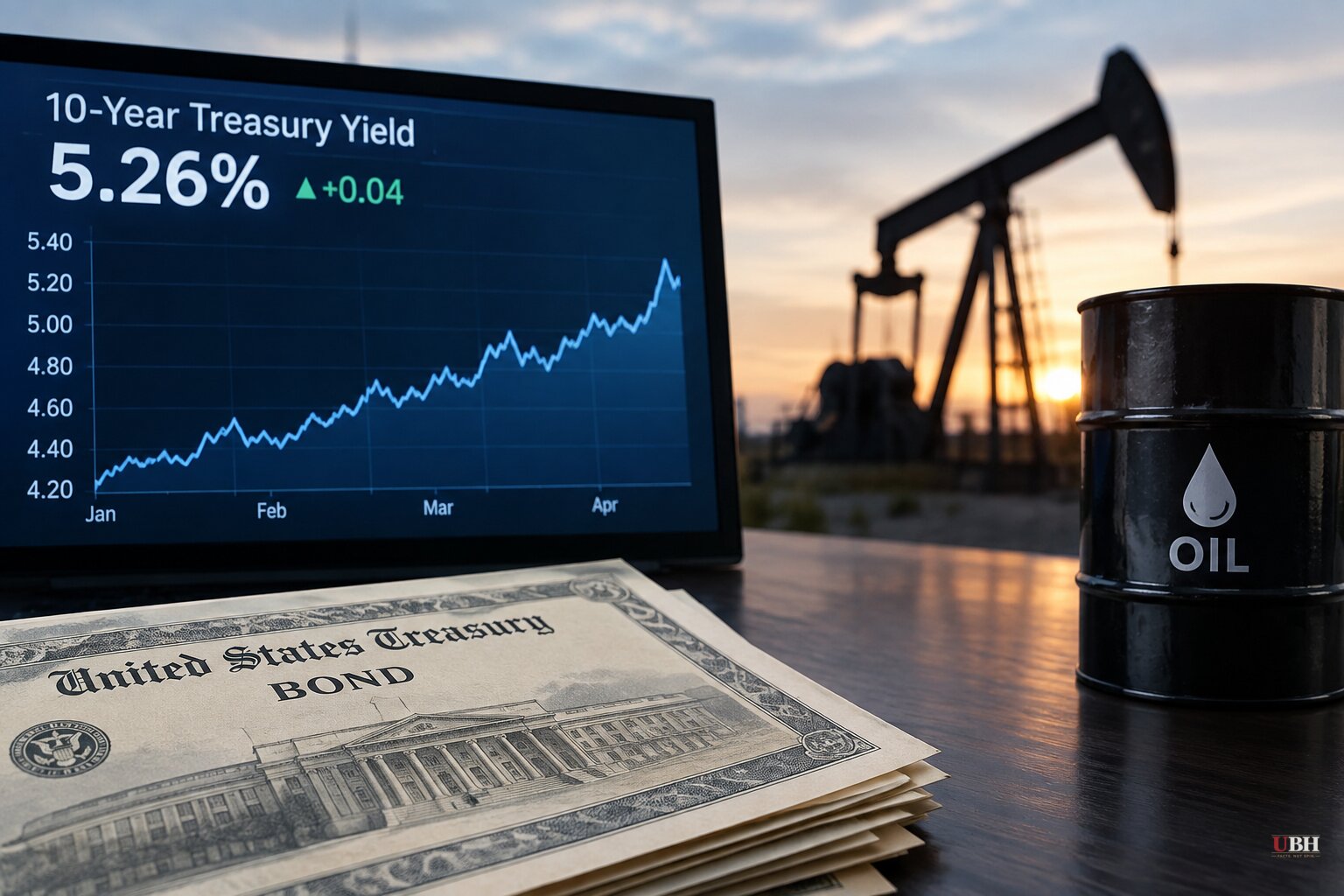
Since Tuesday's report that the riskiest US corporate bonds hit distressed levels not seen since the 2023 banking crisis, the pain has spread into the benchmark Treasury market. The 10-year yield touched 5.34% on Thursday, according to Reuters reporting carried by AOL, its highest level since 2002, after earlier in the day hitting 5.31%, which several outlets including Euronews and WBOW 102.7 FM flagged as the highest since 2007. Bargain hunters stepped in during the late US morning and pulled the yield back to around 5.26%, Reuters reported.
However you slice the historical comparison, the direction is the same. The 10-year racked up an 87.1 basis point rise over the September quarter, according to LSEG data cited by Reuters, the sharpest quarterly jump since 1994. The 30-year yield topped 5.65%, its highest since 2002, per the same Reuters report.
The average 30-year fixed mortgage rate topped 7% on Thursday, its highest level in almost two years, CNN reported. Higher Treasury yields push up the cost of mortgages, auto loans and every form of consumer and corporate borrowing.
Oil keeps pouring fuel on it
Brent crude was up 2.6% at just above $100 a barrel on Thursday, with West Texas Intermediate up the same amount to roughly $92.80, according to Euronews. Brent is up 15% this month alone and more than 60% since the start of the year, CNN reported, seven months into the war with Iran.
Crude exports from the Gulf have climbed back close to pre-war levels and Saudi Arabia has partly restored its East-West pipeline that bypasses the Strait of Hormuz, Euronews reported. But three vessels were struck in the strait on Tuesday, according to British maritime authorities, and a resolution remains elusive.
Iranian President Masoud Pezeshkian said Wednesday that Iran had received a US response to its offer to reopen the strait if Washington lifts its port blockade, releases frozen assets and eases oil sanctions. "We will make every effort to bring the agreement to fruition," Pezeshkian said.
President Trump was blunter. "We blow them up or make a deal," Trump told reporters in the Oval Office Wednesday night, adding the war would end "very soon" one way or another. OPEC+ delegates cited by Bloomberg say the cartel is expected to hold November output targets unchanged when it meets Sunday.
Gennadiy Goldberg, head of US rates strategy at TD Securities, told CNN that "oil, to use a bad analogy, is throwing gasoline on the inflationary environment, and that's what has investors worried. That's what has the Fed worried as well." Cboe Global Markets data show the correlation between oil prices and the 10-year yield hit its highest level in 35 years this week, per CNN.
Fed expectations flip
Softer-than-expected August PCE inflation briefly cut the odds of an October Fed hike to around 38% from 50%, according to CME's FedWatch tool cited by Yahoo Finance Singapore, before stronger growth data pushed those odds back up. Traders now expect at least three more Fed hikes before mid-2027, Reuters reported, a sharp reversal from earlier expectations of rate cuts.
Mike O'Rourke, chief market strategist at JonesTrading, said "the longer higher oil prices persist, the more likely inflation spreads to other portions of the economy. That is prompting the Federal Reserve to raise interest rates, which is pressuring bonds." Andrew Lilley, chief rates strategist at Barrenjoey, told Reuters "it was the Treasury bear market that had to happen. I'd say the end is in sight," though he warned other markets could come under pressure from higher bond returns.
Not every analyst reads the moment as pure danger. Danny Zaid, portfolio manager at TwentyFour Asset Management, told Reuters that broader fundamentals "still look very strong," even as he acknowledged a "K-shaped economy" where "the lower cohort has been suffering for quite some time" and needs relief from higher oil prices. The split between resilient headline numbers and real strain on lower-income households paying more at the pump and for mortgages reflects the underlying tension in the data.
France adds its own pressure point
France's government presented its 2027 budget Thursday, targeting a 5.0% deficit versus roughly 5.4% this year, with €339.7 billion in state financing needs next year, according to FXStreet. French 10-year borrowing costs hit their highest since 2002, closing in on 5%, after the worst quarterly performance since 1987, Reuters reported. The gap between French and German yields is near its widest since the 2010s euro-zone debt crisis, and the cost of insuring French debt against default is at its highest since 2013.
Stocks diverge, chips rally
European stocks fell broadly Thursday. The Stoxx 600 dropped 1.5% and the FTSE 100, CAC 40, DAX, FTSE MIB, IBEX 35 and AEX all fell between 1% and 2%, Euronews reported, as investors digested faster-than-expected September inflation in Germany, France and Italy.
Asia told a different story. Japan's Nikkei 225 jumped nearly 2% after Micron forecast stronger-than-expected results, lifting chipmakers, while South Korea's Kospi rose over 2% on September exports that jumped 83.5% year-over-year to a monthly record, driven by chip sales. Markets in mainland China and Hong Kong were closed for National Day holidays.
Underneath Wall Street's relatively calm index level, FXStreet's market note points to a widening gap: the equal-weight S&P 500 fell 4.4% in September while the cap-weighted index posted a small gain, and the broader market is on pace for a seventh straight weekly decline, a run previously seen only in 2002 and 2022. Cash-rich AI mega-caps can absorb a 5%-plus discount rate; banks, small industrials and companies that must refinance debt cannot as easily.
The open question now is whether Sunday's OPEC+ meeting or any US-Iran breakthrough on the Strait of Hormuz arrives before the next Fed decision, and whether French lawmakers can pass the 2027 budget without the kind of political standoff that has rattled French bonds twice already this year.
Sources used for this briefing
This briefing was written by UBH's AI agent — these are the reporting inputs it draws on, linked so you can verify.


