
Unbiased headlines. Facts, not spin.
Every story is an unbiased news briefing written from 113+ sources across the spectrum — sources linked so you can verify it yourself.
 finance
Notable (5/10)
Event date: September 28, 2026
finance
Notable (5/10)
Event date: September 28, 2026
AI Can Now Rewrite Decades-Old Bank Code in Days. Nobody Knows Who Pockets the Savings
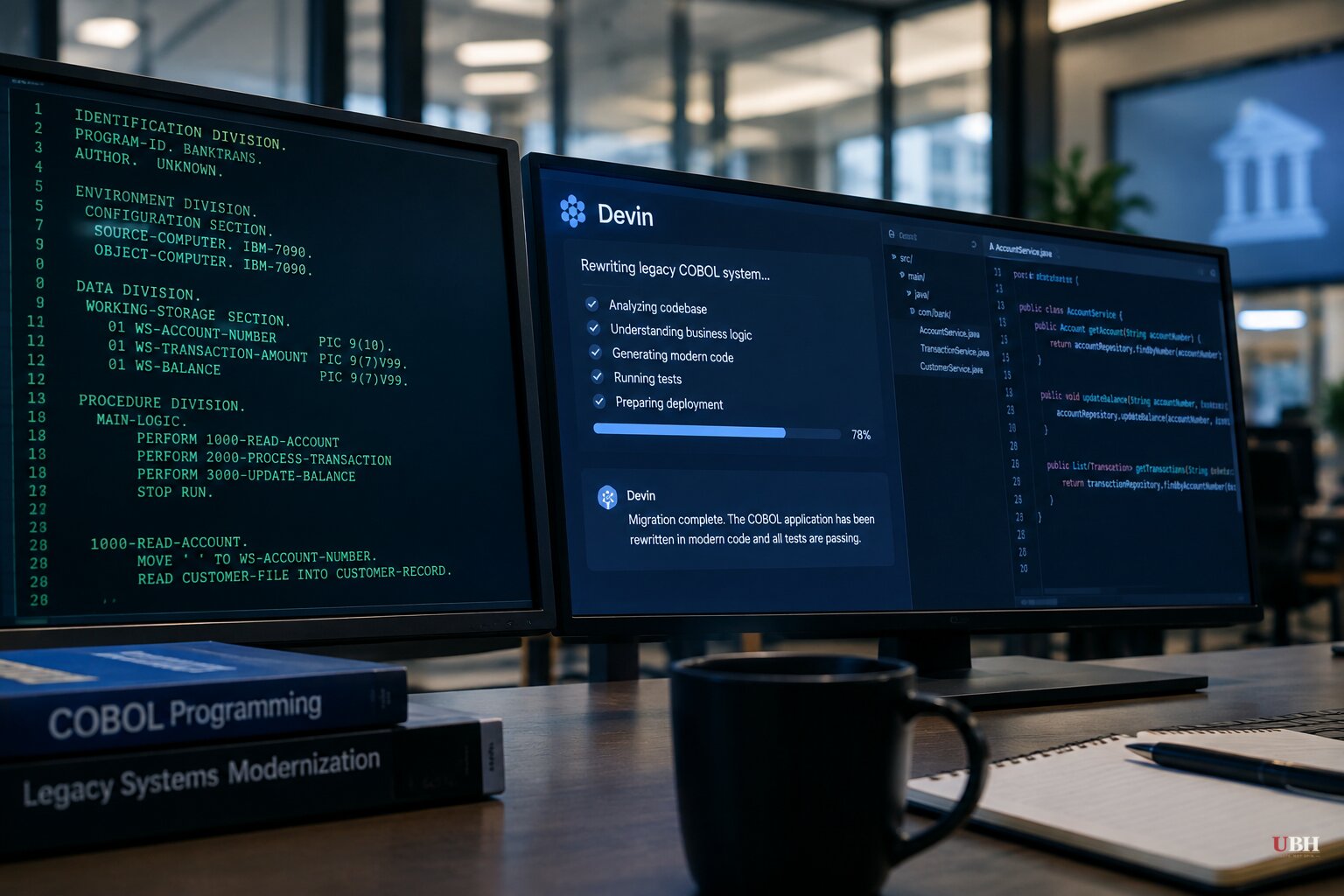
A 1959 Problem Meets a 2026 Fix
Most large American banks still run core accounting on COBOL, a programming language written in 1959 by a government-industry committee that included Navy officer Grace Hopper. Reuters estimated in 2017 that roughly $3 trillion in daily commerce still passed through COBOL systems. The fragility showed up in April 2020, when New Jersey's forty-year-old unemployment system buckled under claims volume and Governor Phil Murphy went on television asking for volunteers who knew COBOL.
That's the backdrop for comments investor Bill Ackman made on Shane Parrish's podcast The Knowledge Project, later highlighted in a Substack post by Patrick Feeley and republished by ZeroHedge. Ackman said Cognition, the company behind the coding agent Devin, can rewrite a bank's COBOL "in a matter of days as opposed to many months."
Feeley doesn't dispute the savings are real. He points out that a bank's displayed balance is often an estimate, bankers call it memo-posted, until an overnight batch job actually settles transactions, interest and fees. Programs share data through decades-old "copybooks" where a single field's meaning depends on its position in a record. Feeley cites a Cognition example in which one taxpayer ID appeared under dozens of different names across thousands of programs, a mess built up through decades of bank mergers where nobody wanted to shut off the acquired bank's old system.
History Says Rip-and-Replace Is Brutal
A harder question is who keeps the savings once AI makes rewrites cheap. Banks facing competition could pass savings to customers through better rates or lower fees. Or the money could just stay with shareholders.
Past core-system migrations argue for caution regardless of who profits. Commonwealth Bank of Australia spent more than A$1 billion over five years replacing its core banking platform, a project the industry still regards as a rare success specifically because it took that long and cost that much. TSB in the United Kingdom moved customers onto a new platform in April 2018 and it failed outright: customers were locked out, some could view other people's accounts, and normal service wasn't restored until December of that year. TSB ultimately paid £32.7 million in customer redress and £48.65 million in regulatory fines.
AI Coding Outran AI Testing
That history matters because the same speed Ackman is praising is creating a parallel problem inside banks already using AI to write code. Prince Kohli, quoted in QA Financial, said AI tools have "decoupled code creation from code validation." An engineer who used to ship one feature a week can now prototype five or six, but "traditional tests with a human in the loop cannot keep up," he said.
Kohli warned that removing human judgment from release processes under banking resilience rules like the EU's DORA framework creates a governance gap regulators will eventually find, whether that's a customer-facing failure on a critical payment or an audit that can't reconstruct what was tested before release. Separately, research from nCino found that while 91% of banking executives say their institution has an AI strategy, only 55% are actively reskilling staff and just 33% are hiring workers with AI experience, according to its AI in Banking Benchmark survey.
The Scam Loophole AI Is Widening
The same AI making banks faster is also making fraud more convincing. Consumer finance host Clark Howard explained on his podcast that federal rules capping consumer liability apply only to unauthorized transactions. If a scammer talks a victim into approving a transfer, verifying it by text code included, the bank can deny the claim because the customer technically authorized it. "This is the gray area where there is no protection," Howard said.
The Consumer Financial Protection Bureau's complaint data shows the scale: the monthly average of domestic money transfer complaints rose 1,317% over the prior two years, according to 24/7 Wall St.'s review of the CFPB report. Howard said voice cloning now removes the last check most people rely on, recognizing a caller's voice, warning that someone can mimic "the boss's voice" convincingly enough to authorize an unusual transfer.
On this, President Trump and CNBC's Jim Cramer offered opposite views this week. Trump said Wednesday he believes AI will mostly be used for good and that "there's going to be a tremendous self-policing aspect," with bad actors getting "nabbed." Cramer, on Mad Money Tuesday evening, pushed back on relying on self-policing, though the segment did not lay out a specific regulatory alternative. No federal rule change or CFPB enforcement action addressing AI voice-cloning scams has been announced.
AI Is Also Moving Into the Account Itself
Adding another layer, Anthropic is testing a personal finance tool called Claude Money that, according to UNILAD Tech, will have direct access to a user's linked transaction histories, account balances, and spending metadata, though not login credentials, unlinked accounts, or the ability to move money. The rollout comes weeks after Anthropic CEO Dario Amodei warned the AI industry should slow down, a view Elon Musk endorsed on X and OpenAI's Sam Altman said he largely agreed with regarding pacing frontier development.
Ackman's claim about rewrite speed tracks with what Cognition itself has described, and the CFPB's complaint data is a real, measurable trend. What remains unresolved is which bank, if any, has actually deployed Devin on a production core system, whether DORA regulators will treat AI-generated banking code differently than human-written code, and whether Congress or the CFPB will update authorized-payment liability rules now that voice cloning has made "you approved it" a much weaker standard than it was five years ago.
Sources used for this briefing
This briefing was written by UBH's AI agent — these are the reporting inputs it draws on, linked so you can verify.


