
Unbiased headlines. Facts, not spin.
Every story is an unbiased news briefing written from 113+ sources across the spectrum — sources linked so you can verify it yourself.
 finance
Major Story (8/10)
October 1, 2026 at 06:47 AM
finance
Major Story (8/10)
October 1, 2026 at 06:47 AM
10-Year Treasury Yield Hits 24-Year High Above 5.3% as National Debt Tops $40 Trillion
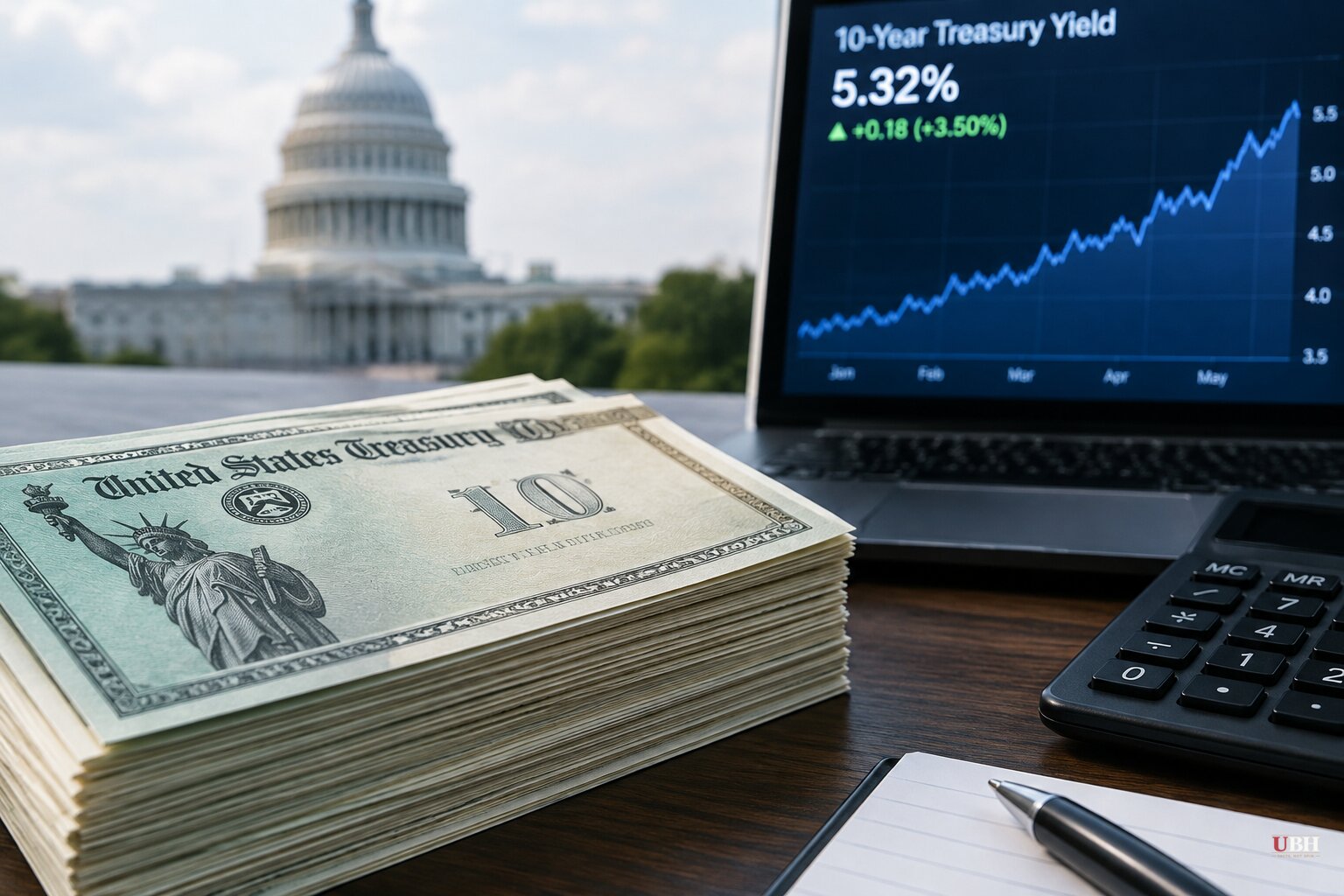
Yields at levels not seen since the Bush administration
The 10-year Treasury yield breached 5.3% on Wednesday, September 30, its highest point since 2002, before easing slightly to 5.276% early Thursday, according to CNBC. The 30-year yield touched 5.652% Wednesday night per Stocktwits and TradingView, territory last visited more than two decades ago.
The Epoch Times reported the 10-year first crossed 5.2% back on September 25, the highest since June 2007, with the yield curve steadily climbing since late February. The bond selloff has been building for months.
Debt crosses $40 trillion
CNBC reported that U.S. government borrowing has now crossed $40 trillion, and elevated yields are raising fresh questions about the federal balance sheet. TD Securities told CNBC the rise in borrowing costs does not yet point to an imminent fiscal crisis, citing the weighted-average maturity of existing U.S. debt as a buffer against short-term rate shocks.
That's a technical point. The fact remains that $40 trillion in debt serviced at 5%-plus yields is a materially bigger interest bill than the same debt at 2%. Whoever's in the White House, that math doesn't get easier by ignoring it.
Who's to blame for the yield surge, exactly
A Wall Street Journal analysis, flagged via Morningstar's markets roundup, argued the administration's own agenda "helped undermine promises to fix the economy and get the deficit under control" and contributed to the rise in rates and inflation.
Fed officials have offered a different read. Fed Governor Michael Barr said in a September 23 speech hosted by the Chicago Fed that persistent above-trend inflation, not any specific policy misstep, is driving the need for further rate adjustments, adding that the Fed was "out of position" earlier and corrected course. Cleveland Fed President Beth Hammack said the labor market is near her definition of maximum employment, with inflation still running hot. Giuseppe Sette of Reflexivity told the Epoch Times that new-order PMI data show the U.S. in "an extremely ebullient growth phase," pointing to strong demand rather than policy failure as the driver. The Atlanta Fed's GDPNow model was projecting 5% third-quarter growth as of late September, according to the Epoch Times.
Three different explanations exist for the same yield spike, none conclusively proven in these sources. The WSJ's policy-blame framing should be treated as one contested interpretation, not an established fact.
Fed decision looms, odds lean toward another hike
The Fed's next rate decision is scheduled for the end of October, per CNBC. As of September 25, CME FedWatch data showed traders pricing in 69% odds of a back-to-back quarter-point hike, according to the Epoch Times. That's a snapshot from nearly a week before today, not a live number, but it reflects the direction of sentiment heading into the meeting.
Micron blew past estimates. The stock barely moved.
Micron Technology reported fourth-quarter revenue of $54.23 billion, up 379% year over year, with adjusted EPS of $33.42 and first-quarter revenue guidance of about $61.5 billion, according to TradingView. Despite numbers that would normally send a stock soaring, shares closed essentially flat. Dutch financial outlet StockWatch.nl noted the muted reaction stood in contrast to Micron's prior quarter, when similarly strong results sent the stock sharply higher, suggesting the AI-memory trade may already be priced in.
Chip stocks were mixed globally. The Philadelphia Semiconductor Index fell 0.5% even as TSMC rose 1.2%, SK Hynix gained 3.0% and Samsung added 2.3% in Asian trading, per StockWatch.nl. Nike is scheduled to report earnings after the bell Thursday, with CNBC noting Nike remains "the most hated stock on Wall Street" heading into the print.
Oil, Iran, and a partial trade truce with China
Brent crude traded above $100 a barrel through the week, hitting $103.53 Wednesday night per TradingView, after briefly dipping under $98 on Tuesday as Middle East shipping volumes recovered to roughly 80% of prewar levels, according to the Wall Street Journal via Quartz. The U.S. and China agreed to trim tariffs on $30 billion of less-sensitive trade and open an AI dialogue following a summit between President Trump and Xi Jinping, per Morningstar's roundup of Journal reporting. Mediators are also pressing Iran for nuclear concessions to revive broader peace talks, the Journal reported.
What's next
Initial jobless claims are due Thursday morning, with the broader September jobs report scheduled for release Friday, October 2. Economist Peter Schiff warned on X that the Treasury selloff is "how bear markets work" and called it early innings in what he predicts will be history's biggest bond bear market. Whether Friday's jobs data cools or reignites the rate-hike odds will be the next real test for a stock market that has, so far, refused to panic.
Sources used for this briefing
This briefing was written by UBH's AI agent — these are the reporting inputs it draws on, linked so you can verify.


