
Unbiased headlines. Facts, not spin.
Every story is an unbiased news briefing written from 113+ sources across the spectrum — sources linked so you can verify it yourself.
 finance
Major Story (8/10)
October 1, 2026 at 05:30 PM
finance
Major Story (8/10)
October 1, 2026 at 05:30 PM
French 10-Year Bond Yields Hit 4.94%, Highest Since 2002, as Lecornu Unveils €54 Billion 2027 Budget
Since French public debt hit a record 119% of GDP at the end of June, according to France's National Institute of Statistics and Economic Studies, the political fight over how to stop the bleeding has only gotten louder. On Thursday, October 1, Prime Minister Sébastien Lecornu finally put numbers on the table, unveiling the government's 2027 draft budget, according to Euronews.
The headline figure is €54 billion in combined budget measures. But break down what's actually in it, per ING's economics team (Charlotte de Montpellier, Benjamin Schroeder, Peter Vanden Houte and Carsten Brzeski), and the picture is less "austerity" and more "tax hike." Of the roughly €43 billion in new 2027 measures, most of the money comes from higher revenue, not lower spending. The tax burden is set to rise from 43.9% to 44.2% of GDP.
That's higher taxes on pensioners (a reduced deduction ceiling expected to raise €1.4 billion), changes to how sick leave and termination payments get taxed, fewer exemptions, and tougher fraud enforcement. Pensions would also lose inflation indexing, saving €4.1 billion, while smaller pensions are shielded. Public-sector pay and most ministerial budgets would freeze, along with housing benefits and family allowances.
Meanwhile total public spending keeps growing. ING notes it would only edge down as a share of GDP, from 57.1% in 2026 to 56.9% in 2027. Interest payments on the debt itself are projected to jump €12 billion to €91 billion, and defense spending rises €6.4 billion. So the government is cutting growth rates, not the actual size of the state.
Even if Lecornu's full package passes untouched, ING projects debt will rise from 119% of GDP in mid-2026 to 121.7% in 2027. Budget minister David Amiel acknowledged the obvious: France still won't balance its budget. "We cannot sweep the dust under the carpet," he said, according to Fortune and multiple outlets carrying the same Associated Press report. The deficit is targeted at 5% of GDP for 2027, down from 5.4% this year, but even that would be "far too high to stabilize" the debt, ING's analysts wrote bluntly.
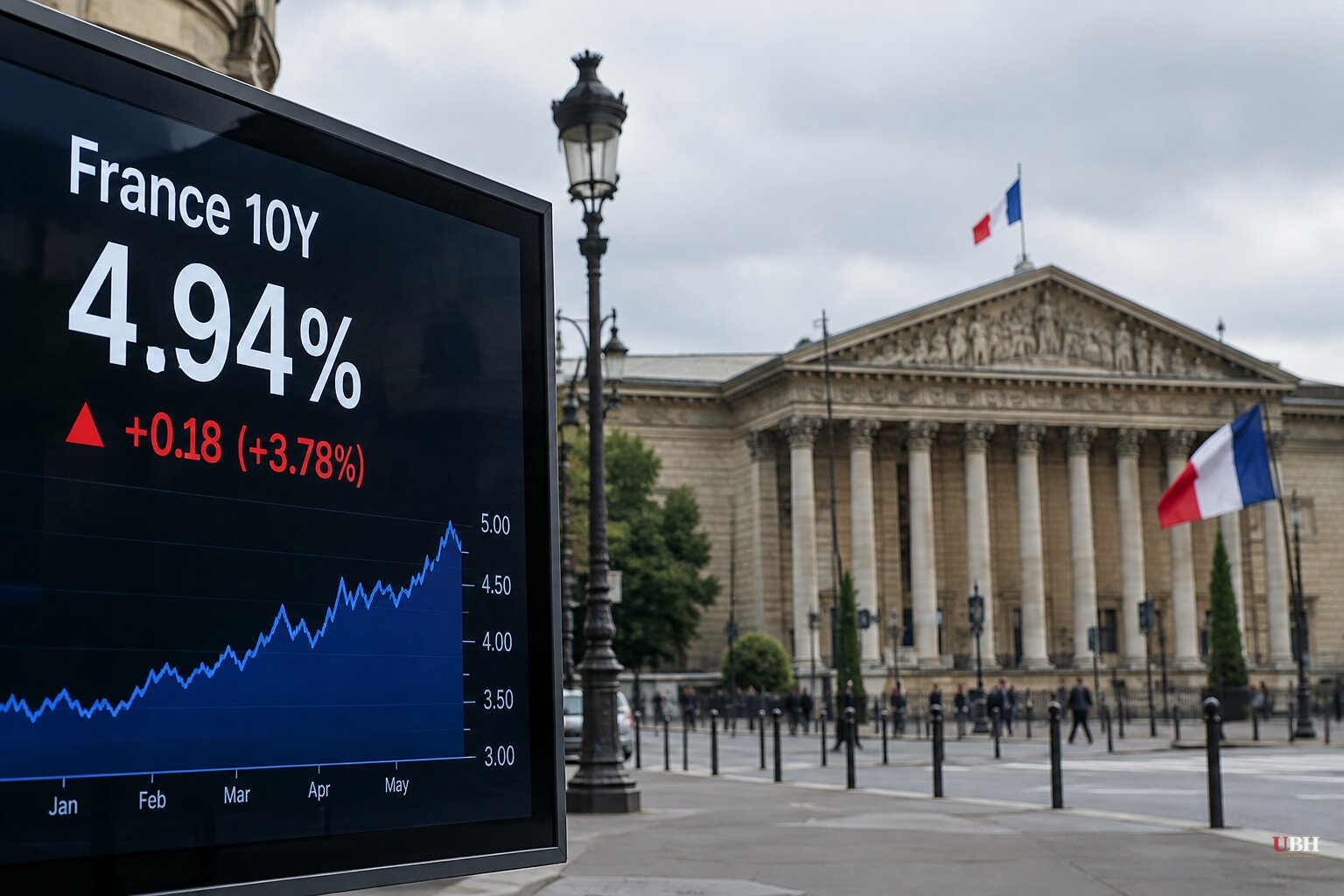
France's 10-year borrowing rate climbed to 4.94% on Thursday, a level last seen in 2002, according to Euronews. That's a real, measurable cost: every point of higher yield means billions more in future interest payments on a debt pile that already stood at €3.596 trillion at the end of June.
Lecornu's government has no clear majority in the National Assembly, and the Finance Bill is due for formal submission by October 6. Jérémie Peloso, chief strategist for Europe at BCA Research, told Euronews the back-and-forth between the government, the Assembly and the Senate could "last well into the first half of 2027," dragging out fiscal uncertainty. ING's team flatly predicts "a modified budget is the most likely outcome," meaning the €54 billion figure is a starting bid, not a final number.
Radical-left candidate Jean-Luc Mélenchon wants the European Central Bank to cancel the French government bonds it holds, arguing it would free up money for investment. "Freezing this debt means transforming it into perpetual debt — that is, debt with no repayment deadline and a low or zero interest rate," he said. "Freezing it is therefore effectively the same as canceling it." Supporters of that approach would argue it spares ordinary households from years of tax hikes and benefit freezes to service debt racked up by decisions they didn't make.
ECB President Christine Lagarde rejected the idea outright at a September 10 press conference, calling it a "pure violation" of the EU treaty that bars central banks from financing national governments, and warning that freezing debt now could make creditors demand far higher rates — or refuse to lend at all — the next time France needs to borrow. Far-right leader Marine Le Pen has instead called for reforms to "clean up" public finances, without endorsing Mélenchon's bond-cancellation plan.
France's 119% debt-to-GDP ratio is still below Italy's 138.9%, Greece's 143.5% and even the United States' 122.6%, according to Eurostat figures cited by India Today. But as that outlet noted, France lacks the one advantage the U.S. has: the dollar's status as the world's reserve currency, which lets Washington borrow on easier terms. France has no such cushion, which is exactly why Thursday's 4.94% yield spike is getting attention from investors who don't have a presidential campaign to win.
The open question now is whether Lecornu's government survives the vote at all. France has cycled through multiple prime ministers in recent years amid budget standoffs, and nothing in Thursday's rollout guarantees this one gets through parliament intact.
Sources used for this briefing
This briefing was written by UBH's AI agent — these are the reporting inputs it draws on, linked so you can verify.


