
Unbiased headlines. Facts, not spin.
Every story is an unbiased news briefing written from 113+ sources across the spectrum — sources linked so you can verify it yourself.
 finance
Major Story (7/10)
Event date: September 16, 2026
finance
Major Story (7/10)
Event date: September 16, 2026
BlackRock Says Treasury Yields Above 5% and the AI Buildout Are Now Competing for the Same Dollar
A Crowded Bond Market
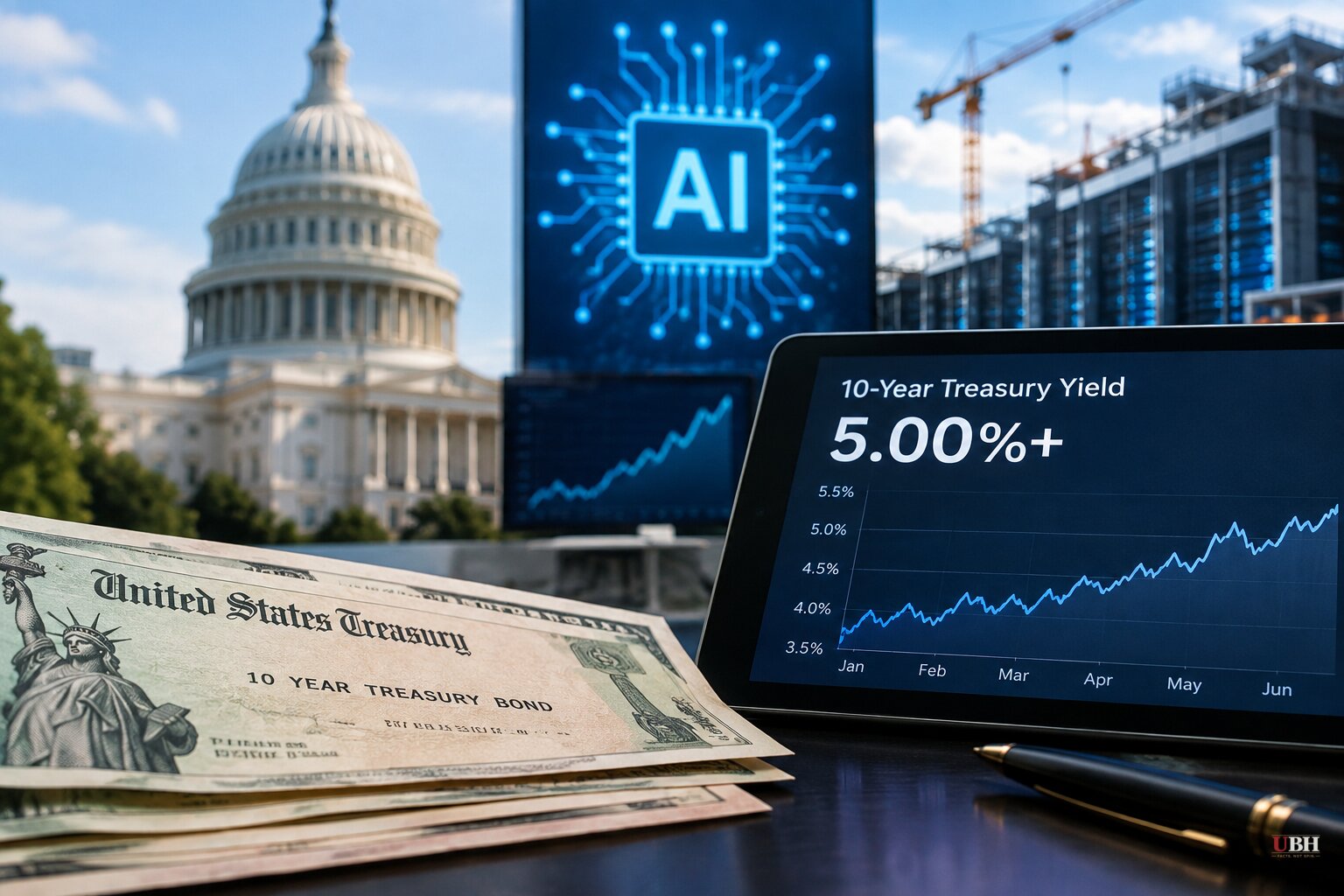
BlackRock's investment strategists, including Jean Boivin, Wei Li, Vivek Paul and Ehsan Khoman, are putting a number on something that's been obvious for months: AI capital spending and federal deficit spending are now fighting over the same pool of money. The firm estimates annual U.S. financing demand, AI investment plus government borrowing combined, could top $7.5 trillion by 2030, according to Finwire's analysis of BlackRock's research.
The 10-year Treasury yield is already sitting above 5%, and the AI and data-center bond universe now makes up roughly 14% of U.S. investment-grade issuance this year, up from 5% in 2025 and just 1% over the prior decade, per BlackRock's own numbers. Wall Street is financing the AI buildout with debt at a scale nobody was doing two years ago.
Why the Source of Higher Yields Matters
BlackRock's argument, per Finwire, is that not all rate increases are created equal. If yields are rising because growth is strong and policy is credible, stocks can keep climbing even as borrowing costs go up. If yields are rising because of inflation and a widening term premium, that's a tougher environment for risk assets. The firm is betting on the first scenario, staying "overweight U.S. equities and broadly pro-risk."
That's a reasonable read if earnings keep delivering. BlackRock manages trillions in assets that benefit from investors staying in stocks and bonds, which means its own call to stay risk-on deserves the same scrutiny as any other interested party's forecast, not automatic trust.
Energy Throws a Wrench In
Wei Li, BlackRock's Global Chief Investment Strategist, told Bloomberg's Francine Lacqua on "The Pulse" (recorded September 30, aired October 1) that disruption to oil flows through the Strait of Hormuz is creating "macro damage" and called energy a "big caveat" to the firm's risk-on stance. She also said new AI agents could "catalyze a wave of AI adoption," which cuts the other way on the bullish side of the ledger.
That same week, Minneapolis Fed President Neel Kashkari said on Bloomberg the Fed "will do what we need to do" on inflation, a reminder the central bank still sees price pressure as a live threat, not a solved problem. Higher oil prices feeding into inflation is exactly the kind of yield-driver BlackRock says would undercut its bullish case.
Valuations Already Cooled, Quietly
Jeff Blazek, co-head of multi-asset strategies at Neuberger Berman, which manages $613 billion in assets, told clients the S&P 500's forward price-to-earnings ratio has fallen from 22.9 last October, the highest since 2000, to 19.09, according to Business Insider. The Magnificent Seven's collective forward P/E dropped from about 33 to 23 over the same stretch.
Despite that compression, the S&P 500 is still up 12.8% since its forward P/E peaked last October, Business Insider reported. Earnings growth, not just price gains, did the heavy lifting. Blazek called it a "rare" scenario where valuations deflate in an orderly way instead of stock prices crashing while profits stall.
The China Angle and the Fiscal Problem Underneath It All
On Fox Business, economist Steve Moore, an America First Policy Institute senior fellow and Unleash Prosperity co-founder, framed the AI and robotics race with China as a national security issue, telling host Gerri Willis that falling oil prices could still spark a broader market rally even with the geopolitical noise.
Washington isn't shrinking its borrowing appetite while private industry races to build data centers on borrowed money too. BlackRock's own $7.5 trillion estimate makes clear that federal deficits are a direct competitor to AI capital, not a side issue. Every dollar the Treasury needs to borrow is a dollar AI developers have to outbid for, at a higher price.
What's Still Unresolved
BlackRock's base case depends on AI adoption, especially inference workloads running already-deployed models, staying strong enough to justify current valuations even as financing costs rise. If oil prices from the Strait of Hormuz disruption push inflation higher instead of fading, or if Congress and the White House don't rein in borrowing, the "good yields vs. bad yields" distinction BlackRock is leaning on gets a lot harder to defend. Whether the AI bond share of investment-grade issuance keeps climbing past 14% in the fourth quarter will be one of the clearest early signals of which scenario is playing out.
Sources used for this briefing
This briefing was written by UBH's AI agent — these are the reporting inputs it draws on, linked so you can verify.


