
Unbiased headlines. Facts, not spin.
Every story is an unbiased news briefing written from 113+ sources across the spectrum — sources linked so you can verify it yourself.
 finance
Major Story (8/10)
Event date: October 1, 2026
finance
Major Story (8/10)
Event date: October 1, 2026
Global Bond Selloff Eases Friday After France Hits 24-Year High Borrowing Costs, UK 30-Year Gilts Top 6%
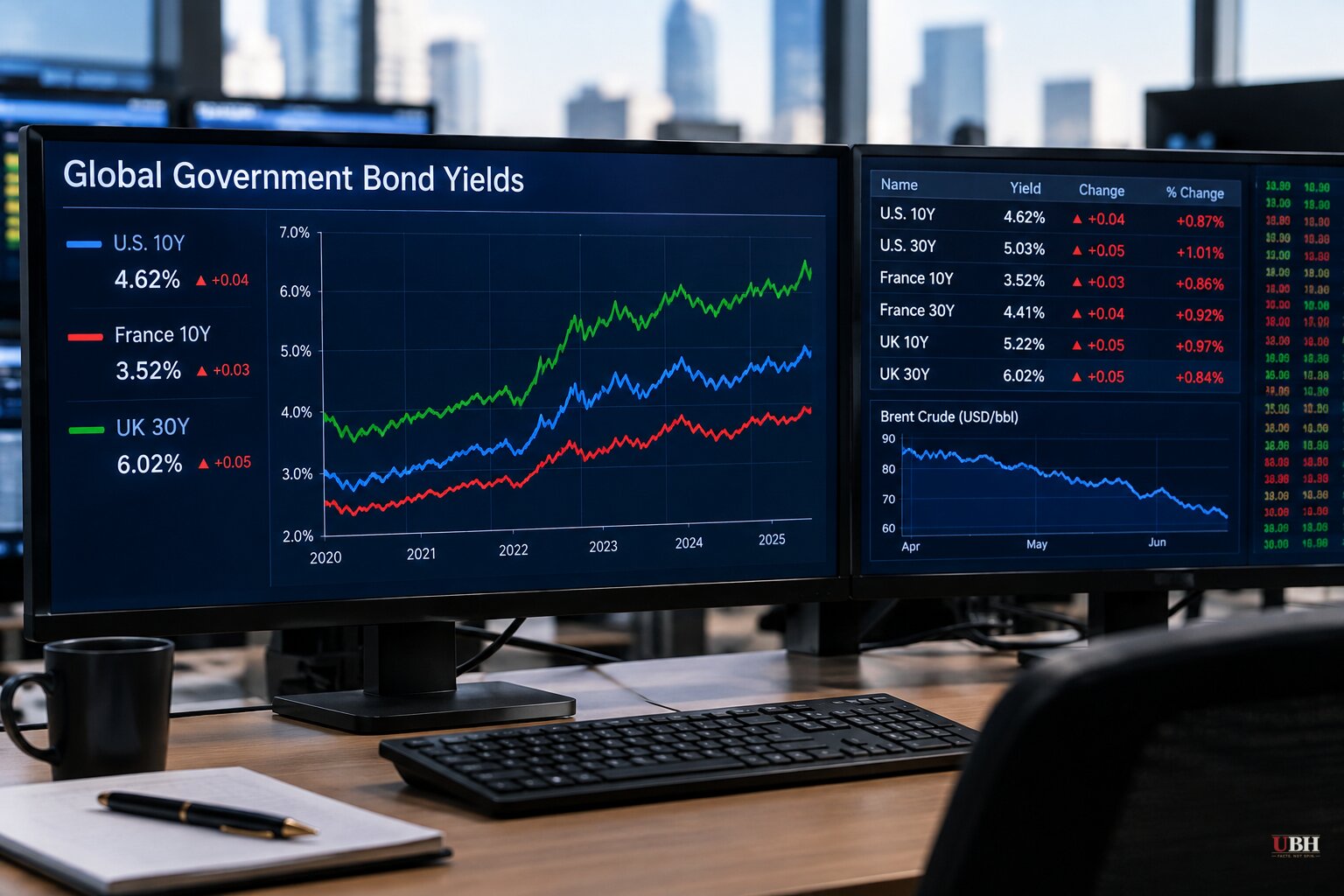
Since the 10-year Treasury yield first cracked a 19-year high at 5.079% earlier in the week, the selloff in global government debt accelerated into Thursday before easing back Friday morning.
The 10-year Treasury touched 5.34% intraday Thursday, the highest since 2002, according to the Heisenberg Report, before a sharp midday reversal pulled it back to close around 5.251%, according to PrimeXBT. The 30-year Treasury hit its own 24-year high before settling near 5.61%.
France took the hardest hit. The French 10-year yield reached 4.96% Thursday, its highest level since July 2002, before easing to about 4.92% by Friday midday, according to Euronews. The gap between French and German borrowing costs, the OAT-bund spread, widened by 13.9 basis points Thursday alone, its biggest one-day jump since March 2020, according to Deutsche Bank strategist Jim Reid. Reid told clients the daily swings were "reminiscent of the Euro crisis," with sovereign contagion becoming a major talking point.
French Finance Minister Roland Lescure pushed back on the gloom. "France's signature is solid," he said, responding to what he called "prophets of doom." France's own fiscal watchdog, the High Council of Public Finances, was less convinced, calling the government's 1% growth forecast for 2027 optimistic. Paris is seeking €43 billion in new savings in its 2027 budget to trim the deficit from 5.4% of GDP to 5%, while public debt sits at a post-war record of 119% of GDP and the government plans to borrow €340 billion next year.
UK Gilts Break Through 1998 Levels
UK 30-year gilt yields broke above 6% Thursday for the first time since 1998 before easing to roughly 5.92% Friday, according to both Euronews and PrimeXBT. The 10-year gilt eased to about 5.37%. The FTSE 100 closed down 177 points, a 1.68% drop and its worst single-day loss since May, according to PrimeXBT.
British bank stocks took a separate hit. NatWest, Lloyds, HSBC and Barclays all fell 4% to 5% Thursday after Sky News reported that Chancellor Rachel Reeves had summoned bank bosses to a meeting ahead of her October 28 budget, stoking speculation about a new bank tax, according to Euronews. No new tax has been announced. This is speculation tied to a single meeting, not a confirmed policy.
Separately, Bank of England Governor Andrew Bailey has said holding rates steady becomes harder the longer high energy prices persist, according to PIQ Markets. Ofgem, the UK energy regulator, is expected to raise its price cap roughly 24% in January based on current energy futures pricing. Markets are pricing in as many as four Bank of England rate hikes over the next 12 months, which would push the benchmark rate to 4.75%, PIQ Markets reported.
Oil Pulls Back, Taking Some Pressure Off
Brent crude slipped about 2% to roughly $99.95 a barrel Friday, according to Euronews, after climbing more than 3% to $101.50 Thursday amid the ongoing US-Israel conflict with Iran restricting Middle East crude exports, according to PrimeXBT. Falling oil eased fears that an energy-driven inflation spike would force central banks into further hikes, which is part of why yields retreated Friday.
The Fed's Mixed Signals
Fed Governor Michael Barr said earlier in the week that further tightening "is likely needed" to bring inflation to the Fed's 2% target, according to Breitbart, days after the Institute for Supply Management reported its manufacturing prices index surged to 77.9 in September. But by Thursday, Fed officials Philip Jefferson and John Williams were both signaling that an October rate hike might come too soon. "Any future adjustments in policy should be determined by carefully examining trends in the data," Jefferson said, according to the Heisenberg Report.
President Trump has continued pressing the Fed publicly for rate cuts. In a TIME interview, he said of the Fed's board: "We have a very hostile board, and the board says, 'We want to hurt Trump.' They're not doing this for you. They're doing this because they have Trump derangement syndrome." Trump's claim that the board is acting out of personal animus toward him is his own assertion and has not been independently verified. Jefferson's public comments frame the Fed's deliberations as data-driven rather than political. The two accounts of the Fed's motivations are in direct conflict, and nothing in the available record resolves which one is accurate.
The rate environment is already reshaping corporate finance. Paramount Skydance launched a $32 billion bond sale tied to its Warner Bros. Discovery deal even as borrowing costs spiked, according to a legal-industry newsletter tracking the deal. Whether the Fed holds steady at its late-October meeting, and whether Chancellor Reeves's October 28 budget includes a bank levy, are the next concrete tests of whether Friday's calm in bond markets holds or was just a pause.
Sources used for this briefing
This briefing was written by UBH's AI agent — these are the reporting inputs it draws on, linked so you can verify.


