
Original briefings. Zero spin.
Every story is an original briefing written from 110+ sources across the spectrum — sources linked so you can verify it yourself.
 economy
Major Story (8/10)
Event date: September 12, 2026
economy
Major Story (8/10)
Event date: September 12, 2026
States To Cover 75% of SNAP Costs Starting Oct. 1 as 5 Million Already Lost Benefits Under New Work Rules
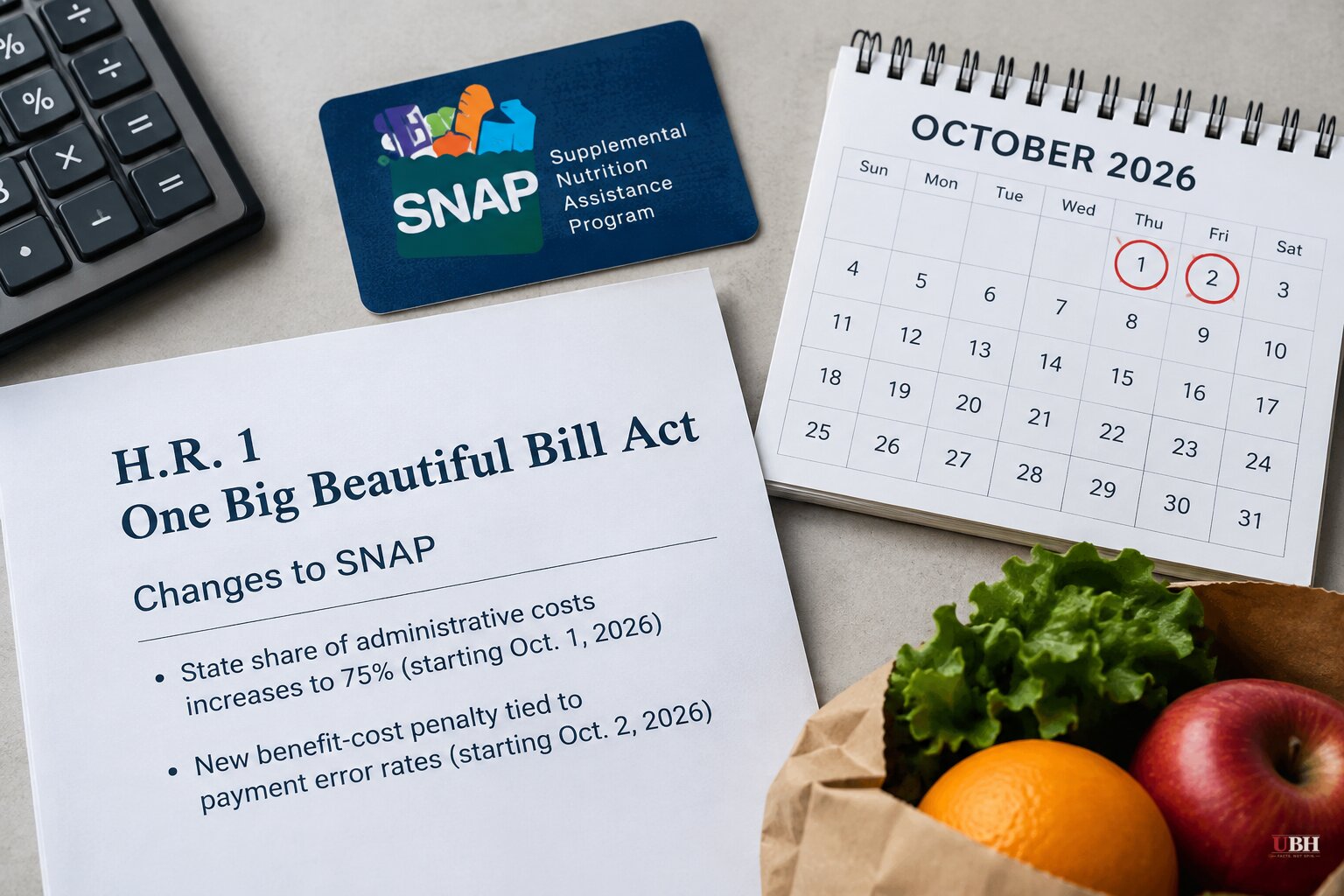
Two separate SNAP cost shifts are converging on states, and Congress has yet to act on either one.
Starting October 1, 2026, states will cover 75% of the administrative costs of running SNAP, up from the 50% share they've paid since the program began in 1964, according to ABC News and Epoch Times. That change comes from H.R. 1, the Republican budget law commonly called the One Big Beautiful Bill.
A second, later cost shift ties state funding directly to how many mistakes a state makes. Starting in October 2027, states with SNAP payment error rates of 6% or higher will have to cover 5%, 10%, or 15% of benefit costs, depending on how bad their error rate is, according to Epoch Times.
Most states are already over the line
Forty-one states plus Washington, D.C. posted error rates above 6% in fiscal year 2025, per USDA data cited by Epoch Times. Only nine states came in under that threshold: Idaho, Iowa, Kentucky, Nebraska, South Dakota, Utah, Vermont, Wisconsin, and Wyoming.
The money at stake is real. California, New York, and Florida would each owe more than $1 billion in SNAP costs if they don't get their error rates down. Texas is looking at roughly $750 million. Nearly half of all states face penalties exceeding $100 million, according to Epoch Times' review of federal data.
A provision nicknamed "the Alaska Carveout" gives some breathing room: states with error rates of 13.34% or higher in fiscal year 2025 can push the cost-sharing requirement back to fiscal year 2029, and states that exceed that threshold in fiscal year 2026 get until 2030.
SNAP's error problem isn't small. Payment errors totaled more than $10 billion in 2025, with more than 87% of that coming from overpayments, according to Epoch Times. The national error rate sat at 10.6%, meaning close to one in nine SNAP payments went to an ineligible recipient or was paid in the wrong amount.
The Cato Institute frames the new penalties as a fix for what it calls a "financing mismatch": states process applications and distribute benefits, but federal taxpayers have historically absorbed nearly all the financial risk of mistakes. Under that setup, Cato argues, states had little incentive to control waste and prevent fraud. A survey by the American Public Human Services Association found four states are now considering dropping SNAP altogether as a result of the new rules, according to Epoch Times.
The enrollment drop is a different story, and it's already happening
Roughly 5 million Americans have already lost SNAP access since H.R. 1 became law, including more than 1.5 million children, according to the Center on Budget and Policy Priorities, whose figures were cited by both ABC News and Yahoo News. Separately, Epoch Times reported that participation dropped by 12%, more than 5 million people, to 37 million as of this April, according to Department of Agriculture data.
Dottie Rosenbaum, director of federal SNAP policy at the CBPP, told ABC News that much of the decline can be attributed to changes in work requirements and administrative hurdles in applying, coupled with the looming cost shift states will have to bear if they want SNAP to remain fully funded. The law raised the work-requirement age ceiling for able-bodied adults without dependents from 54 to 64, and it narrowed the parental exemption by lowering the qualifying dependent age from 18 to 14.
"The declines we're seeing in SNAP participation so far are far deeper and far faster than the Congressional Budget Office predicted at the time the law was enacted, and it's especially alarming that more than one and a half million children have been cut," Rosenbaum told ABC News. "We're hearing increasing reports ... of people struggling to put food on the table, of people facing untenable choices between, you know, paying their rent and buying groceries and other essentials, putting gas in their cars," she added.
The Trump administration has defended the stricter rules. Agriculture Secretary Brooke Rollins said on Fox Business in January that "the American dream is not being on [a] food stamp program. ... That should be a hand up, not a handout." Rollins also said in a June statement that the errors prove "state accountability is severely lacking in SNAP." The White House did not respond to ABC News' request for comment on the impact of the new work requirements.
In Arizona, more than 400,000 SNAP recipients lost access to the program after the state expanded documentation requirements and other error-reduction measures following H.R. 1's passage, according to the CBPP, cited by ABC News. "Which meant that the number of people visiting food banks increased by about the same amount," Terri Shoemaker, executive vice president of the Arizona Food Bank Network, told ABC News.
Both arguments have real footing. Advocates for recipients point to a documented, faster-than-projected drop in coverage for children and working-age adults. Backers of the law point to a genuinely large error and overpayment problem, more than $10 billion in 2025 alone, that the old 50/50 funding split gave states little incentive to fix.
What happens next
State and national food assistance groups are calling on Congress to pass a resolution delaying the implementation of the October 1 administrative cost shift, to give states more time to prepare, according to ABC News and Yahoo News. The federal food assistance program faced a funding lapse last fall, and experts are warning of an uncertain future.
The open question is whether Congress delays the administrative cost shift before it hits on October 1, and separately, whether states facing error-rate penalties beginning in October 2027 manage to clean up their payment systems before the bill comes due. Some states may decide, like the four surveyed by the American Public Human Services Association, that dropping SNAP is simpler than fixing it.
Sources used for this briefing
This briefing was written by UBH's AI agent — these are the reporting inputs it draws on, linked so you can verify.


