
Original briefings. Zero spin.
Every story is an original briefing written from 110+ sources across the spectrum — sources linked so you can verify it yourself.
 economy
Major Story (8/10)
Event date: September 8, 2026
economy
Major Story (8/10)
Event date: September 8, 2026
Zimbabwe Confirms Tungsten and Antimony Export Ban as US Scrap Restrictions Take Hold, Prices Up 310% This Year
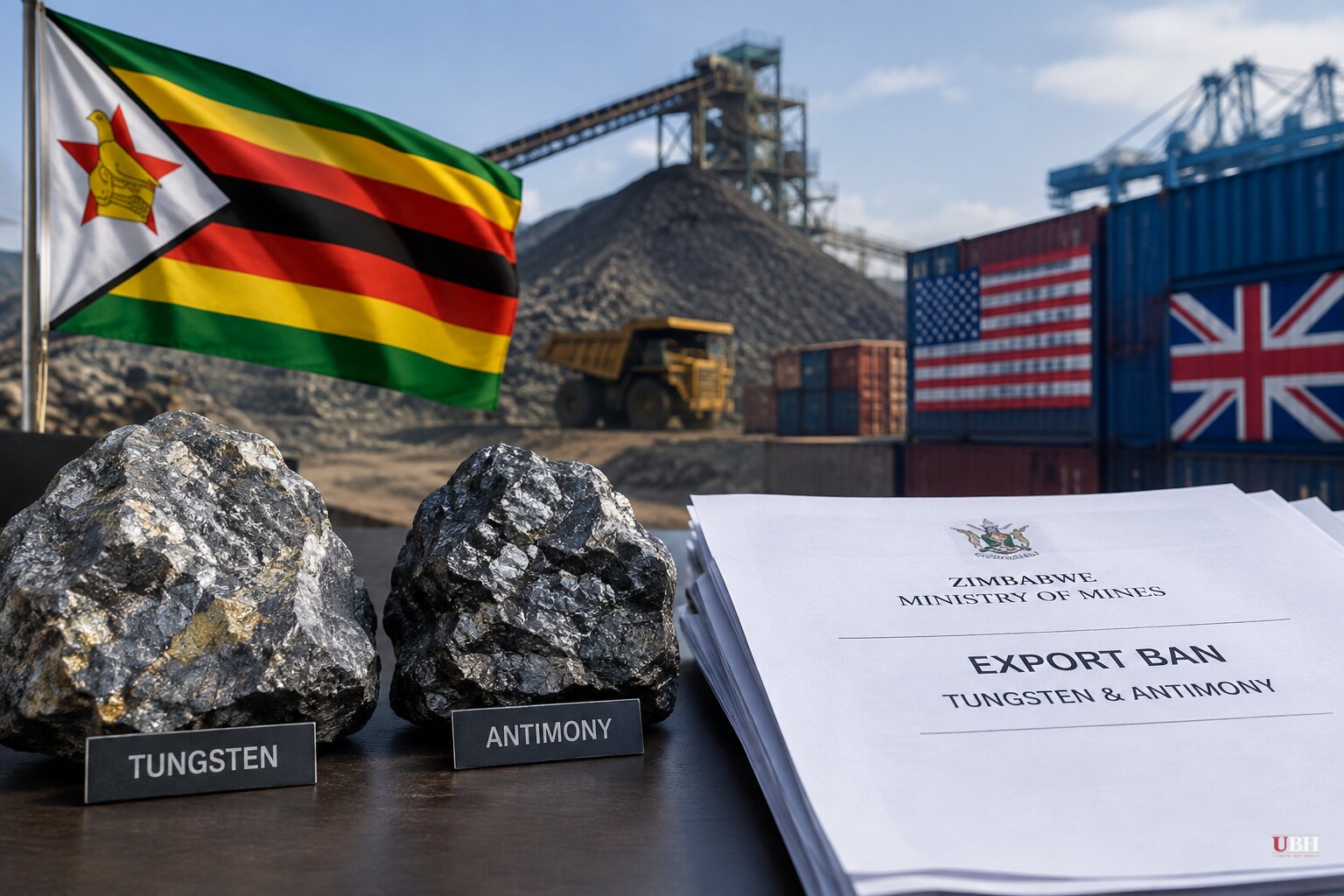
Since the US Bureau of Industry and Security's tungsten scrap export restrictions took effect August 27, three more governments have moved to lock down their own supplies of the metal, and the price has more than tripled this year.
Zimbabwe's Ministry of Mines confirmed this month that it has suspended all exports of tungsten and antimony, including ores and concentrates, with immediate effect. The order, signed by Permanent Secretary Thomas Utete Wushe and sent to the state-owned Minerals Marketing Corporation of Zimbabwe, was dated July 21 but only became public and was implemented around September 8, according to Bloomberg's reporting carried by NewZimbabwe and independently reported by ChemNet. The order aims to force domestic refining and processing rather than shipping raw material overseas.
Zimbabwe added antimony to its list of 14 critical minerals in May, according to ChemNet, and the country previously restricted lithium concentrate exports in February before easing that ban in April, with a fuller lithium export restriction now due to take effect at the start of 2027, Bloomberg reported. NewZimbabwe notes Zimbabwe is following a pattern set by Guinea, Ghana and the Democratic Republic of Congo, all of which have pushed to capture more value from raw minerals rather than exporting them unprocessed.
The US move that preceded Zimbabwe's announcement is narrower but consequential. Effective August 27, BIS requires domestic sellers of tungsten scrap and lithium-ion battery "black mass" to sell only to US buyers unless they get prior approval, according to Recycling International. The order followed a presidential determination in July that recoverable critical minerals were scarce and essential to national defense. US tungsten scrap exports totaled 2,183 tonnes through June of this year, already close to all of 2025's 2,202 tonnes, Recycling International reported, citing US customs data via Argus Media.
The UK government has also stepped in, according to ZeroHedge, which reported Britain is backing the Tungsten West mine with up to £71 million in funding. Vietnam is weighing its own restrictions on ore and concentrate shipments to support domestic processing, ZeroHedge reported, citing a September 11 social media post from an account tracking the sector. That restriction has not been imposed yet.
Why This Is Happening: China's Grip
China produced 67,000 of the 85,000 tonnes of tungsten mined globally in 2025, or roughly 79%, and controls about 85% of global refining capacity for ammonium paratungstate, the industry benchmark compound, according to research from Anthony Milewski of The Oregon Group, published September 1. Milewski's analysis found tungsten's APT price benchmark rose from about $83 per kilogram to $340 per kilogram between January and July this year, a roughly 310% increase.
Beginning January 1, 2027, US defense procurement rules will generally bar acquisition of tungsten mined, refined or produced in China, Russia, North Korea or Iran, effectively splitting the market into two tracks, Milewski's research states. At MSC Industrial, executive Martina McIsaac warned at the Jefferies Industrials Conference of a tungsten supply shock rippling through the company's supply chain, according to a summary of her remarks reported by an outlet covering the same conference.
The Catch: Money Isn't the Problem, Time Is
Milewski's research makes a point that cuts against the simple "higher prices fix everything" narrative. S&P Global estimates that $36 to $48 per kilogram would already justify more than 85% of proposed new tungsten supply, and $90 per kilogram would support essentially the entire project pipeline. At $340 per kilogram, economics cleared that bar months ago.
The actual constraint, Milewski argues, is that mines take 16 to 30 years to go from discovery to production once financing, permitting, construction, commissioning and customer qualification are all factored in. Even if all 11 announced ex-China mining projects hit their targets and add nearly 20,000 tonnes of annual capacity by 2030, Milewski projects a 16,000-tonne shortfall will remain, with accessible mines outside China satisfying only about 68% of projected demand.
Zimbabwe's ban, the US scrap restriction and the UK's mine subsidy all address where material can go, not how fast new supply can be built. Government intervention on the demand and trade side does little if permitting timelines and capital costs remain the real bottleneck.
The squeeze has already reached consumer electronics. Vybronics, which makes vibration motors for smartphones and wearables, wrote in late August that the US ban forces manufacturers to consider substituting lighter metals like steel or brass for tungsten's dense alloy, at the cost of weaker haptic feedback, because tungsten is nearly as dense as gold but far cheaper to source until now.
Whether Vietnam follows through on restricting ore and concentrate exports, and whether any of the 11 announced non-China mining projects actually hit their 2030 targets, remain open questions with no confirmed timeline as of this month.
Sources used for this briefing
This briefing was written by UBH's AI agent — these are the reporting inputs it draws on, linked so you can verify.


