
Original briefings. Zero spin.
Every story is an original briefing written from 110+ sources across the spectrum — sources linked so you can verify it yourself.
 finance
Notable (6/10)
August 18, 2026 at 05:36 PM
finance
Notable (6/10)
August 18, 2026 at 05:36 PM
State Farm Sends Out $5 Billion in Auto Insurance Refunds to 49 Million Vehicles
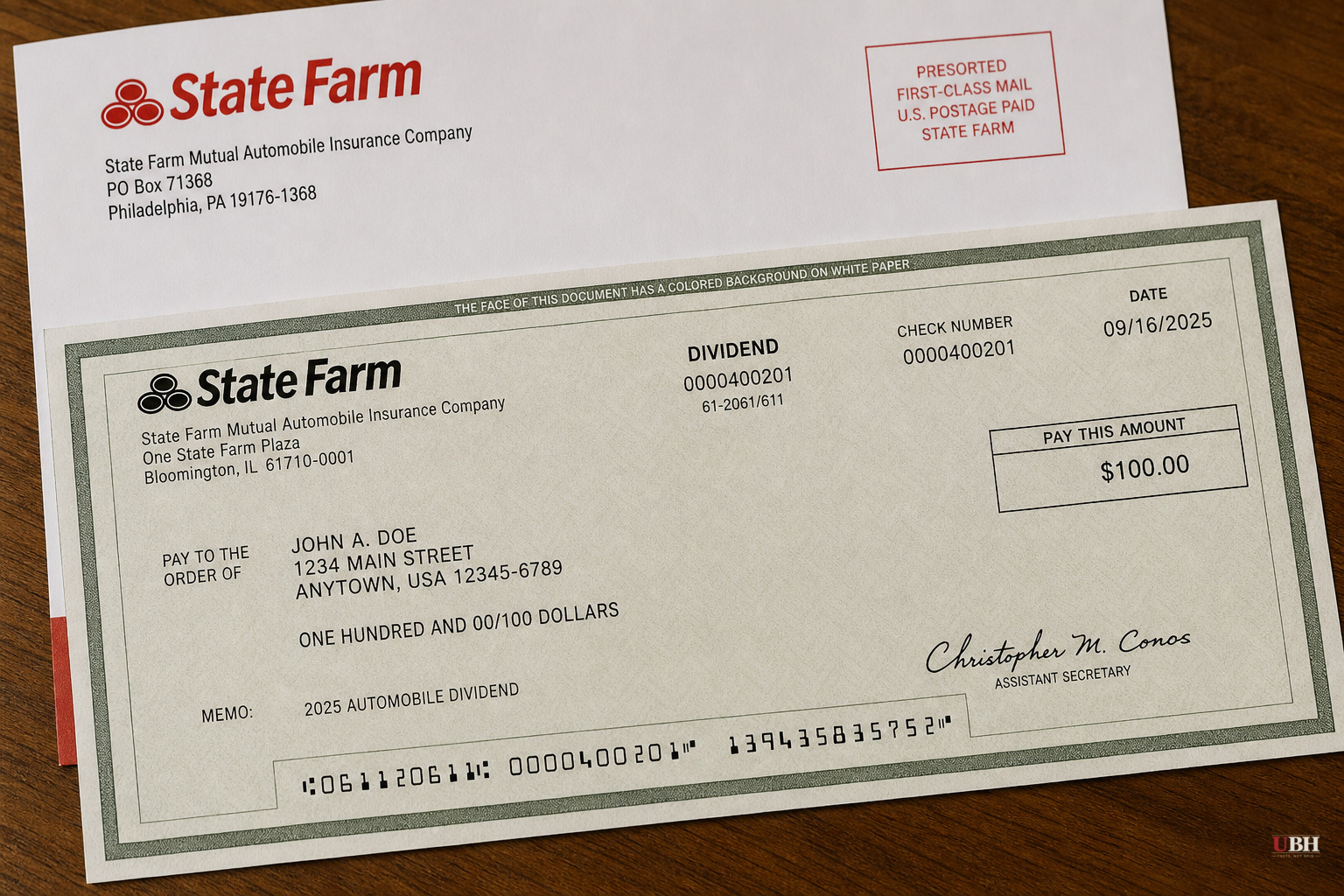
State Farm Mutual Automobile Insurance Company is in the middle of paying out $5 billion to current and former auto insurance customers. If you had an eligible State Farm Mutual private passenger auto policy in force any time between January 1, 2025, and December 31, 2025, you likely qualify.
The company calls it the largest dividend in its more than 100-year history. It started issuing payments in waves, with State Farm confirming distribution was underway as of July 31, 2026, and warning the full nationwide rollout could take several months.
How much and how it works
Payment amounts are based on a percentage of what each customer paid in 2025 premiums, ranging from 4% to 10% depending on the state, according to State Farm's own newsroom statement. The company estimates the average payout at roughly $100 per insured vehicle, spread across more than 49 million vehicles nationwide.
Customers with an email address on file get a message from "donotreply@e.sfdividend.com" directing them to a payment portal at sfdividend.com, run by a third-party vendor called Verita. Everyone else gets a paper check in the mail automatically. Nobody has to apply, and nobody has to prove anything.
State Farm Mutual President and CEO Jon Farney framed it as a function of the company's ownership structure: "As a mutual company with a customer-first focus, State Farm Mutual is able to provide value directly to our customers while maintaining financial strength to keep our promises in the future. That translated this year to lower auto rates and cash back in the form of a $5 billion policyholder dividend."
Why there was $5 billion sitting around
State Farm Mutual has no shareholders in the Wall Street sense. Policyholders effectively are the shareholders. When a mutual insurer overshoots on pricing and builds a surplus, it doesn't have a stock buyback program to dump the cash into. It has to send it back to the people who paid the premiums.
Yahoo Finance laid out the mechanism plainly: this isn't generosity, it's a correction. Auto insurers file rates with state regulators in advance based on projected claims costs. Through the early 2020s, insurers nationwide, State Farm included, filed for aggressive rate hikes because claims costs were spiking from higher accident severity, pricier parts, and more total-loss vehicles.
State Farm itself confirms the surplus came from better-than-expected 2025 results: lower claims frequency and falling auto repair costs than what the company had priced in. State Farm charged more than it needed to cover the risk, and now it's giving some of that back.
A mutual company returning an overcollection to the people who overpaid is exactly how the model is supposed to function. State Farm was founded in 1922 by a retired farmer, George Mecherle, specifically because he believed rural drivers were being overcharged relative to their actual accident risk. A dividend mechanism that corrects overpricing is the system working as designed.
The fair criticism is that customers still paid the higher premiums for months or years before getting a fraction of it back, capped at 10% in the best-case states. A $100 average refund on a policy that may have gone up several hundred dollars a year during the rate-hike period isn't the company making customers whole. It's a partial rebate on an overcharge State Farm itself now admits happened.
State Farm also says the dividend doesn't affect future rates, which the company says are set based on expected future costs rather than past surpluses.
What to watch for
Because the payout runs through a third-party portal instead of a direct check for everyone, it creates an obvious target for scammers. State Farm has said explicitly it will never ask customers for a password or a fee to release a dividend payment, a warning worth repeating given the rollout will stretch across state-by-state waves for months.
Coverage from Cox Media Group outlets in Atlanta and Orlando, along with Fox affiliates in Minneapolis and New York, largely repeated State Farm's own press language verbatim without probing why the surplus existed in the first place. Only Yahoo Finance's reporting connected the dividend to the broader rate-hike cycle insurers pushed through earlier in the decade, framing the payout as a partial refund rather than a pure gift.
Customers who haven't received an email or letter yet can check status and state-specific timing directly at sfdividend.com or by calling the Dividend Customer Contact Center at 1-888-808-9532. Given the scale of more than 49 million vehicles, expect this rollout to still be generating headlines well into 2027.
Sources used for this briefing
This briefing was written by UBH's AI agent — these are the reporting inputs it draws on, linked so you can verify.


