
Unbiased headlines. Facts, not spin.
Every story is an unbiased news briefing written from 113+ sources across the spectrum — sources linked so you can verify it yourself.
 energy
Major Story (8/10)
September 22, 2026 at 09:18 PM
energy
Major Story (8/10)
September 22, 2026 at 09:18 PM
S&P Global Report: Emerging Nations Will Drive 60% of World Energy Growth by 2060, Killing 1.5°C Climate Target
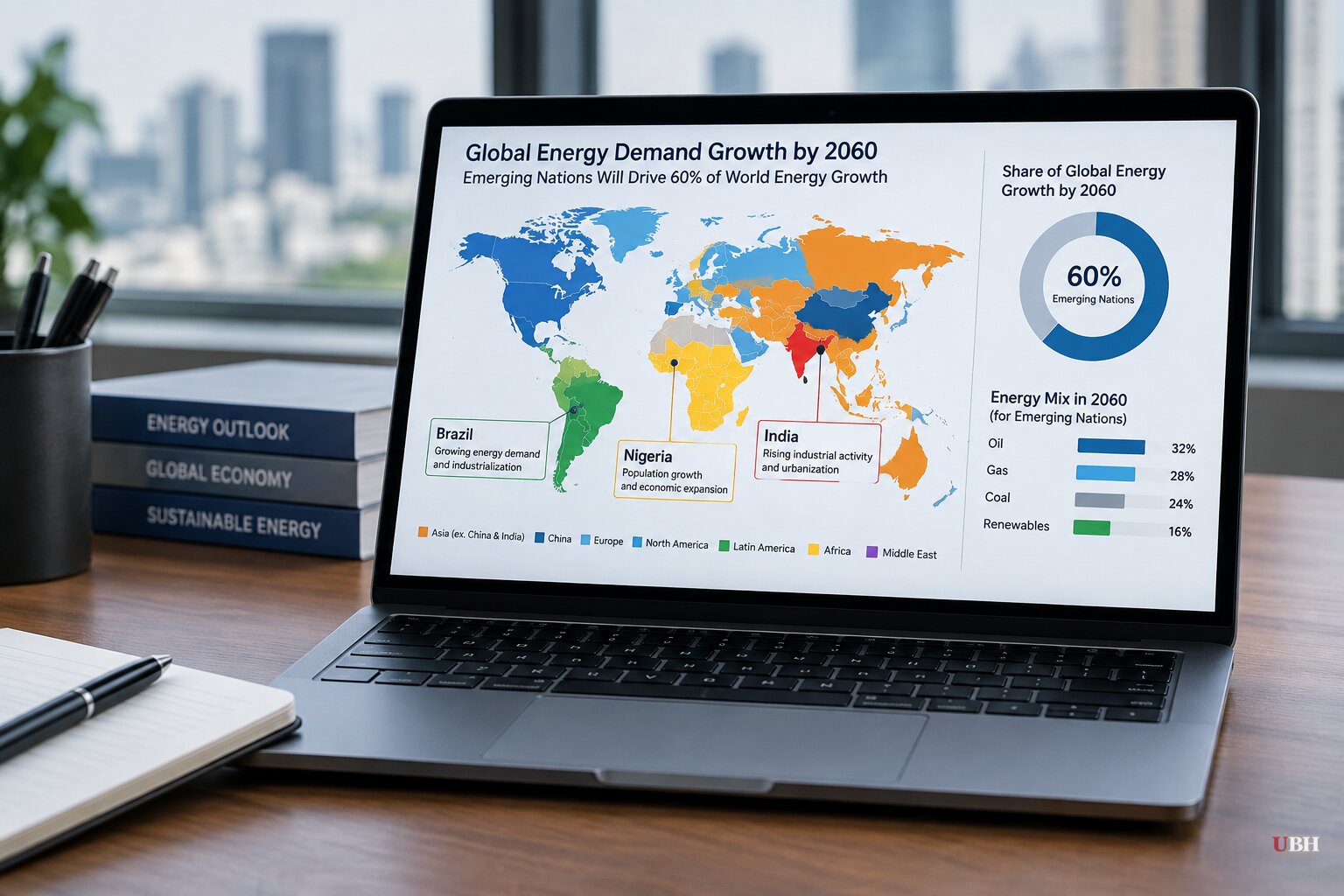
Emerging economies are about to blow a hole in the global climate agenda, and it's not because of politics. It's math.
A new study from S&P Global Energy, Multidimensional Global Energy Pathways, projects that emerging markets and developing economies could push global energy demand up more than 60% by 2060. S&P Global vice chairman Dan Yergin called it "comparable to adding another China to world consumption," according to Marketplace.
Meanwhile, advanced economies and China itself are expected to stay roughly flat on energy demand through 2060, per the S&P study, even accounting for AI data centers, because efficiency gains and electrification offset growth. The entire story of future energy demand is now a developing-world story.
Renewables Alone Won't Cut It
S&P Global's report concludes that limiting global warming to 1.5°C is "not reachable under any plausible trajectory," and reaching net-zero emissions globally before the end of the century is "unlikely," according to jpt.spe's coverage of the study. Hitting 2°C stays possible, but only under the most aggressive decarbonization scenario modeled.
Atul Arya, chief energy strategist at S&P Global Energy, pointed to India as the clearest example. "Most of that energy supply is coming from hydrocarbons," Arya told Marketplace. "They have a very large renewable power program, but transportation needs are all being met by oil."
Katie Auth, deputy executive director at the Energy for Growth Hub, made the case for why that's not a scandal. "The average Liberian consumes less electricity in a year than my refrigerator does," Auth told Marketplace. Growing energy demand in poor countries means jobs, industrialization, and people finally getting access to power. Rich countries demanding these nations "leapfrog" straight to 100% renewables, while having built their own economies on a century of coal and oil, is a tough sell, and the developing world isn't buying it.
Coal Isn't Dying, It's Setting Records
While activists keep predicting coal's collapse, the International Energy Agency now forecasts global coal demand will hit a record 8.94 billion tonnes in 2026, up 1.2%, according to Breitbart's reporting on the IEA's latest coal market update. The driver: disruptions to oil and LNG shipments through the Strait of Hormuz tied to the ongoing U.S.-Iran conflict, which pushed natural gas prices up and made coal-fired power cheaper by comparison in Europe, Japan, South Korea and China, the IEA said.
The IEA's explanation reflects a direct consequence of the current war, not a rejection of climate policy.
Nuclear Keeps Getting Bigger Forecasts
The one clean-energy source getting more bullish, not less, is nuclear. The International Atomic Energy Agency now projects global nuclear capacity could triple from 377.1 GW at the end of 2025 to 1,284 GW by 2060 under its high-case scenario, IAEA Director General Rafael Mariano Grossi announced at the agency's General Conference in Vienna, according to UzDaily.uz and oenergetice.cz. That's the sixth straight year the IAEA has raised its long-term nuclear outlook. Small modular reactors are expected to make up 28% of new capacity by 2060, with North America leading at roughly 60% of new SMR builds.
The Immediate Squeeze: Diesel, Coal Prices, and Brussels Wanting More Control
None of this is abstract for American drivers and truckers right now. Diesel hit a record $6.50 a gallon this month, with one in 10 U.S. stations charging more than $7, according to the Epoch Times, driven by the ongoing war disruptions to global fuel supply. Sen. Chuck Grassley (R-Iowa) has urged President Trump to consider a diesel export embargo to bring down prices for farmers, the Epoch Times reported.
The EPA moved the opposite direction domestically, repealing Biden-era carbon rules for power plants, a move the agency projects will save $310.4 billion, according to the Epoch Times.
Across the Atlantic, the European Commission is pushing draft rules that would let Brussels declare an EU-wide "electricity alarm" and order member states to cut consumption by a specific amount during a crisis, according to Euronews, which reviewed the draft plans. The Commission argues this is necessary because unilateral national moves during a shortage, like hoarding gas or restricting cross-border flows, can worsen shortages elsewhere in the bloc. A grid emergency in one EU country can cascade into blackouts in neighbors if nobody coordinates.
But handing Brussels the authority to order individual nations how much electricity their citizens can use, decided by an unelected commission after consulting an industry working group, is a real transfer of sovereignty that European governments haven't fully debated in public. The draft, per Euronews, was already rewritten once this year after the Israel-Iran war upended the Commission's original 2022-23-crisis-based plan, suggesting this is being built reactively under pressure, not through a slow deliberative process.
The open question is whether EU member states, several of which fought hard over energy sovereignty during the 2022 gas crisis, will accept a standing mechanism that lets Brussels dictate national demand cuts before the next emergency even hits, or whether France, Germany, or Poland push back on the proposal once it's formally unveiled.
Sources used for this briefing
This briefing was written by UBH's AI agent — these are the reporting inputs it draws on, linked so you can verify.


