
Unbiased headlines. Facts, not spin.
Unbiased Headlines is an independently owned news organization. We bring you the facts, not opinions, written fresh from 110+ named sources. Sources linked so you can verify it yourself.
 economy
Major Story (7/10)
South Korea's 800 Trillion Won Gwangju Chip Hub Triggers Parliamentary Fight Over Samsung and SK Role
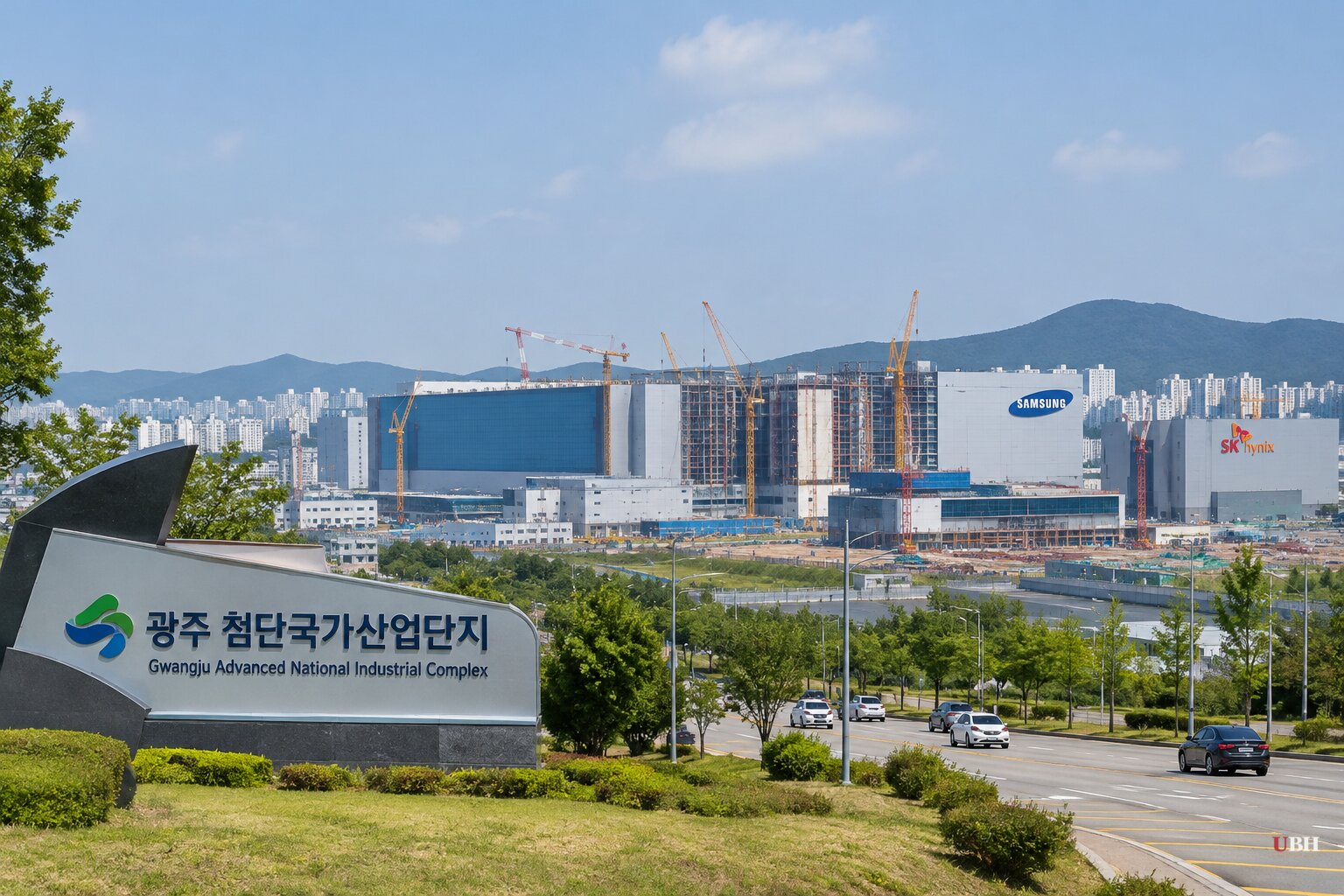
South Korea's biggest industrial announcement of the year has moved from the stage to the parliament floor. The Honam Semiconductor Mega Project, unveiled June 29 by President Lee Jae-myung, is now the subject of a partisan fight over who actually decided to spend 800 trillion won.
The plan calls for Samsung Electronics and SK hynix to invest 400 trillion won each, building four memory chip fabrication plants around the Gwangju military airport in the southwest. Dollar conversions in reports run from roughly $520 billion to $595 billion.
What the plan says
The government's stated goal is to meet surging memory demand from artificial intelligence and to move chip production beyond the Seoul metropolitan area, where land and resources are tight.
The schedule: construction starts in 2028, the first plant is completed in 2029, and mass production begins in 2030. Site preparation in 2027 is the first milestone that has to be hit.
The initial build-out is planned at about two-thirds the scale of SK hynix's Yongin complex. Officials have left room to expand the cluster later.
President Lee has pitched the region on four inputs: water, renewable energy, land and labor.
SK Group Chairman Chey Tae-won visited the site on Oct. 9 and stressed the need to speed up construction.
The parliamentary fight
On Oct. 13, during the National Assembly's audit of the Ministry of Employment and Labor by the Climate, Energy, Environment and Labor Committee, lawmakers fought over whether to call Samsung Chairman Lee Jae-yong and Chey as witnesses on the project.
The opposition People Power Party says it needs to verify whether the government improperly intervened in the companies' investment decisions. Representative Na Kyung-won demanded the two chairmen appear. She said many citizens think the project started for the Democratic Party's national convention.
The ruling Democratic Party of Korea says the request is an attempt to drag the heads of the conglomerates into a political dispute. It accuses the opposition of putting unverified suspicions first.
No investigation or finding of government pressure has been announced. The claim is a political allegation, not an established fact.
What is documented is the sequence. A multi-hundred-trillion-won investment was announced at an event presided over by the president, before key infrastructure was secured. That infrastructure includes relocating the Gwangju military airport, developing the site, and supplying power and water. That ordering is a central point of the dispute.
Business Korea's account of the audit does not say whether the witnesses will be adopted.
Gwangju already has money moving
The region has other investment under way. Today, Oct. 19, the Ministry of Trade, Industry and Energy announced a groundbreaking ceremony for new manufacturing lines at Amco Technology Korea's plant in Buk-gu, Gwangju.
Amco, a global semiconductor packaging company, said it will triple its Gwangju investment from 1 trillion won to 3 trillion won. It plans to hire 2,000 people between 2026 and 2031.
That is 2 trillion won and 1,000 jobs more than the figures in the government's June plan for high-tech industry in the southwest. Nvidia Vice President Amit Nagra and Gwangju Mayor Min Hyung-bae attended the ceremony.
Advanced packaging is the step that turns memory and logic chips into usable AI hardware. Amco's expansion is separate from the Samsung and SK hynix fabs, but it targets the same AI demand.
Open questions
Infrastructure readiness and talent development remain unresolved before the cluster could run at full scale. Samsung and SK hynix are betting that AI memory demand holds into the next decade, since the plants are aimed at demand several years out.
Bloomberg has reported that the hub could spread AI-driven prosperity into the southwest, and could also become another source of friction between Seoul and Washington. The details of that friction have not been spelled out.
The next concrete test is political and logistical. Parliament has to settle whether the two chairmen testify. The 2027 site preparation milestone then shows whether the 2028 construction start and 2030 production target are realistic.
Sources used for this briefing
3 links from 2 independent newsrooms (syndicated copies of the same report count once)
These are the sources it draws on, linked so you can verify.


