
Unbiased headlines. Facts, not spin.
Unbiased Headlines is an independently owned news organization. We bring you the facts, not opinions, written fresh from 110+ named sources. Sources linked so you can verify it yourself.
 economy
Major Story (7/10)
China's Central Bank Says It Will Study Making the Overnight Rate Its Main Policy Rate
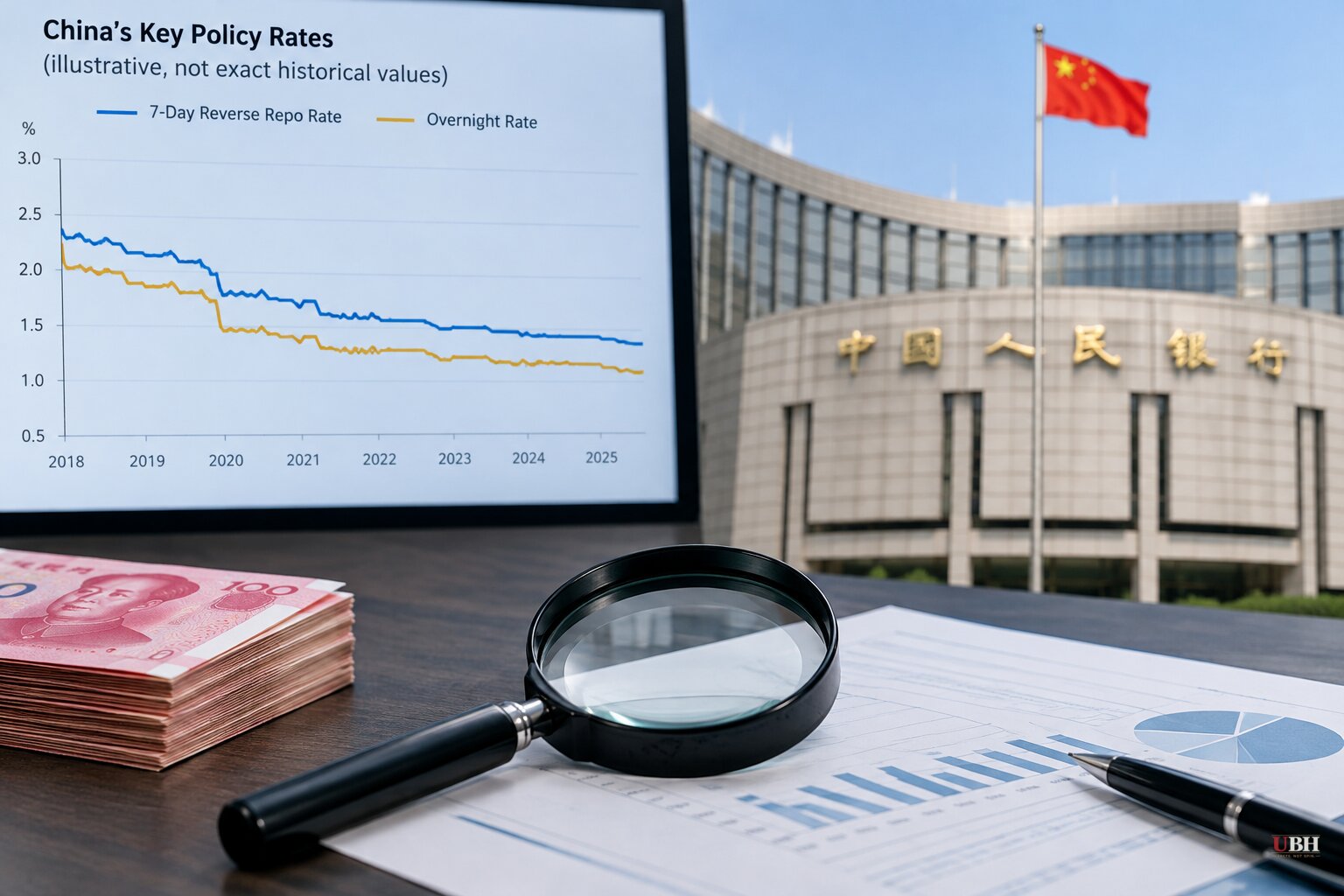
China's central bank is moving to change the interest rate that anchors its monetary policy.
People's Bank of China Governor Pan Gongsheng said at the Financial Street Forum in Beijing on Monday, Oct. 19, that the PBOC will study switching the main tenor of its open market operations to overnight "at an appropriate time." Once that happens, the overnight reverse repurchase rate becomes its primary policy lever, according to the central bank-run Financial News.
The overnight rate would replace the seven-day reverse repo rate, which has been the main benchmark since 2024. That rate stands at 1.4%.
What Pan said about the rate
Pan said the market has already done much of the work. "Currently, the interbank overnight repo rate has effectively become the target rate for the PBOC's monetary policy," he said. "It sensitively reflects the supply and demand for short-term liquidity and has shown greater stability in recent years."
That market rate is known as DR001. It tracks what banks pay to borrow from one another overnight against bond collateral, and it is the most heavily traded product in the interbank money market. Pan said the change will make interest rate control more precise. He also said the PBOC will promote DR001 as the main policy rate.
The move follows earlier signals. In June, at the Lujiazui Forum in Shanghai, the PBOC introduced an overnight tenor to its open market operations. It also narrowed its interest-rate corridor to 50 basis points from 70. The rate on new overnight reverse repo transactions was set at 1.25% at that time.
Overnight borrowing costs among banks have since slipped below 1.3% in October, the lowest since May. The overnight repo rate was steady at 1.26% after Monday's remarks.
Rate cut or relabeling
The gap between 1.25% and 1.4% is why economists disagree about what this means.
Huatai Securities analysts led by Zhang Jiqiang wrote before the announcement that such a shift would "function as a de facto rate cut." Xing Zhaopeng, senior China strategist at ANZ, said the decision "will substantially change the policy framework and the market." He said the current rate corridors will be recalibrated if the overnight rate comes in below 1.4%. He suggested it could land at 1.25%.
Wang Qing, chief macro analyst at Golden Credit Rating International, takes the opposing view. She said the actual operating rate for overnight reverse repos will be announced only when the central bank makes the switch. She cautioned that the change does not amount to a rate cut.
Markets barely reacted. The 30-year government bond yield fell a little over 1 basis point. The 10-year and 30-year yields were roughly 1.64% and 2.06%. The yuan rose 0.1% to 6.6813 per dollar in the offshore market.
The shift would bring the PBOC closer to the practice of other major central banks, such as the U.S. Federal Reserve, which anchor policy on overnight rates.
A backstop for non-bank funds
Pan also announced a second measure. The PBOC, together with the National Financial Regulatory Administration and the China Securities Regulatory Commission, will launch a liquidity support tool for large redemptions at non-bank institutions.
The tool is meant to activate when asset managers face herd liquidity risk and the bond market enters a redemption-selloff spiral. Eligible institutions include bank wealth management subsidiaries, public fund managers, and their parent banks and securities companies. Operations must meet macroprudential requirements and be backed by high-grade collateral.
Pan said the design is meant to balance systemic-risk prevention against moral hazard. He said the collateral requirement is meant to prevent distorted market pricing and "the illusion of a backstop," and to maintain market discipline.
The bond market has come under repeated selling pressure since the start of the year as wealth management products and public funds faced concentrated redemptions.
The PBOC will also widen the range of institutions that can use its Standing Lending Facility. That includes insurers and fund managers.
Other changes on the list
Pan outlined several further steps:
- Diversifying loan pricing benchmarks and retiring the deposit and lending benchmark rates.
- Issuing guidance on fintech finance.
- Piloting participation by overseas clearing banks in the onshore foreign exchange market.
The timing sits against a strong growth backdrop. The yuan has reached a four-year high on solid GDP data, which has tempered the case for fresh stimulus.
What is still open
No date for the switch has been given, and Pan said only that the PBOC will "study" it. The level of the new operating rate has not been announced. Wang says it will be revealed only when the central bank makes the change.
That figure settles the argument. If the overnight rate is set near 1.25%, borrowing benchmarks move down about 15 basis points. If it is set at or above 1.4%, the change is a relabeling.
Sources used for this briefing
6 links from 6 independent newsrooms (syndicated copies of the same report count once)
These are the sources it draws on, linked so you can verify.


