
Unbiased headlines. Facts, not spin.
Unbiased Headlines is an independently owned news organization. We bring you the facts, not opinions, written fresh from 110+ named sources. Sources linked so you can verify it yourself.
 economy
Major Story (8/10)
China to Require Export Licenses for Long-Range Drones, Tunnel Boring Machines and Dredger Parts From Nov. 18
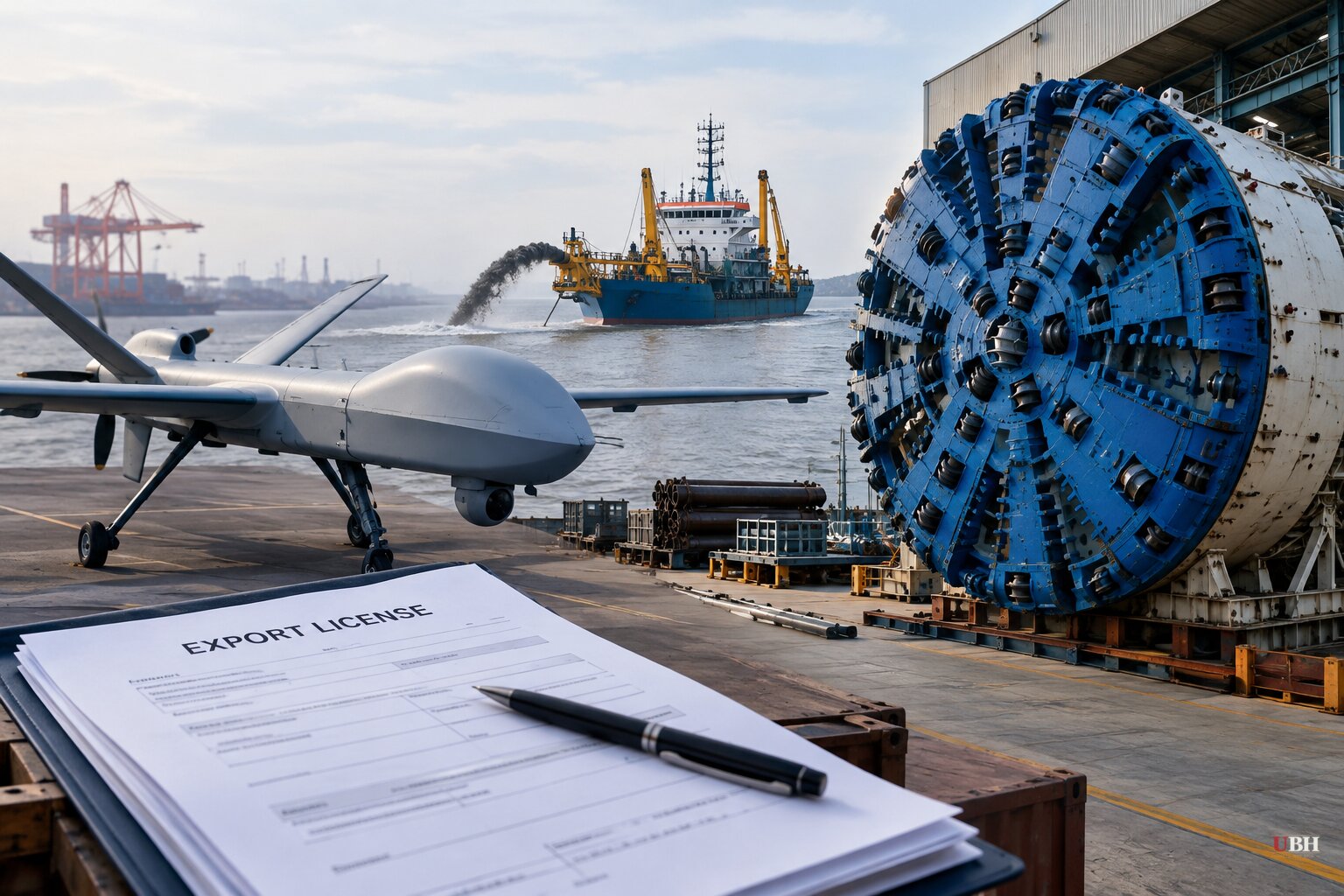
China announced export controls on a broad set of drones and heavy engineering equipment on Monday, Oct. 19. The rules take effect Nov. 18.
The Commerce Ministry and the General Administration of Customs issued four announcements at once. On the drone side, the Equipment Development Department of the Central Military Commission signed on as a co-issuer.
What needs a license
Drones. Items that meet specified technical thresholds cannot leave China without a license. That covers drones or unmanned airships that can fly under control beyond the operator's line of sight with at least three hours of endurance, and drones with a range of 300 kilometers (186 miles) or more. It also covers UAV-specific autopilots, certain engines, communications equipment, motors, propeller blades, software and related technologies.
Tunnel boring machines. Shield and rock tunnel boring machines are now on the control list, along with cutting tools, cutterheads, screw conveyors, segment erectors and main drive systems. Under Announcement No. 50 of 2026, remanufacturing technology for these machines is covered too. Bloomberg noted that some of these machine types had not been subject to export controls before.
Dredgers. Announcement No. 51 tightens controls on key dredger components, including mud pumps and cutterheads.
Other machinery. Certain walking excavators are covered if they exceed set thresholds for crossing obstacles or trenches, wading through water or climbing slopes. So are high-altitude wet shotcrete machines designed for use above 3,000 meters (9,843 feet), plus related hydraulic and pumping technologies.
Two tracks for exporters
The machinery rules split destinations in two. Exports to what the announcements call sensitive countries and regions, described as those in disputes with China, require individual licenses. Shipments elsewhere go through a registration-based export certification procedure.
Exporters and end users must formally pledge not to transfer covered Chinese-origin items to sensitive destinations without authorization. Overseas organizations and individuals are barred from making such unauthorized transfers.
There are carve-outs on the drone side. Qualifying exhibition exports get simplified procedures. Companies with effective internal compliance systems may qualify for general licenses.
China's dual-use export control list will be updated when the measures take effect. Regulators also set deadlines for classifying dual-use items: seven working days for an exporter to submit materials and 15 working days to complete a determination, according to the announcements.
Beijing's stated reasons
A Commerce Ministry spokesperson said the drone items "have a clear dual-use nature" for military and civilian purposes. The ministry said the changes are meant to safeguard national security and interests and to meet international obligations such as non-proliferation.
The spokesperson also said China is committed to keeping global industrial and supply chains secure and stable, and that license applications meeting requirements will be approved.
The ministry said it notified the relevant countries and regions with which it has export-control dialogue mechanisms before making the announcement.
India's exposure
India is the clearest example of a buyer with something to lose. India depends on imports for tunnel boring machines, which it uses for metro rail networks, railway corridors and tunnels in border areas, according to The Hindu.
New Delhi has already raised customs clearance delays on Chinese TBM shipments. The problems started in 2024. That October, Commerce Minister Piyush Goyal publicly told visiting German Vice Chancellor Robert Habeck that China was blocking exports of TBMs made by a German company in China.
China's announcements do not name India or any other destination country. Whether a given buyer is treated as sensitive will determine how much friction it faces after Nov. 18.
The wider tech push
The announcements follow Friday, Oct. 16, when the Commerce Ministry and the Ministry of Science and Technology jointly published a draft update to China's catalog of technologies subject to export bans or restrictions. The draft lists 40 technologies, including 23 AI technologies, 12 solar-related technologies such as polysilicon production, and five biomedicine technologies such as cell and gene therapy.
Under the draft, exports of core technologies for AI large models trained on sensitive national data would be prohibited. So would AI agents built for highly sensitive environments such as national defense and critical information infrastructure. AI models with 2 trillion parameters or more, or with certain world-leading capabilities, could be restricted.
The commerce ministry called the draft "necessary" and said it aims at "reinforcing the security bottom line, preventing misuse and abuse, and ensuring that AI remains under human control."
Lian Jye Su, chief analyst at Omdia, said the draft "can be seen as a response to Western countries posting sovereignty requirements on AI, robotics, telecommunications, and other key technologies."
The Hindu noted that new controls on next-generation solar manufacturing technology could affect efforts by India and others to reduce dependence on China as they move up the solar supply chain.
The draft is a proposal, not a final rule. The drone and machinery announcements are final and carry a date.
The next marker is Nov. 18. That is when exporters of covered drones, tunnel boring machines and dredger parts must have licenses in hand, and when the ministry's promise to approve compliant applications gets its first real test.
Sources used for this briefing
7 links from 7 independent newsrooms (syndicated copies of the same report count once)
These are the sources it draws on, linked so you can verify.


