
Unbiased headlines. Facts, not spin.
Unbiased Headlines is an independently owned news organization. We bring you the facts, not opinions, written fresh from 110+ named sources. Sources linked so you can verify it yourself.
 economy
Major Story (7/10)
Event date: October 23, 2026 ·
South Korean Shipbuilders Move Into U.S. Yards as America Builds Under 1% of the World's Ships
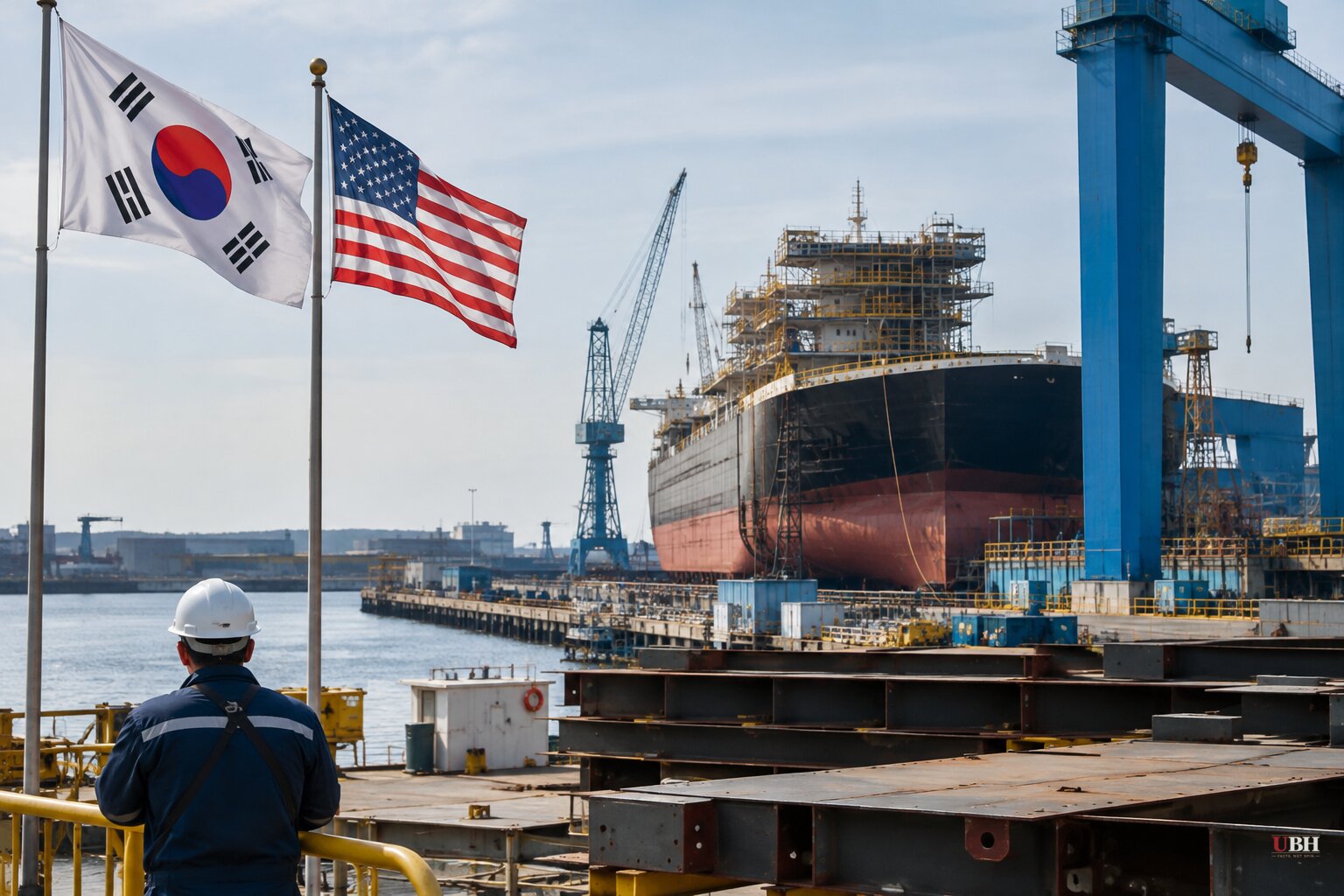
America wants its shipyards back. For now, it is borrowing the blueprint from Seoul.
Sen. Dave McCormick, a Pennsylvania Republican and co-sponsor of the bipartisan Ships for America Act, recently toured the main yard of South Korea's Hanwha Ocean. The site is bigger and more technologically advanced than any facility in the United States. McCormick says the U.S. lost its shipbuilding capacity over a generation and needs "shock therapy" to rebuild it. "The world is not going to wait for us to get there," he said. "We need to move faster."
The gap with China
The numbers explain the urgency. The Wall Street Journal reports the U.S. accounts for less than 1% of global shipbuilding, while China, the largest builder in the world, has more than 230 times American capacity.
Rebeccah Heinrichs, director of the Keystone Defense Initiative at the Hudson Institute, puts it in terms of output, according to Türkiye Today: the U.S. builds under 1% of the world's commercial ships by volume.
The damage is not abstract. Türkiye Today reports that American naval maintenance yards face backlogs that leave nuclear attack submarines, destroyers and aircraft carriers idling in dry dock for months past their repair windows.
Hanwha's U.S. footprint
Hanwha bought Philly Shipyard in Philadelphia in December 2024. The Journal reports the company has put about $350 million into upgrades and plans to invest several billion dollars more.
The company became a subcontractor on the Navy's next-generation logistics support ship program in March. Earlier this month it was named a builder of special auxiliary vessels tied to the "Golden Dome" missile defense system. Philly Shipyard can already build naval auxiliary vessels. It aims to win certification to build warships by 2028.
The Journal also reports Hanwha is the only foreign company to acquire a U.S. shipyard in recent years, and that it has made an offer of more than $1 billion for Austal USA's shipyard in Mobile, Alabama. The company is currently in negotiations.
The Journal says Hanwha is struggling at Philly with high production costs, a shortage of suppliers and limited space.
A Texas yard from HD Hyundai and Kiewit
On Thursday, Oct. 22, Kiewit Maritime Co. and HD Hyundai USA LLC announced plans for HD Kiewit Shipbuilding LLC. The joint venture would build a new yard on an existing industrial site in Ingleside, Texas, with deepwater access to the Gulf.
The yard would target naval auxiliary and commercial vessels, plus ship block and module fabrication for other U.S. builders. Construction is targeted to begin in 2027 and full-scale operations in 2029. At full scale it could support up to 3,000 jobs.
The deal follows a strategic partnership agreement the two companies signed in July. Hannae Choi, executive vice president at HD Korea Shipbuilding & Offshore Engineering, called it "an important milestone in HD Hyundai's journey to become a strategic partner to the U.S. shipbuilding industry."
Kiewit brings large-scale fabrication and construction capability. HD Hyundai brings shipbuilding technology and yard operating experience.
The policy behind it
An April 2025 executive order, "Restoring America's Maritime Dominance," established a Maritime Action Plan to strengthen U.S. maritime industries. Seoul then committed $150 billion to shipbuilding cooperation with the U.S. in a bilateral strategic investment memorandum signed in November 2025. The effort is branded MASGA, for "Make American Shipbuilding Great Again."
In July, the two countries opened a shipbuilding partnership center in Washington, D.C., alongside 15 agreements involving South Korea's three largest shipbuilders, U.S. shipyards, technology companies and research institutions.
Not everyone reads this as a comeback. A column in Türkiye Today titled "Borrowed hulls, bruised pride" calls the strategy an outsourcing of America's shipbuilding revival. It points to federal officials buying Finnish-designed icebreakers and leaning on allied engineering and European designs to restart domestic industry.
The missing demand signal
The Journal reports that allies such as South Korea and Japan need confidence in future Department of Defense demand before they expand in the U.S. Congress has not yet passed a defense budget, which makes the Pentagon's long-term procurement needs hard to gauge. The Journal identifies that uncertainty as an obstacle to bigger investment.
That puts the burden on Washington. Foreign capital is on the table, with Hanwha's multibillion-dollar plans and Seoul's $150 billion commitment, and a Texas yard is targeted to begin construction in 2027. Whether any of it scales depends on Congress passing a defense budget that tells builders what the Navy will actually order.
Sources used for this briefing
4 links from 4 independent newsrooms (syndicated copies of the same report count once)
These are the sources it draws on, linked so you can verify.


