
Unbiased headlines. Facts, not spin.
Unbiased Headlines is an independently owned news organization. We bring you the facts, not opinions, written fresh from 110+ named sources. Sources linked so you can verify it yourself.
 energy
Major Story (7/10)
energy
Major Story (7/10)
South Korea Agrees to $22.3 Billion Texas Gas Plant for AI Power, But Seoul Says the Deal Isn't Final Yet
The Numbers
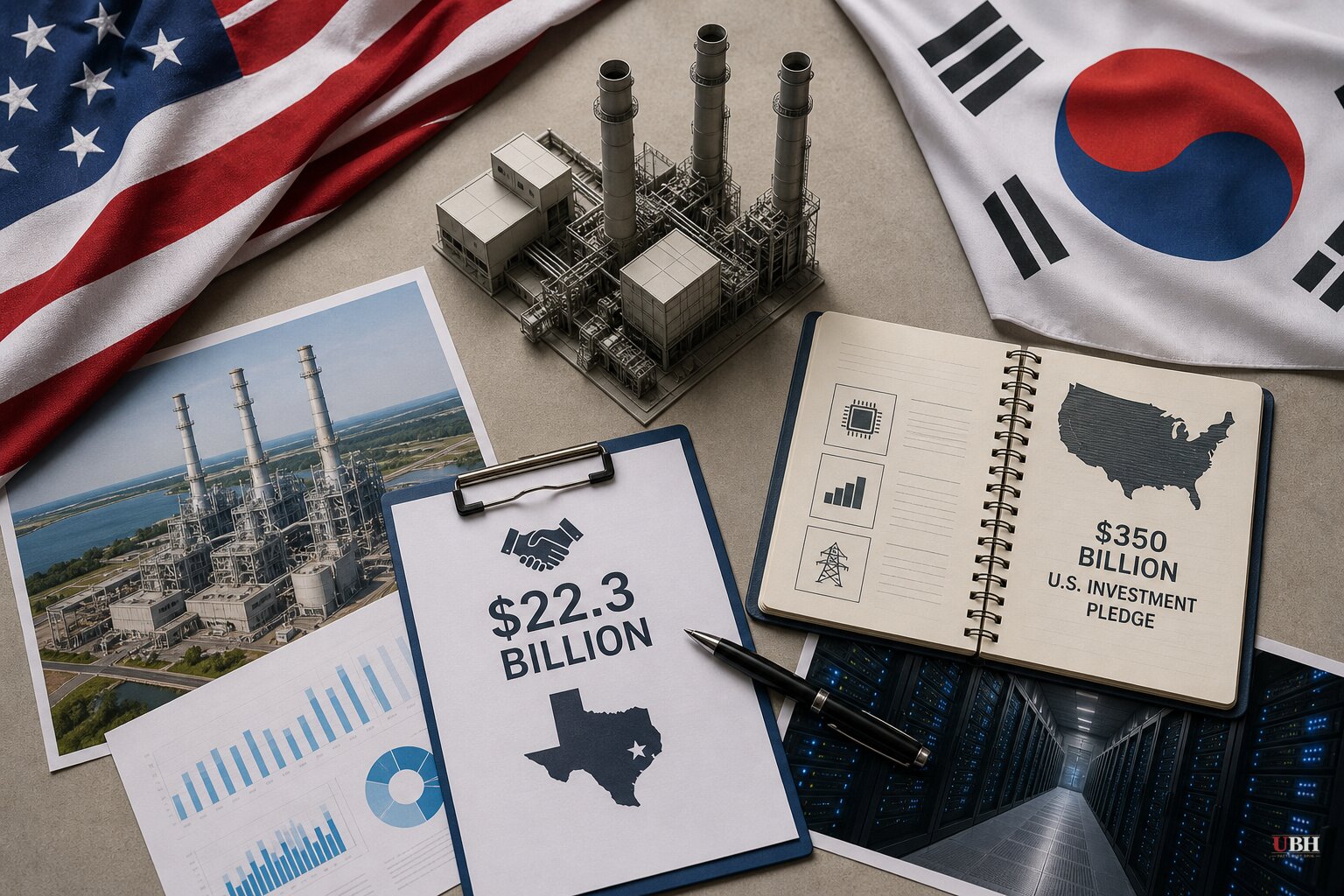
South Korea and the United States have landed on $22.3 billion as the price tag for a natural gas power plant in Encinal, Texas, according to Reuters, citing the Korean outlet Edaily. The plant would run 6.3 gigawatts of combined-cycle gas turbines, roughly the output of six nuclear reactors, built specifically to feed the electricity appetite of AI data centers, per Business Korea.
That number moved. Business Korea reports the project started as a $19.8 billion estimate, with the U.S. side pushing to get it as high as $25 billion. The two sides landed at $22.3 billion, about 33% higher than the initial estimate, according to Business Korea. Lewis Energy Group, a U.S. energy company, will own the project, according to Business Korea.
Construction would come in phases. The first stage delivers 1.4 gigawatts of gas turbine capacity, with 4.9 gigawatts of combined-cycle facilities added later as demand and financial feasibility get assessed, Business Korea reports. The power could go straight to ERCOT, the Texas grid operator, or be sold directly to nearby data centers through long-term contracts.
Whose Money, and Is It Even Final?
Business Korea and GuruFocus frame this as essentially locked in, reported to South Korea's National Assembly at a government-ruling party meeting on Sept. 7, with an official announcement expected later this month pending parliamentary sign-off.
Reuters, in reporting picked up separately by WMBD Radio and Internazionale, tells a different story. South Korea's Industry Ministry directly pushed back on the Edaily report, calling it "inaccurate" and saying consultations with Washington are still ongoing, which makes it "difficult to confirm specific details." The ministry said Seoul will make its own announcement only after negotiations wrap and parliamentary procedures are handled. It also separately shot down speculation about a nuclear power plant, saying no decision has been made there either.
One set of reports treats this as a done deal reported to lawmakers. Another, sourced to the ministry itself, says nothing is locked and don't believe everything you read. Neither side disputes the $22.3 billion figure or the Encinal location. The disagreement is about how final "final" actually is. None of the reporting says whether South Korea is covering the full $22.3 billion itself or splitting it with U.S. partners.
The Bigger Trade Deal
This project is meant to be the first concrete piece of South Korea's $350 billion U.S. investment pledge, made as part of a trade agreement that got Seoul a 15% tariff rate on its exports to the U.S. instead of a threatened 25%, according to ua.news. Under that same deal, South Korea also committed to buying $100 billion in U.S. liquefied natural gas and other energy resources.
Notably absent from this package: the Samsung Electronics and SK hynix semiconductor fab investments that U.S. Commerce Secretary Howard Lutnick had pushed to include. Business Korea reports those are expected to proceed separately as standard foreign direct investment rather than counting against Seoul's $350 billion commitment.
Seoul is also weighing a large-scale nuclear plant and a liquefied natural gas project in Alaska as further pieces of the pledge, according to both Reuters and Business Korea, though nothing on either is settled.
The China Angle
The timing lines up with a broader argument the Trump administration has been making about power and the AI race. Fox News reported that Vice President JD Vance told Fox Business there's "a very good chance" the U.S. could lose the AI race to China if Democrats retake Congress, pointing to China now generating roughly three times the electricity of the U.S. and arguing "we've got to build more power plants."
President Trump made a parallel case on Truth Social, warning that opposition to new data centers plays directly into Beijing's hands: "China could not be happier with this anti Data Center movement." China expert Gordon Chang told Fox News Beijing understands the U.S. lead is hard to erase if America keeps building at pace, though Stanford's 2026 AI Index still counts 5,427 U.S. data centers against 449 in China. The Chinese Embassy in Washington, for its part, rejected framing AI infrastructure as a geopolitical contest at all.
Whether the Encinal plant becomes the model for the Korean-U.S. energy build-out, or just a headline that outran the actual paperwork, comes down to what South Korea's National Assembly does with it. The ministry says a formal announcement is still pending. Until then, the $22.3 billion figure is real, but "agreed" and "finalized" are apparently two different things in Seoul.
Sources used for this briefing
7 links from 7 independent newsrooms (syndicated copies of the same report count once)
These are the sources it draws on, linked so you can verify.


