
Unbiased headlines. Facts, not spin.
Unbiased Headlines is an independently owned news organization. We bring you the facts, not opinions, written fresh from 110+ named sources. Sources linked so you can verify it yourself.
 energy
Notable (6/10)
NESO forecasts 5.9 GW winter surplus as probe finds control-room stress over renewables balancing
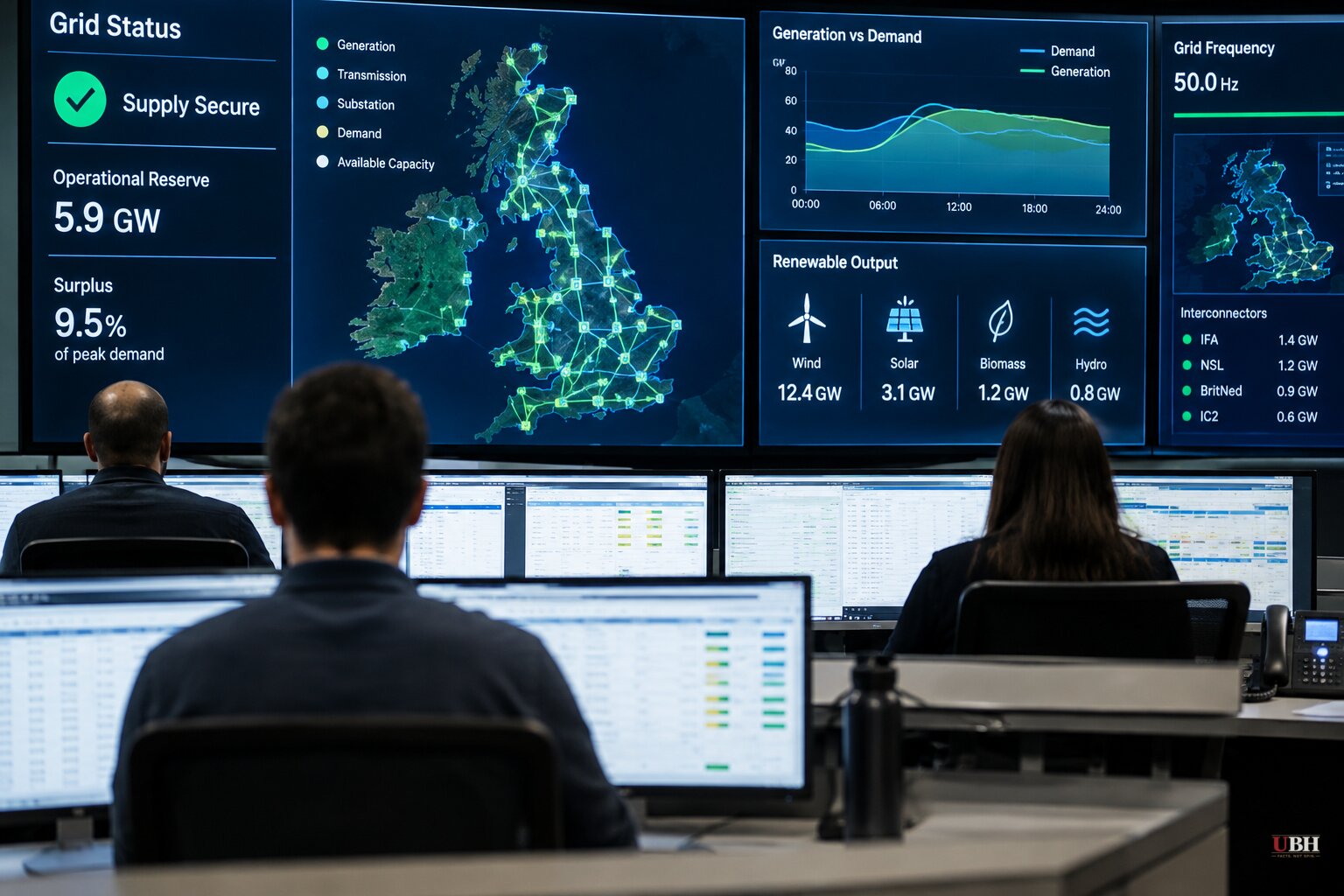
The National Energy System Operator (NESO) says the lights will stay on this winter. Its Winter Outlook, published today, Oct. 23, forecasts a surplus of 5.9 GW over peak demand, a 9.5% buffer.
That is in line with NESO's preliminary assessment earlier in the year and broadly similar to winter 2025/26. NESO says it is also higher than in 2022, when the system ran securely on smaller margins.
The modelling covers every day from Oct. 31, 2026 to March 31, 2027, using 30,000 scenarios per day that vary weather, demand, wind output and generator availability.
"While we never take resilience for granted, households and businesses can be confident that Great Britain's electricity system remains secure, reliable and among the most resilient in the world," said Deborah Petterson, NESO's director of whole energy system resilience.
NESO also warned of possible "tight days." On those days it would issue Electricity Margin Notices to producers saying more generation may be needed. NESO calls the notices routine, used in most winters, and says they are not a warning of power cuts.
What the control-room investigation found
The outlook arrives just after an independent review of NESO itself. Law firm Eversheds Sutherland investigated after Conservative shadow energy secretary Claire Coutinho said in July that a whistleblower had contacted her. The whistleblower alleged NESO was hiding information about how securely the grid was being run.
One claim was that control-room staff were encouraged to conceal or alter records of efforts to stabilise the grid during extreme heat in June. The allegation held that this was to avoid public scrutiny or reputational damage for the government-owned operator.
Eversheds did not substantiate any of the whistleblower allegations. A NESO statement on Monday said the investigation found "no evidence of inappropriate influence over operational decisions or that control room records were altered or inappropriately managed in any way."
The firm did identify cultural, governance and control issues that it called significant findings in their own right.
It reported "high levels of stress and concern" in the Electricity National Control Centre about the state of the energy industry and the long-term ability to keep it balanced. Staff told investigators that gas generation was "easier to manage" than renewables, which are "less flexible."
The report also found a significant disconnect between control-room staff and NESO leadership. Multiple witnesses said senior executives do not fully understand how the control room works or the pressures on the people keeping the lights on.
Interviewees also said the system on June 23 was "consistently in breach of operational limits for a number of hours," even though a NESO press release that day said the system was "not at risk." Eversheds did not find that the records were manipulated.
NESO chief executive Fintan Slye said the probe identified areas where the organisation can improve how staff raise concerns and how it responds. "We will act on the recommendations, working closely with our trade unions," he said.
Gas does the heavy lifting on cold, still days
National Gas, the private company that runs the gas network and is separate from NESO, also published its winter outlook. It expects enough supply to meet demand.
It also forecasts that gas burned for power generation will rise at peak demand because of the "intermittent" nature of renewables, even as overall gas demand is expected to fall. Wind was Britain's largest source of electricity last year at almost 30%, marginally ahead of gas.
LNG imports are forecast to rise about 6%. National Gas says only a "rare and very unlikely" combination, such as extreme weather alongside a major supply disruption, would threaten security of supply.
Britain enters winter with low gas storage and relies on a Europe whose own storage is at record lows, according to the BBC's reporting. National Gas warns that "international disruptions, including geopolitical events, may affect market conditions." Conflicts in the Middle East and Ukraine have pushed energy prices higher.
A U.S. grid scrambles in October
The same pressure showed up in the U.S. last week. PJM Interconnection, which runs the grid across 13 states and Washington, D.C., issued emergency procedures on Oct. 13 and 14, including a Maximum Generation Alert and a Load Management Alert.
The trigger was unseasonably warm weather, with demand projected near 111,500 MW on Oct. 13, and heavy maintenance season. About 61,000 MW of generation was offline, leaving PJM with roughly 66% of its fleet's capacity.
More than two-thirds of those outages were planned. About 15,000 MW were unplanned. PJM recalled about 10,000 MW from maintenance but said cancelling more outages would leave plants unprepared for winter.
Energy Secretary Chris Wright issued an emergency order covering Oct. 13 through Oct. 16. PJM says it is the ninth such order this year allowing it to direct backup generation at data centers and other large-load customers to run and protect other customers. PJM has not used that authority. Federal and grid officials say the order is not a notice of planned outages.
PJM's explanation is that data-center demand runs around the clock and is outpacing new transmission and supply. It says the once-quiet shoulder seasons now carry real reliability risk. Its answer is more power plants. The grid also set a preliminary peak-demand record of about 168,000 MW on July 2.
The lights stayed on in both countries. The test in Britain begins Oct. 31, when NESO's winter modelling window opens, with the control-room culture findings and Slye's promised follow-up still to be worked through.
Sources used for this briefing
7 links from 6 independent newsrooms (syndicated copies of the same report count once)
These are the sources it draws on, linked so you can verify.


