
Unbiased headlines. Facts, not spin.
Unbiased Headlines is an independently owned news organization. We bring you the facts, not opinions, written fresh from 110+ named sources. Sources linked so you can verify it yourself.
 economy
Major Story (7/10)
Event date: October 15, 2026 ·
Social Security Gets 3.6% Raise for 2027 While Trustees Still Project 22% Cut in 2032
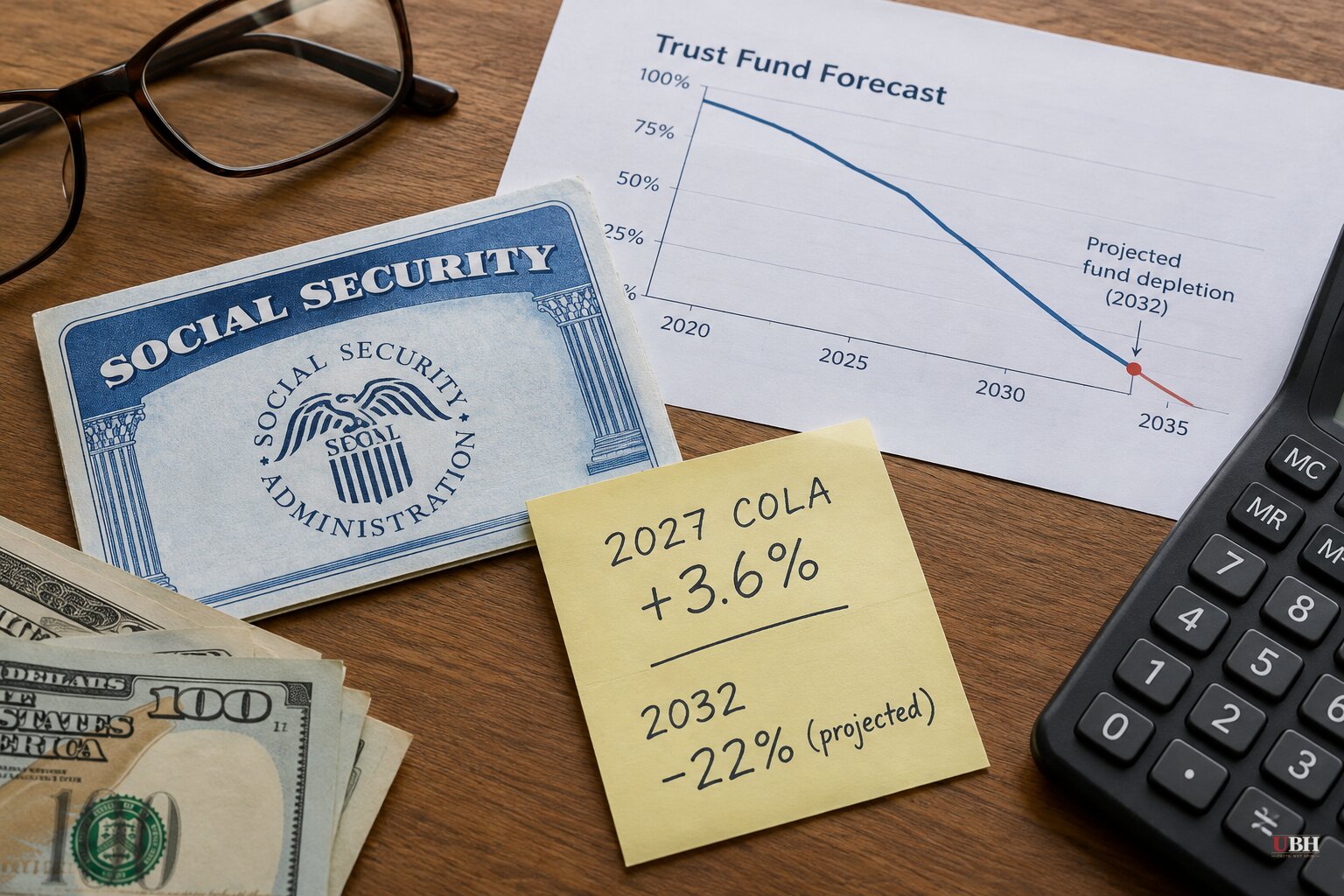
Nearly 72 million Social Security beneficiaries get a raise in January. The program that pays them is on track to run short of money six years from now.
The Social Security Administration announced a 3.6% cost-of-living adjustment (COLA) for 2027 on Oct. 14. The average retirement benefit rises about $75 a month, from $2,095 to an estimated $2,170, according to the agency's fact sheet. Payments to about 7.3 million Supplemental Security Income recipients rise starting Dec. 31, 2026. Counting people who get both, the agency says the increase reaches 76 million Americans.
The adjustment is the highest in four years. This year's was 2.8%. It tracks the Consumer Price Index for Urban Wage Earners and Clerical Workers, which rose 3.9% year over year in September.
The 2032 problem
The 2026 trustees report projects that the Old-Age and Survivors Insurance trust fund, which pays retirement and survivor benefits, will exhaust its reserves in the fourth quarter of 2032. After that, incoming payroll tax revenue would cover about 78% of scheduled benefits. That is an across-the-board cut of roughly 22%, and the covered share is projected to fall to 62% by 2100.
The combined retirement and disability funds are projected to run dry in the third quarter of 2034. At that point revenue would cover 83% of scheduled benefits, falling to 65% by 2100.
Depletion does not end benefits. The program keeps collecting payroll taxes and keeps paying, but only what revenue covers. For a retiree collecting $40,000 a year, a 22% cut is $8,800.
Why the numbers got worse
The trustees' 2032 date did not move in this year's report. The underlying picture did. The trustees cut their fertility assumption to 1.75 children per woman from 1.90. They also lowered projected immigration of temporary or unlawfully present immigrants and assumed higher emigration from that group in the near term.
The trustees' report, as summarized by Morningstar, also says changes to income tax rates and standard deductions under the One Big Beautiful Bill Act reduced revenue flowing to the trust fund.
The actuarial balance, which measures the payroll tax increase needed to make the program solvent for 75 years, went from 3.82% last year to 4.42%. Morningstar's analysis calls the 2032 date a likely best case.
The drivers are not new. Fewer workers are paying in per retiree, and more national income sits above the $184,500 wage cap subject to the payroll tax. Net drawdowns of the trust funds began in 2021 as baby boomer retirements accelerated.
What the fixes cost
The options come down to more revenue or smaller benefits.
The payroll tax is currently 12.4%, split between employer and employee. The trustees estimate a rate of 16.65% would close the gap. The Congressional Budget Office puts the figure at 17.31%. The Cato Institute calculated that for a median full-time worker earning $61,583, that means $2,617 to $3,024 in additional taxes a year.
Lifting the wage cap entirely could close about 60% of the long-range shortfall by itself, former Social Security chief actuary Steve Goss told NPR. Raising the full retirement age from 67 or changing the COLA formula are benefit cuts by another name, and both have drawn opposition. Higher immigration would also narrow the gap, since the trustees found lower immigration has enlarged the deficit.
The raise is not evenly shared
The Committee for a Responsible Federal Budget estimates the COLA adds about $900 a year to the average retiree's benefits. Top-benefit recipients could see more than $2,200. The group says the highest-earning couples who retired this year at normal retirement age could get a combined $3,600 increase, pushing their annual benefits above $100,000.
The raise also gets partly eaten. AARP projects the standard Medicare Part B premium will rise $6.60 a month in 2027 to $209.50. Some retirees and advocates say the 3.6% bump does not cover rising costs for groceries, utilities, insurance and health care.
A Federal Reserve report released in May found 63% of adults ages 18 to 29 said they were doing okay financially or living comfortably in 2025, versus 83% of adults 60 and older.
What the administration says
Social Security Commissioner Frank Bisignano pushed back on the alarm in an Oct. 12 interview on CNBC's "Squawk Box." "This is a long journey. It's 90 years old, and it'll be around for another 90 years. The president has promised to protect and preserve and that's what we're doing," he said.
The administration has not laid out a plan to close the funding gap. Bisignano, a former Wall Street CEO who has been overhauling how the agency operates, said the agency is working to fix erroneous records.
The Peter G. Peterson Foundation, led by CEO Michael Peterson, and the Committee for a Responsible Federal Budget say lawmakers need to pursue solutions now. Budget watchdogs have described the program as on a "collision course toward insolvency."
The vote that is coming
The timeline runs through this year's midterms. AARP's Bill Sweeney told NPR: "The people who we elect to the United States Senate in November are almost certainly going to be the ones in the Senate in 2032 deciding what to do with people's Social Security."
The 3.6% raise lands in January. The 22% cut, absent a law, lands almost six years after that.
Sources used for this briefing
7 links from 6 independent newsrooms (syndicated copies of the same report count once)
These are the sources it draws on, linked so you can verify.


