
Unbiased headlines. Facts, not spin.
Unbiased Headlines is an independently owned news organization. We bring you the facts, not opinions, written fresh from 110+ named sources. Sources linked so you can verify it yourself.
 economy
Major Story (7/10)
Event date: October 16, 2026 ·
IMF Meetings in Bangkok Close With Warnings on Rich-World Debt, AI Valuations and Cyberattacks
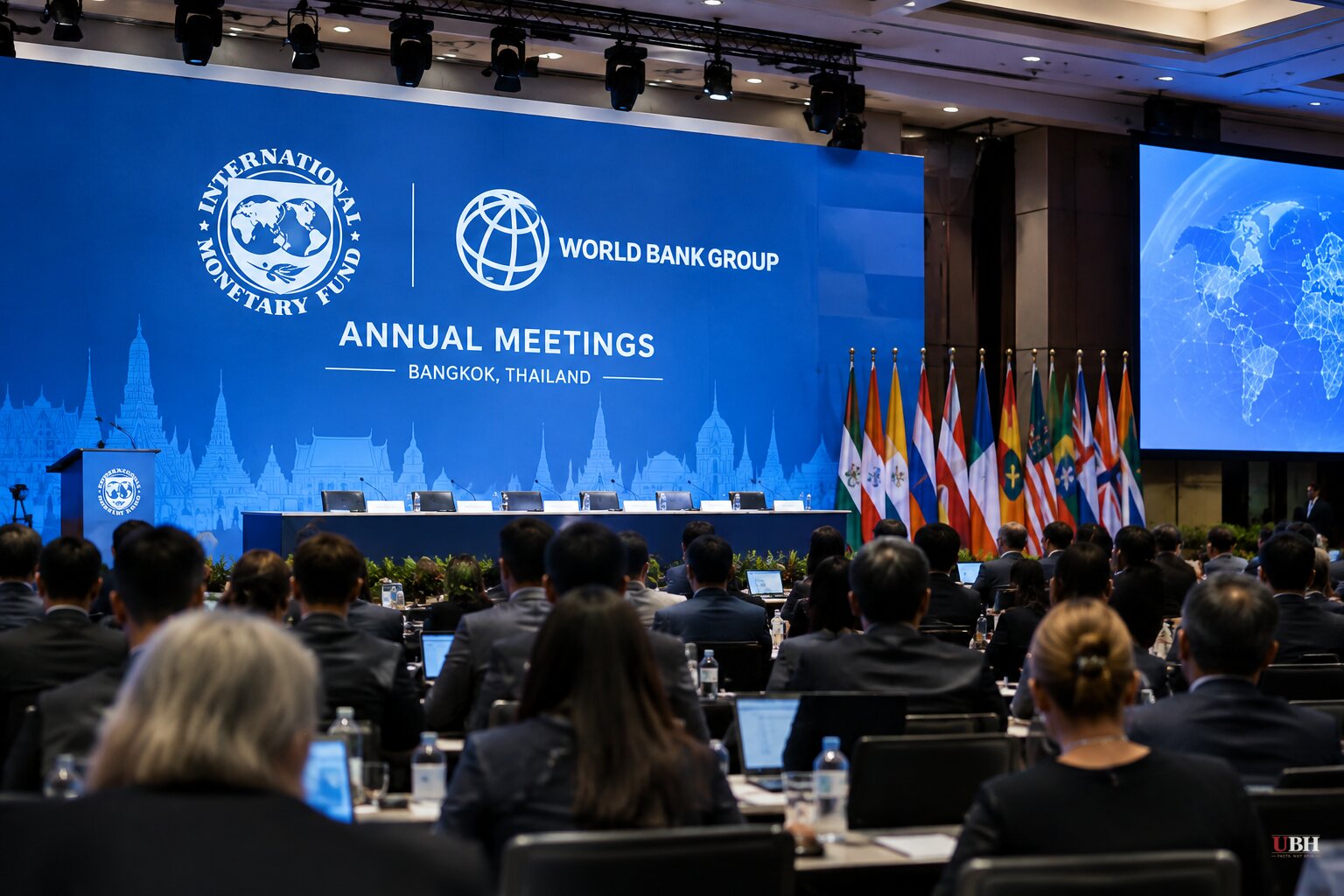
The world's finance chiefs spent the week of Oct. 12 in Bangkok, and the worry list looked different from past years. Debt in the wealthy world, an AI-concentrated economy and cyber threats led it. China, a fixture of these discussions for years, was no longer at the top.
The meetings were the first in Asia since Bali in 2018. Thailand last hosted in 1991.
The IMF's numbers
The IMF projects global growth of 3.1% this year and 3.4% in 2027, with inflation around 4.7% before it eases. Asia-Pacific is carrying much of the load. The Fund pegs India at 7%, China at about 4.5% and host nation Thailand at 2.1%.
IMF Economic Counsellor Silvana Tenreyro said the global economy has held its ground but that resilience is under strain, with risks tilted to the downside. The Fund pointed to depleted energy inventories, growth leaning on a concentrated AI supply chain, and high public debt colliding with steep borrowing costs.
Its Global Financial Stability Report named three triggers that could sour markets quickly: a sudden correction in AI valuations, a spike in government bond yields, and cyberattacks on critical technology providers.
Its advice to governments was to tighten fiscal belts and keep support temporary and targeted.
The rich world is the problem
The IMF is usually called in when poor countries drown in debt. This year the pressure sits in the richest ones. Bloomberg reported that borrowing costs in America, Europe and Japan have climbed to multi-decade highs, with the Iran war pushing up inflation and oil near $100 a barrel. Higher rates make historically large debts costlier to service, which pushes governments to borrow more.
IMF Managing Director Kristalina Georgieva called advanced economies the "worst offenders" on debt. "We should prepare for people being more unhappy," she said last month. "Maybe on the street."
U.S. federal debt now exceeds $40 trillion. Georgieva said strong growth alone will not put the country on a sustainable path.
The Treasury did not take it quietly. David Zervos, a counselor to Treasury Secretary Scott Bessent, dismissed the warning. "It's good to remember how messy their forecasts have been in the past," he said. "So take it all with a grain of salt."
The debt figure is not in dispute. The argument is over what the IMF's forecasts are worth and whether growth can outrun the interest bill.
China's central bank governor, Pan Gongsheng, told the International Monetary and Financial Committee on Saturday that Beijing backs stronger Fund monitoring of spillovers from "major advanced economies' fiscal risks." He said deficit countries should fix their own deficits, while surplus countries should boost consumption and investment.
Little coordination on display
CNBC reported that Chinese and U.S. finance officials were seated at a distance from each other at Thursday's G20 finance ministers and central bank governors meeting, according to a seating layout it saw.
Russia was back in the room. Finance Minister Anton Siluanov attended the G20 session on the margins of the IMF gathering in person, for the second time this year after an August G20 session in Asheville. Ukraine returned as a central focus as tensions flared.
Kevin Gallagher, director of Boston University's Global Development Policy Center, said he is watching whether the IMF, the Federal Reserve and the People's Bank of China can coordinate or end up pulling in different directions and "make things worse."
The Nation Thailand's account of the sessions describes a consensus among leaders to reject protectionism and self-sufficiency in favor of open trade and diversification.
AI and cyber risk
Georgieva used a recent hack to make her case. Supermarket chains across France had to discard spoiled food after attackers reached their refrigeration controls and pushed temperatures to 50°C. She warned that AI is "putting the potential of digital fraud on steroids" and that cybercrime could erode trust in the financial system itself. Recalling her childhood in communist Bulgaria, she said she worries about "lots of people with shoeboxes under their beds."
JPMorgan CEO Jamie Dimon raised a related problem this week: bank customers handing their finances to AI agents. JPMorgan, he said, will not allow digital agents to operate on its customers' behalf. "You don't want rogue agents, and there could be thousands of them," he said.
The most concrete result came from the G7. Finance ministers and central bank governors signed off at ministerial level on tabletop exercises simulating AI-driven cyberattacks on the financial sector, Japanese Finance Minister Satsuki Katayama said. A Japanese finance ministry official who attended said the G7 authorities will develop the scenarios. Depending on the scenario, private banks and other institutions may be pulled in to test recovery from start to finish.
The stated aim is to test existing safety protocols, update response manuals and close gaps in cross-border cybersecurity. The G7 has not announced a date for the first exercise.
Geopolitics moves to the center
The Atlantic Council's closing assessment on Oct. 16 said the mood of the ministers had changed. For three years, its speaker said, he had urged the IMF and World Bank membership to "wake up to the era of geoeconomics." This time, ministers asked him to put the tough questions to them, including about Saudi Arabia and the Iran war.
France's finance minister, Roland Lescure, spoke at the Council about bond market pressure and upcoming elections. India's finance minister, Nirmala Sitharaman, spoke about her country's approach to trade.
The week produced warnings and one agreement on simulated attacks. It produced no joint plan on debt, and the U.S. Treasury has publicly dismissed the IMF's fiscal assessment.
Sources used for this briefing
7 links from 7 independent newsrooms (syndicated copies of the same report count once)
These are the sources it draws on, linked so you can verify.


