
Unbiased headlines. Facts, not spin.
Unbiased Headlines is an independently owned news organization. We bring you the facts, not opinions, written fresh from 110+ named sources. Sources linked so you can verify it yourself.
 economy
Major Story (8/10)
Event date: October 17, 2026 ·
Global Food Prices Up 5.8% in a Year as UN Agencies and S&P Warn Hormuz Energy Shock Is Reaching Farms
The Iran war began on Feb. 28. Eight months in, its effects are moving from the gas pump to the grocery shelf, and two UN bodies and a major analytics firm are now saying so in public.
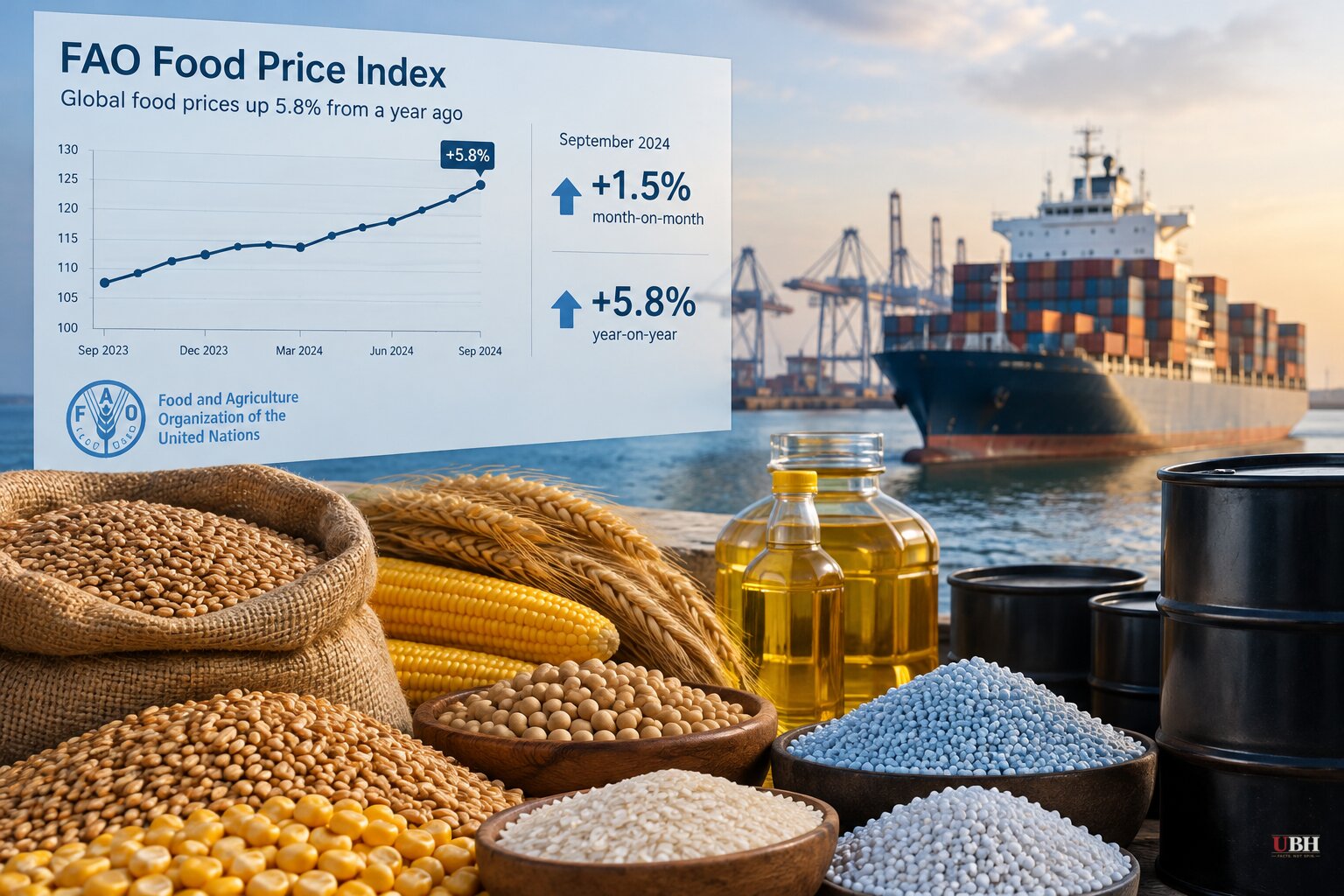
The UN Food and Agriculture Organization said on Oct. 2 that its Food Price Index averaged 136 points in September. That is up 1.5% from August and 5.8% above a year earlier.
Cereals drove the increase. Wheat rose 6.3% on the month, which the FAO tied to transport constraints around the Black Sea and dry weather in parts of North America ahead of winter wheat planting. Maize climbed 5.6%. Sugar jumped 6.1%, the biggest move among the major groups.
Not everything went up. The FAO's meat index fell 1.1% as pig and poultry prices dropped on ample export supplies.
Fertilizer is the pressure point
A new report from the S&P Global Institute, released Oct. 19, argues the damage runs through fertilizer and fuel. Its authors are Daniel Yergin, Shankari Srinivasan, Allan Pickett and Simon Blakey.
About 20% of global oil supply and 20% of global LNG trade moved through the Strait of Hormuz before the war. The report says the Gulf's role in fertilizer gets less attention. Roughly 29% of global urea trade, nearly half of global sulfur trade and about 21% of merchant ammonia trade normally pass through the strait.
The damage also reaches countries far from the Gulf. Fertilizer plants elsewhere burn natural gas as both feedstock and fuel, so restricted oil and LNG flows raise production costs well beyond the region.
South Asia is especially exposed, according to the authors. Gulf producers are an important source of imported urea for India, and LNG supports around 85% of its domestic urea output.
"The world's food producers rely on a steady supply of natural gas and sulfur for fertilizer, diesel for machinery and transport, and open sea-lanes for trade," the authors write. "Conflict is now testing all of them at once, just as El Niño tests the harvest."
The report also points to biofuel-linked demand as a reinforcing factor.
The UN fund's warning
The International Fund for Agricultural Development said global agricultural prices jumped 13% in the third quarter. IFAD President Alvaro Lario told AFP that a "global food crisis is looming."
"Over the next six to nine months, we will see continued increases related to food prices," Lario said, adding that the burden will land hardest on people who can least afford it. He said almost one in three people worldwide already cannot afford a healthy diet. UN figures put food insecurity at around 260 million people.
Smallholder farmers produce about one-third of the world's food, and up to 70% in many developing countries. IFAD says they are the most exposed to the energy shock, particularly to fertilizer costs.
Lario was blunt about the limits of policy. "In the very short term, there is very little that governments can do," he said. They can subsidize fertilizer or fuel, but that is the extent of it.
G7 nations pledged on Oct. 15 to mobilize $2.5 billion for countries at risk of food insecurity, with a focus on fertilizer. That is taxpayer money, and the G7 has not said how it will be spent or how results will be measured.
Oil, and a war with no end date
Brent crude averaged roughly $65 to $70 on Feb. 27, according to the U.S. Energy Information Administration. It surged past $100 once fighting began and briefly touched $120. Prices dipped in July during an interim peace agreement that later collapsed, and have stayed above $100 for much of the past quarter, according to The Independent.
Neil Quilliam, an energy specialist at Chatham House, told the paper that oil settling near $100 "should not be mistaken for stability." He pointed to Saudi energy infrastructure that remains exposed to attack.
The Independent also reported that Trump lifted sanctions on Russia to release diesel exports into global markets, a move it linked to lowering fuel prices before the midterms. The sources do not say whether that has eased diesel costs for farmers.
Not a done deal
The warnings are conditional. The S&P paper is titled "Energy disruption and El Niño: Leading to a global food crisis?" with the question mark intact, and describes "the beginnings of what could be" a crisis.
The FAO's Maximo Torero used similar language. He described a "persistent and increasingly broad-based build-up in global commodity prices" as Hormuz and Black Sea disruptions combine with climate shocks. "If sustained, these pressures will soon pass through to consumer food prices, especially in food- and energy-import-dependent countries," he said.
The Black Sea is a second front. Russia, the world's largest wheat exporter, and Ukraine have intensified attacks on each other's infrastructure in recent months, including grain terminals.
The next test is the FAO's October index, due in early November. It will show whether the September gains were a spike or the start of the sustained rise Torero warned about. Lario's six-to-nine-month forecast puts the squeeze on household budgets into mid-2027.
Sources used for this briefing
7 links from 6 independent newsrooms (syndicated copies of the same report count once)
These are the sources it draws on, linked so you can verify.


