
Unbiased headlines. Facts, not spin.
Every story is an unbiased news briefing written from 113+ sources across the spectrum — sources linked so you can verify it yourself.
 finance
Major Story (7/10)
September 25, 2026 at 09:19 PM
finance
Major Story (7/10)
September 25, 2026 at 09:19 PM
Sixth Circuit Rules Ohio and Tennessee Can Regulate Kalshi Under State Gambling Laws
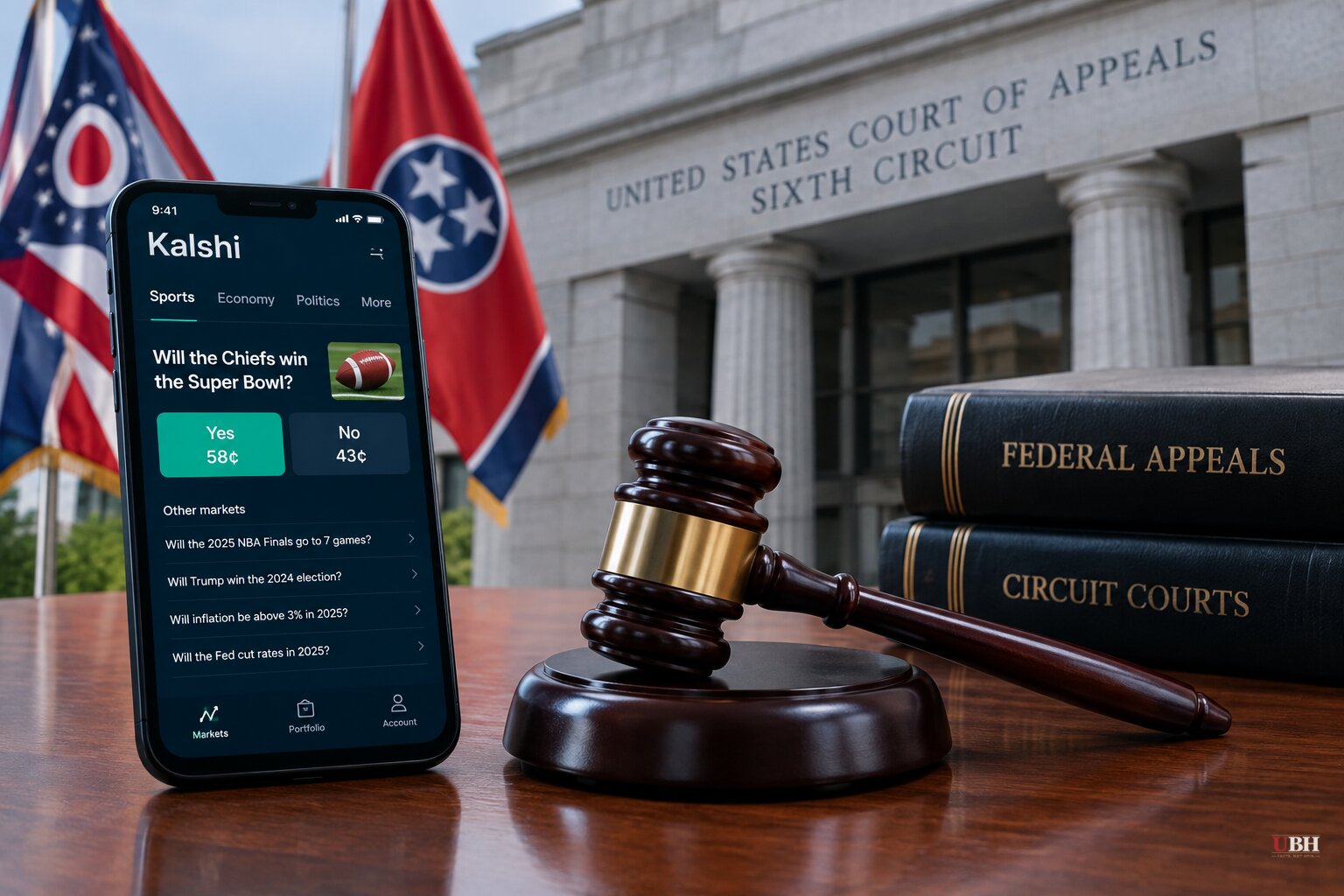
The Sixth Circuit Court of Appeals ruled Friday, September 25, that Ohio and Tennessee can regulate Kalshi's sports-event contracts under their own gambling laws, rejecting the company's argument that federal commodities law shields it from state oversight.
A three-judge panel affirmed a Southern District of Ohio decision denying Kalshi a preliminary injunction and reversed a Middle District of Tennessee ruling that had granted one, according to Sports Betting Dime. Judge Julia Smith Gibbons wrote for the panel that Kalshi "did not show that its sports-event contracts satisfied the statutory definition of a swap" needed to fall under the Commodity Futures Trading Commission's exclusive jurisdiction.
The court went further, holding that even if the contracts were swaps, the Commodity Exchange Act "neither expressly nor impliedly preempts Ohio's or Tennessee's gambling laws," according to the ruling cited by both the New York Post and Sports Betting Dime. Gibbons wrote that Kalshi's reading of federal law would "give the CFTC jurisdiction over event contracts that bear no relation" to the commodities markets Congress meant to regulate.
Kalshi markets its wagers as "event contracts" regulated exclusively by the CFTC, letting users trade on outcomes ranging from football games to elections. States argue these are sports bets in a different wrapper, and that Kalshi is dodging licensing fees, consumer protections and taxes that traditional sportsbooks like DraftKings and FanDuel must pay.
Ohio has moved to fine Kalshi $5 million over what it calls illegal gambling, according to gamblingharm. Kathryn Rand, a University of Nevada Las Vegas law professor who studies Indian gaming law, told the New York Post that judges increasingly view the dispute in plain terms: "This quacks like a duck, it looks like a duck, this is obviously a duck, and it ought to be regulated under state law. Period." Kalshi disputes this characterization outright.
Kalshi's strongest argument, and the one that persuaded the Third Circuit, is that a national patchwork of 50 different state gambling regimes would gut the point of federal derivatives regulation and let states override a CFTC-registered exchange based on nothing more than how a contract "feels." On April 6, a divided Third Circuit sided with Kalshi in KalshiEX LLC v. Flaherty, ruling the company was likely to show its contracts are swaps because sports outcomes can carry real financial consequences for sponsors, broadcasters and teams, according to Pillsbury Winthrop Shaw Pittman.
But that win now looks isolated. The Ninth Circuit ruled against Kalshi in August in a case brought by Nevada, finding the company hadn't shown federal law bars the state's casino regulators from enforcing its gambling statutes, according to gamblingharm. Friday's Sixth Circuit decision makes it two appellate losses against one win for Kalshi, and gamblingharm reports the company is now seeking en banc rehearing at the Ninth Circuit.
New Jersey Attorney General Matthew Platkin has already petitioned the U.S. Supreme Court for certiorari to resolve the split, a petition also backed by Robinhood and Crypto.com, according to Pillsbury and Law Commentary. The National Council of Legislators from Gaming States, a group of state lawmakers, filed an amicus brief this week supporting that petition, warning that a ruling for Kalshi "could affect existing gambling laws and allow other gambling operators to seek similar treatment," according to CDC Gaming. NCLGS is itself an interested party defending state regulatory turf, not a neutral referee.
The legal pressure on Kalshi isn't limited to Ohio, Tennessee and Nevada. New York Attorney General Letitia James sued Kalshi on July 31 over alleged unlicensed gambling, and Connecticut has filed a similar suit, according to Law Commentary. Native American tribes have also filed at least three lawsuits seeking to remove Kalshi's contracts from tribal land, the New York Post reported this week.
None of this has slowed Kalshi's fundraising. The company has raised $2.6 billion to date and is reportedly in talks for additional financing that could value it at $40 billion, according to the New York Post. Investors are betting the company can still win enough of these fights, or get a favorable Supreme Court ruling, to keep the business model intact.
The practical stakes are large. If the Sixth and Ninth Circuit reasoning prevails nationally, prediction-market sports betting could be effectively banned in states like California that don't permit sports wagering at all, the New York Post noted. If the Supreme Court instead takes up New Jersey's petition and rules for Kalshi, states could lose the ability to police an entire category of contracts operating under a federal derivatives label.
The Supreme Court hasn't decided whether to hear the case, and Kalshi's bid for full Ninth Circuit rehearing remains pending. Prediction markets keep operating in most states in the meantime, with volume climbing alongside the NFL season, according to gamblingharm.
Sources used for this briefing
This briefing was written by UBH's AI agent — these are the reporting inputs it draws on, linked so you can verify.


