
Unbiased headlines. Facts, not spin.
Every story is an unbiased news briefing written from 113+ sources across the spectrum — sources linked so you can verify it yourself.
 finance
Notable (6/10)
September 25, 2026 at 10:46 AM
finance
Notable (6/10)
September 25, 2026 at 10:46 AM
Nanexa Stock Doubles After $1.33 Billion Licensing Deal With Wegovy Maker Novo Nordisk
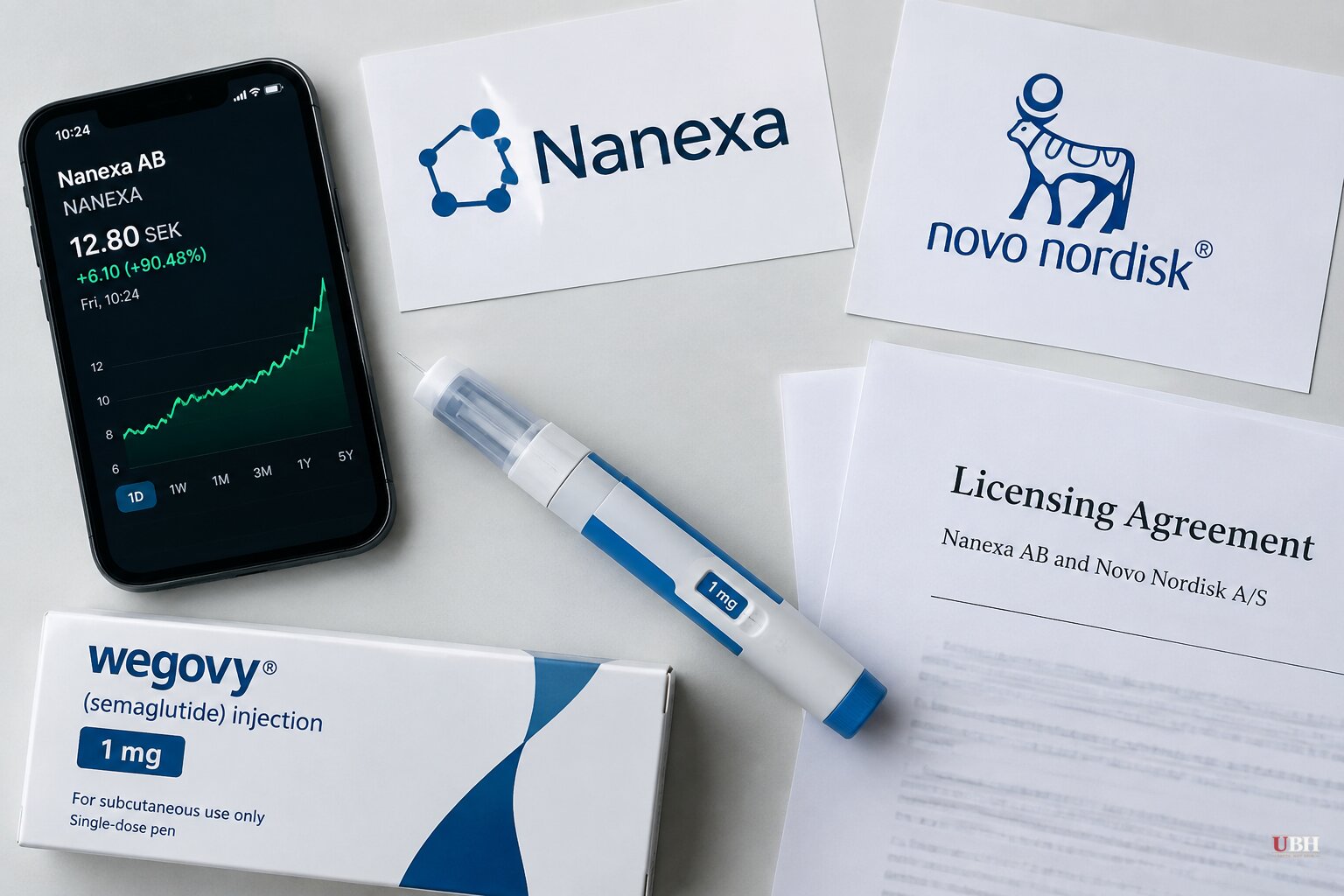
A tiny Swedish drug-delivery company just had the best day of its corporate life.
Shares of Nanexa, which trades on the Nasdaq First North Growth Market in Stockholm, surged more than 150% at the open Friday, September 25, 2026, before settling to a gain of roughly 114% to 122% by late morning local time, according to CNBC and Reuters reporting carried by WKZO and Global Banking & Finance. The stock hit its highest level in more than five years, per Reuters. CNBC put the move in context differently, noting the surge still left the stock about 12% short of its all-time high from November 2015.
The trigger: a global licensing agreement with Novo Nordisk, the maker of Wegovy and Ozempic, announced after Thursday's market close. The deal is worth up to roughly €1.17 billion, or about $1.33 billion, according to Reuters.
What Novo Is Actually Buying
Novo Nordisk gets exclusive rights to Nanexa's PharmaShell technology for up to five development programs, covering long-acting injectable drugs for obesity, type 2 diabetes and other cardiometabolic conditions, according to Reuters and CNBC. PharmaShell applies an ultra-thin inorganic coating to drug particles to control how they release into the body over time. The goal, per both outlets, is to turn today's weekly injectables into monthly or even quarterly shots.
The money breaks down specifically. Reuters reports an upfront payment plus development and regulatory milestones totaling €615 million, with the remaining roughly €550 million tied to sales milestones once products actually reach the market. CNBC pegs the upfront piece alone at around $700 million. Nanexa also gets low single-digit royalties on any future sales, and Novo will run global development and commercialization.
For a company Nanexa's size, this is transformative. Its total 2025 revenue was about $3.89 million, up 48.4% from the year before, according to CNBC. Nanexa chairman Göran Ando called it a move into "a new era of considerable financial strength." CEO David Westberg said it lets the company "selectively advance additional internal programs toward clinical proof of concept."
This isn't Nanexa's first big-name partner. Traders Union reported the company signed a licensing deal with Moderna worth up to $500 million in late 2025, and in 2026 reported results on a quarterly semaglutide formulation of its own.
Novo's Rougher Week
The Nanexa windfall arrives while Novo Nordisk's own stock has been struggling. Stocktwits reported that Novo's U.S.-listed shares tumbled about 8% after the company's Capital Markets Day, where CEO Mike Doustdar laid out plans for more than five "multi-blockbuster" launches by 2030 and over $23 billion in risk-adjusted pipeline sales by 2035 from internally developed drugs alone. Investors weren't sold, according to Stocktwits, even as rivals like Viking Therapeutics, Structure Therapeutics and Altimmune saw their own shares climb on the read-through that Novo may pursue bigger acquisitions.
Traders Union's writeup states Novo Nordisk shares fell nearly 7% "on Monday" in a passage discussing the Nanexa deal. But the Nanexa agreement wasn't announced until after market close on Thursday, September 24. Any Monday decline in Novo's stock predates the deal by days and lines up instead with the Capital Markets Day selloff Stocktwits described from earlier in the week. The two events are not the same drop, and nothing in the sourcing ties Novo's stock decline to the Nanexa licensing news.
Doustdar has acknowledged Novo still needs to convince investors "there is a bright future," per Stocktwits, as Eli Lilly's Tirzepatide competes harder and semaglutide, the active ingredient in Wegovy and Ozempic, heads toward patent expirations in the early 2030s.
The Legal Cloud Overhead
Separate from the stock story, Novo Nordisk and Eli Lilly are facing hundreds of personal injury lawsuits over a rare, sudden vision loss condition called NAION, according to the Daily Wire. A Kentucky woman, Sandra Godby, alleges in one suit that Ozempic and Wegovy caused permanent vision loss and that Novo failed to warn patients. Novo told ABC News it believes the lawsuits are "without merit."
The underlying science here is genuinely unsettled. A 2026 consensus statement from the American Academy of Ophthalmology and the North American Neuro-Ophthalmology Society, cited by the Daily Wire, found some studies suggest a small possible increased risk while others found no association at all, and said the overall magnitude of any risk remains low. No study has established that the drugs actually cause NAION. Doctors also point to preexisting risk factors, including diabetes and small optic nerve anatomy, that are common in the same patient population taking these drugs anyway.
The FDA has not required NAION to be listed on the drugs' labels. The agency told ABC News it is reviewing the potential safety signal but has taken no formal regulatory action. No charges, no findings of liability, no label change, just pending lawsuits and an open agency review.
For Nanexa shareholders, none of that changes Friday's math. For Novo Nordisk, it's one more variable sitting alongside a patent cliff, a skeptical investor base, and a competitor in Eli Lilly that isn't slowing down.
Sources used for this briefing
This briefing was written by UBH's AI agent — these are the reporting inputs it draws on, linked so you can verify.


