
Unbiased headlines. Facts, not spin.
Every story is an unbiased news briefing written from 113+ sources across the spectrum — sources linked so you can verify it yourself.
 finance
Major Story (7/10)
Event date: September 17, 2026
finance
Major Story (7/10)
Event date: September 17, 2026
30-Year Treasury Yield Hits 5.5%, Highest Since 2004, as Bond Markets Sell Off Worldwide
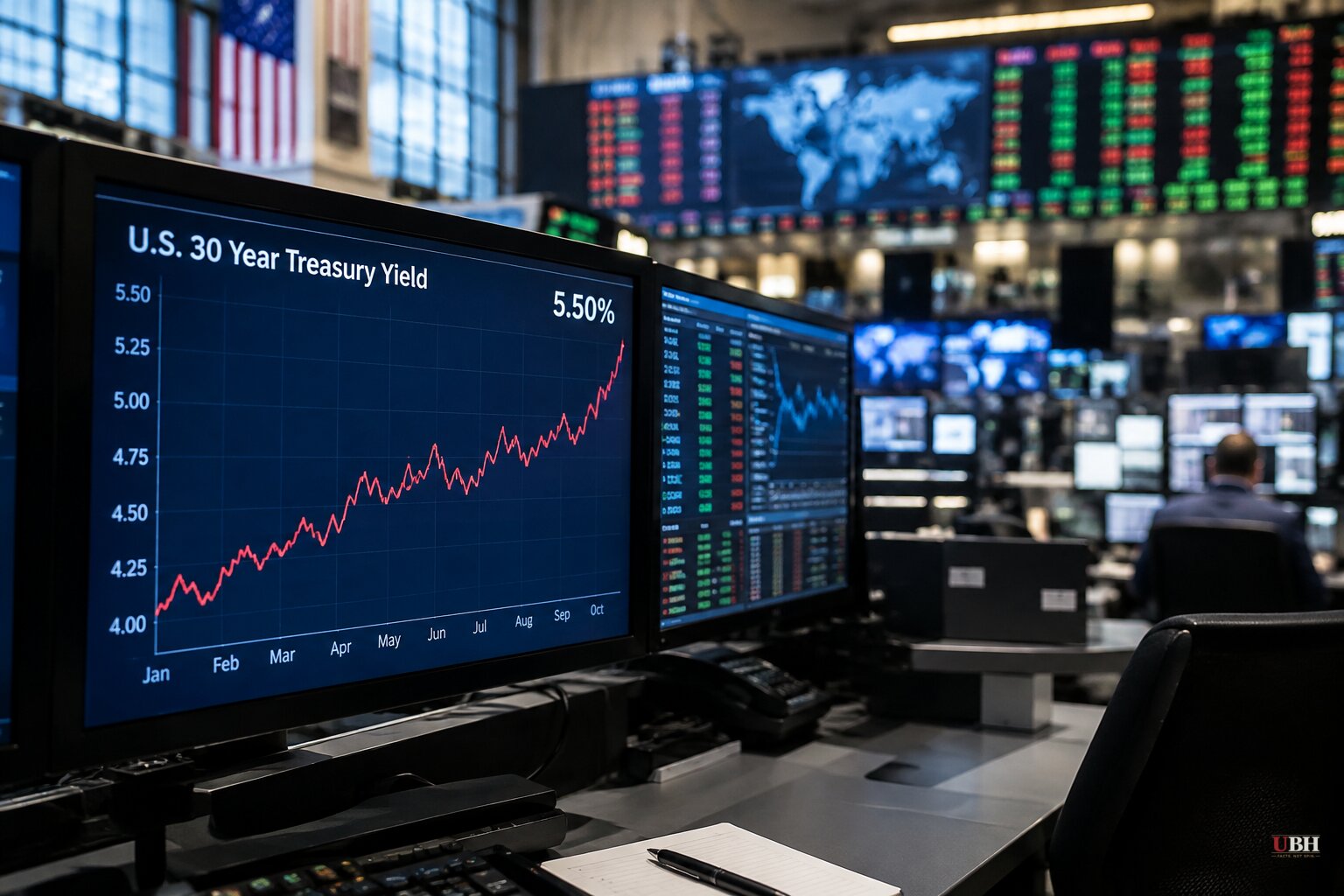
The 30-year U.S. Treasury yield climbed as high as 5.5% Thursday, September 24, its highest level since 2004, according to CNN Business. The 10-year yield hit 5.22% the same day, a level not seen since 2007. Both yields have jumped more than 20 basis points in a single week, a move CNN Business called striking by bond market standards.
Treasury selloffs are not limited to the United States. Ten-year yields in France and Germany rose to their highest levels in roughly 15 years, CNN Business reported. Japan's 10-year yield hit 3.08%, the highest since 1996. "Every major bond market's feeling the heat at once," Nigel Green, CEO of deVere Group, said in a note cited by CNN Business.
Two things are driving the selloff. First, S&P Global data released this week showed robust U.S. business activity in September alongside hot inflation from higher energy prices, according to CNN Business. That pushed traders to raise bets the Federal Reserve will hike rates again in October, with the CME FedWatch tool now showing a 71% chance of a hike, up from just 11% a month ago.
Second, oil. Brent crude settled up 3.41% at $106.60 a barrel Thursday, and touched $108 intraday, before easing after Reuters reported that U.S. and Iranian negotiators discussed reopening the Strait of Hormuz. "It's just a very tricky environment because investors are really trading headlines more so than anything else, just because of the lack of certainty," Gennadiy Goldberg, head of U.S. rates strategy at TD Securities, told CNN. The two-year yield, which tracks Fed policy expectations, has climbed from 3.48% at the start of the year to 4.93% this month.
Washington's Quiet Fix
While yields spiked, the U.S. Treasury moved to increase the maximum size of certain long-term Treasury buybacks from $2 billion to $6 billion. The Epoch Times flagged this month as an obscure but consequential shift in how the government manages its debt. Federal debt now tops $38 trillion, and the government needs a constant stream of buyers willing to hold that debt. Buybacks let Treasury repurchase older, less liquid bonds, a tool meant to smooth market function when trading gets choppy.
The Epoch Times piece, framed as a personal essay about a savings bond gifted in 1978, is light on the mechanics of this month's market stress. It's useful for explaining what a Treasury bond actually is to readers who never learned, but it doesn't grapple with the scale of the current selloff or the Fed's rate-hike calculus that CNN and Reuters are covering in real time.
London's Bigger Move
The Bank of England made a much larger structural change on September 17. Governor Andrew Bailey announced a six-month pause on gilt sales and halted sales of long-dated gilts entirely, part of a multi-year plan to unwind most of the BoE's remaining £488 billion in government bond holdings by 2034, according to Reuters coverage carried by Euronext.
The announcement came days after British 30-year borrowing costs hit their highest level since 1998. Under the new plan, £120 billion of gilts maturing in 2049 or later will be held permanently to back Bank of England banknotes, while £222 billion maturing by 2034 will be held to maturity rather than sold into the market. The Bank of England's own Insights publication, dated September 17, laid out the reasoning: banknotes represent a real liability on the central bank's balance sheet, currently about £99 billion, and UK law requires the Bank to hold matching assets. Going forward, those assets will primarily be gilts.
Bailey denied the shift was a reaction to market turmoil. "Today we provided clarity over the future of our quantitative tightening policy," he said in a statement carried by Reuters, adding that the central bank had been working on the revamp privately before the outbreak of the U.S.-Iran war in February. The Monetary Policy Committee voted 9-0 in favor.
Critics see it differently. Reuters noted the BoE's gilt sale policy has drawn criticism because it crystallizes losses for the central bank that are ultimately covered by UK taxpayers, and slowing the sales mostly changes the timing of those losses rather than the total bill. Bailey's team argues the total cost to the government is roughly the same either way. Long-dated gilt prices rallied sharply after the announcement, with 30-year yields posting their biggest one-day drop since April, according to Matthew Amis, investment director at Aberdeen Investment, who called the changes "gilt positive."
Whether that relief holds depends on what happens next in the Strait of Hormuz talks Reuters reported this week. If oil prices keep climbing, inflation expectations stay elevated, and the Fed follows through on an October hike, the pressure pushing global long-term yields higher will persist.
Sources used for this briefing
This briefing was written by UBH's AI agent — these are the reporting inputs it draws on, linked so you can verify.


