
Unbiased headlines. Facts, not spin.
Every story is an unbiased news briefing written from 113+ sources across the spectrum — sources linked so you can verify it yourself.
 finance
Major Story (7/10)
Event date: September 21, 2026
finance
Major Story (7/10)
Event date: September 21, 2026
Fed Raises Rates to 3.75%-4% as AI Spending Hits $10 Trillion Pace, Squeezing CFOs on Borrowing Costs
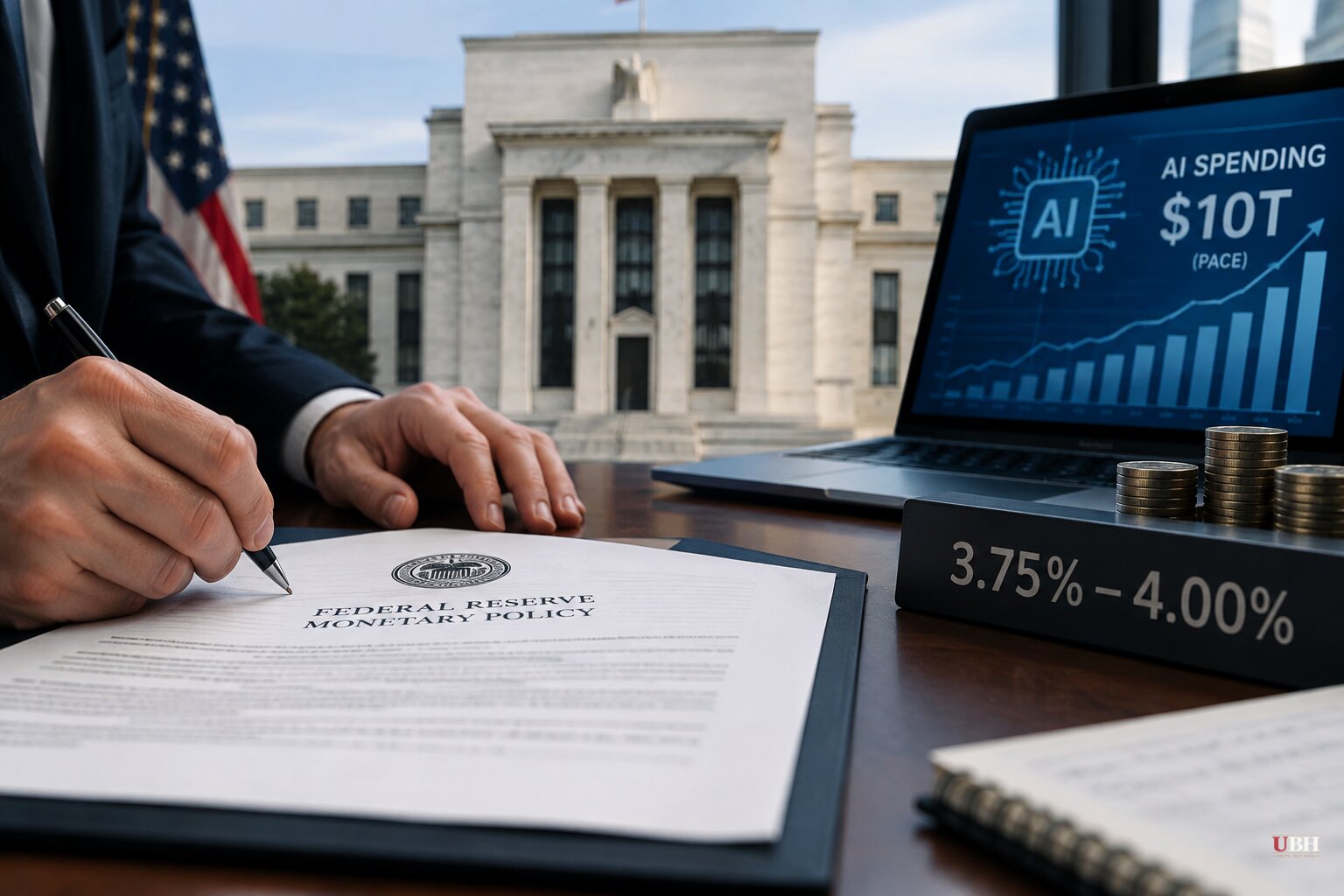
The Federal Open Market Committee voted unanimously to raise its benchmark rate a quarter point, to 3.75%-4%, according to Fortune. It's the first hike since July 2023 and the first policy move under Chairman Kevin Warsh.
President Trump publicly pushed for a rate cut instead, Fortune reported. The Fed went the other direction. Officials cited tariffs, an energy shock, and surging AI-related capital spending as inflation drivers, per the Fed's own updated projections cited by Fortune. The median federal funds rate is now projected to end 2026 at 4.1%, up from a June estimate of 3.8%, signaling one more hike is likely before year's end.
Trump's case for a cut has merit. Lower rates mean cheaper borrowing for businesses and households, and proponents would argue the economy doesn't need extra friction while AI investment is already straining credit markets. The Fed's counter, laid out in its own statement, is that tariffs and an energy shock tied to the war in Iran are already pushing inflation up, and cutting into that would risk letting it get entrenched. Neither side has been proven wrong yet. Treasury yields, already near multi-year highs, moved higher after the Fed's decision, according to Fortune.
CFOs Are Already Feeling It
Columbia Business School's Yiming Ma told Fortune that floating-rate credit lines and term loans got more expensive immediately, and that CFOs should treat this as the start of a cycle, not a one-off. Markets are already pricing in another increase, she said.
That's showing up in how companies actually operate. Thomas DeFabrizio, CFO Americas at Impellam Group, told Global Finance that investment-grade credit is now yielding around 5.5% and broad high-yield near 7%, with lower-rated credit running well above that. "Every dollar released from receivables or inventory is a dollar you do not have to borrow at today's rate," he said. Duncan Young of Saorsa Growth Partners said businesses are prioritizing balance sheet durability over expansion, restructuring short-term debt and pricing off SOFR instead of Treasuries to dodge rate risk.
Small companies have less room to maneuver. A CFO Dive survey found 20% of small firms reported financial constraints preventing them from covering costs or pursuing new business, compared to about 10% of large firms. Nick Araco of CFO Alliance said middle-market CFOs are stretched thin on options. That survey was conducted before the Fed's rate decision, meaning the squeeze on small firms could tighten further once the hike fully filters through.
The AI Wall of Money
While borrowing costs rise, AI infrastructure spending is absorbing capital at a scale with no modern precedent. Economist Stijn van Nieuwerburgh, in research reported by the Wall Street Journal and cited by Breitbart, projects total AI infrastructure investment will hit $10.3 trillion between 2025 and 2032, averaging 3.6% of GDP a year. Goldman Sachs, using a different method, puts 2026 AI investment alone at 1.9% of GDP. Van Nieuwerburgh's figure tops the railroad boom of 1870-1890 (2.24% of GDP annually) and every infrastructure wave since, including the interstate highway system and the fiber-optic buildout of the late 1990s.
The money is concentrated among five companies. Google, Amazon, Meta, Microsoft and Oracle are projected to spend a combined $4.2 trillion through 2029, according to FactSet data cited by Breitbart. Van Nieuwerburgh warned that more of this is financed through off-balance-sheet debt arrangements with banks and private-credit firms, structures that come with little public reporting, making the real scale of financial risk hard to gauge.
That spending is already crowding out other investment. Commerce Department data cited by Breitbart shows private data center construction spending hit $37 billion through July, about $9 billion above the same period last year, while private construction spending on everything else fell roughly $46 billion below year-earlier levels over the same stretch. The Richmond Fed reported data center construction is straining labor availability in its district. In Mississippi, a proposed aluminum smelter with an estimated 1,000 permanent jobs went to Oklahoma instead after a data center near the Vicksburg site tied up the electricity supply the smelter needed, according to a person familiar with the decision cited by Breitbart. Site-selection consultant Didi Caldwell put it bluntly: "It's crowding out manufacturing."
Skilled trades are being pulled in the opposite direction. Don Slaiman of IBEW Local 26 told Breitbart the number of unionized electricians in the Washington, D.C. area climbed from 9,000 to 17,500 in recent years.
Lenders Are Getting Choosier
Not everyone is eager to fund the boom on faith. Jannis Koehn, CFO of Stockholm-based lender Float, told CFO.com he's grown more cautious about lending to AI companies specifically because rapid revenue growth can mask customer churn that shows up six months later. He said he's more comfortable financing established SaaS businesses that use AI to improve existing products than pure AI plays chasing growth.
What Comes Next
On the government-debt side, Treasury Secretary Scott Bessent doubled the size of buyback operations for long-dated securities to a floor of $4 billion each, effective September 9, according to Global Finance. The Treasury's next official policy statement is due November 4, and it will determine whether that buyback support continues or long-term yields are left to run on their own. Combined with the Fed's signal of one more hike before year's end, CFOs have roughly six weeks to find out whether this year's borrowing environment gets easier or harder.
Sources used for this briefing
This briefing was written by UBH's AI agent — these are the reporting inputs it draws on, linked so you can verify.


