
Unbiased headlines. Facts, not spin.
Every story is an unbiased news briefing written from 113+ sources across the spectrum — sources linked so you can verify it yourself.
 finance
Major Story (8/10)
September 25, 2026 at 06:31 AM
finance
Major Story (8/10)
September 25, 2026 at 06:31 AM
10-Year Treasury Yield Hits Highest Since 2007 as Oil Retreats From War Highs, Stocks Sit Near Records
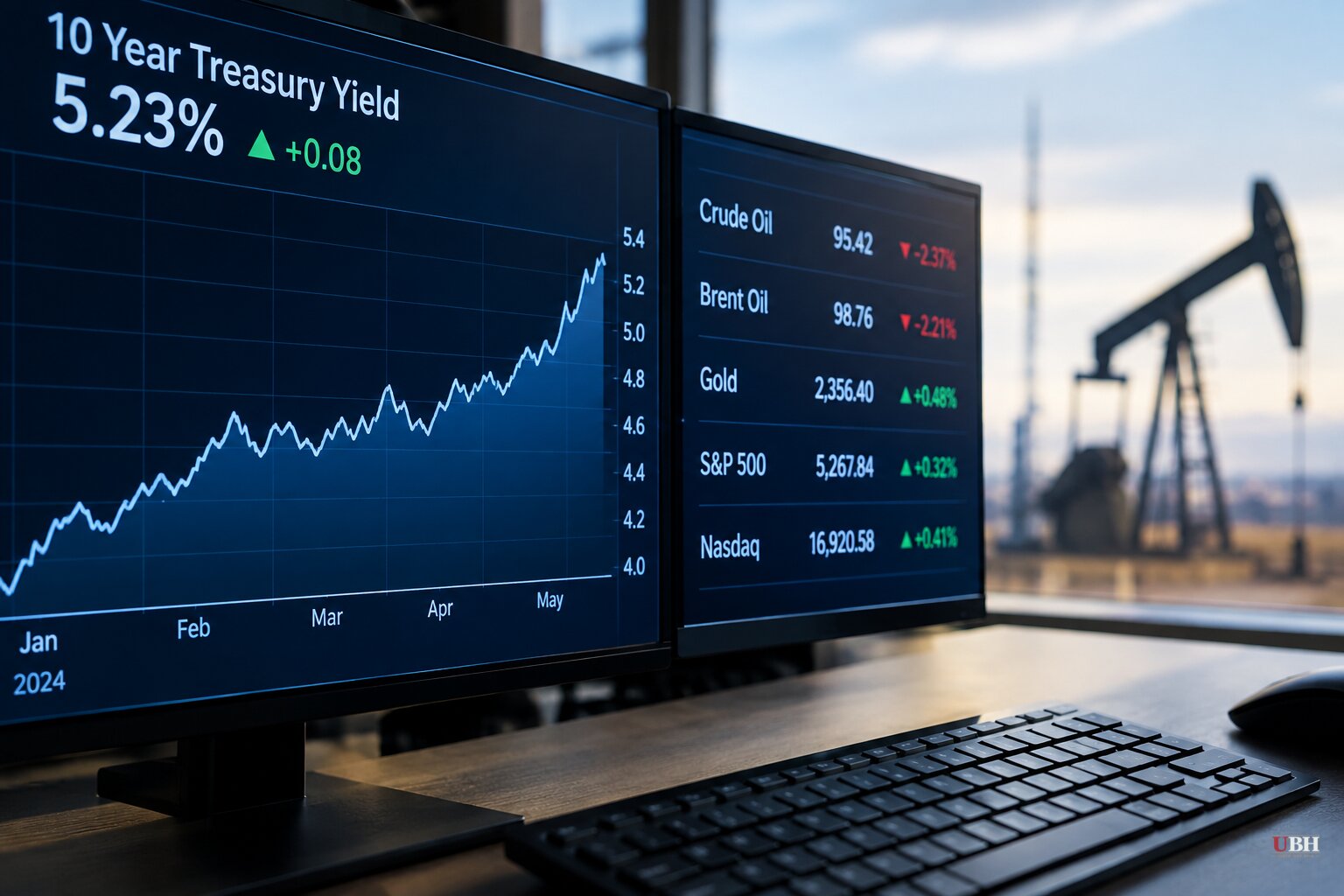
Bonds spike, then catch their breath
The U.S. 10-year Treasury yield climbed above 5.20% on Thursday, September 24, its highest level since 2007, after rising from around 5.11% just a day earlier, according to the Associated Press. By early Friday trading it had eased back slightly to around 5.17% to 5.19%, per figures reported by Bloomberg and the Associated Press. The two-year yield, more sensitive to near-term Fed policy, sat around 4.89% to 4.90%.
The Associated Press attributed the selloff to bond investors demanding higher compensation for two overlapping risks: inflation pressure from an Iran war-driven energy shock, and rising U.S. government debt.
One of those data points: interest-rate swap markets were pricing in roughly three additional quarter-point Federal Reserve rate hikes over the next year, according to FinancialJuice. That's a notably hawkish signal, sitting awkwardly next to Treasury Secretary Scott Bessent's public optimism about the economy.
Oil whiplash tied to the Iran war
Oil has been the story driving all of this. Brent crude fell 1.4% to $98.84 a barrel early Friday, per the Associated Press, still well above the roughly $72 level seen before the war started in February. West Texas Intermediate dropped below $94 a barrel on Tuesday, September 22, down more than 11% over the prior week, according to the Epoch Times.
That pullback followed a sharp run-up. Brent had surged more than 7% over two sessions earlier in the week, and Breitbart's markets coverage separately noted crude jumping to its highest levels since May amid renewed fighting in the Persian Gulf, with Brent crossing above $107 a barrel. The market has been swinging hard in both directions within the same week, driven almost entirely by headlines out of the Gulf.
The latest relief came from reports that U.S. and Iranian negotiators were discussing a phased agreement in which Tehran would reopen the Strait of Hormuz and Washington would lift its blockade on Iranian ports, according to FinancialJuice. Separately, the Epoch Times cited a Reuters report that a senior Iranian official laid out conditions to reopen the Strait within seven days if the U.S. eases military pressure. The Strait handles about 20% of the world's oil and LNG shipments, so any credible move toward reopening it moves prices fast.
The strongest case for caution
Nothing about this is settled. The U.S. carried out strikes on Iranian tankers over the weekend, according to Fox News, and Bessent himself described the strategy as an effort to "asphyxiate" the Iranian regime through blockade and sanctions. A negotiation that depends on both sides easing military pressure simultaneously is fragile, and traders betting on a quick resolution have been burned before this year based on the back-and-forth Brent price swings alone. The underlying conflict hasn't ended, and assuming a clean trajectory downward ignores that reality.
Bessent predicted oil could fall to $40 to $50 a barrel once the conflict ends, telling Fox News host Lara Trump that "there's so much supply coming on" and that the current energy shock is temporary. He called the U.S. an "energy superpower" and pointed to wage growth and a manufacturing renaissance as evidence the underlying economy is strong. That's the administration's case, made on the record, and it's worth weighing against the swaps market's bet on more rate hikes ahead.
Stocks near records despite the noise
Equities have mostly shrugged off the bond turmoil. The S&P 500 closed at 7,780 on September 22, just shy of its August record of 7,798, and is up about 13% for the year, according to the Epoch Times. The Dow Jones Industrial Average cleared 52,000 and is up roughly 8% year-to-date. The Nasdaq Composite blew past 27,000 for a fresh record and sits up 17% on the year.
Thursday's session was quieter: the S&P 500 was almost flat, the Dow fell 0.3%, and the Nasdaq edged up less than 0.1%, per the Associated Press. Gold held around $4,270 an ounce, according to Bloomberg, a level that suggests investors still want a hedge even as stocks grind toward records.
Xi meeting, yen, and what's next
President Trump and Chinese leader Xi Jinping met in Washington this week to discuss trade, artificial intelligence, and the Middle East, but analysts told the Associated Press that concrete progress was limited. Meanwhile Japan's yen strengthened to around 158.34 to 158.40 per dollar after Finance Minister Katayama said Trump raised concerns about yen weakness in his meeting with Prime Minister Takaichi, according to FinancialJuice. Both countries agreed to keep coordinating on currency issues.
The open question is whether the reported phased U.S.-Iran arrangement over Hormuz actually materializes within Bessent's own seven-day framing, or whether this week's oil retreat turns out to be another head-fake in a conflict that's whipsawed markets since February.
Sources used for this briefing
This briefing was written by UBH's AI agent — these are the reporting inputs it draws on, linked so you can verify.


