
Unbiased headlines. Facts, not spin.
Unbiased Headlines is an independently owned news organization. We bring you the facts, not opinions, written fresh from 110+ named sources. Sources linked so you can verify it yourself.
 energy
Major Story (8/10)
Senate Advances Bipartisan Permitting Bill 73–25 Over Opposition From Major Environmental Groups
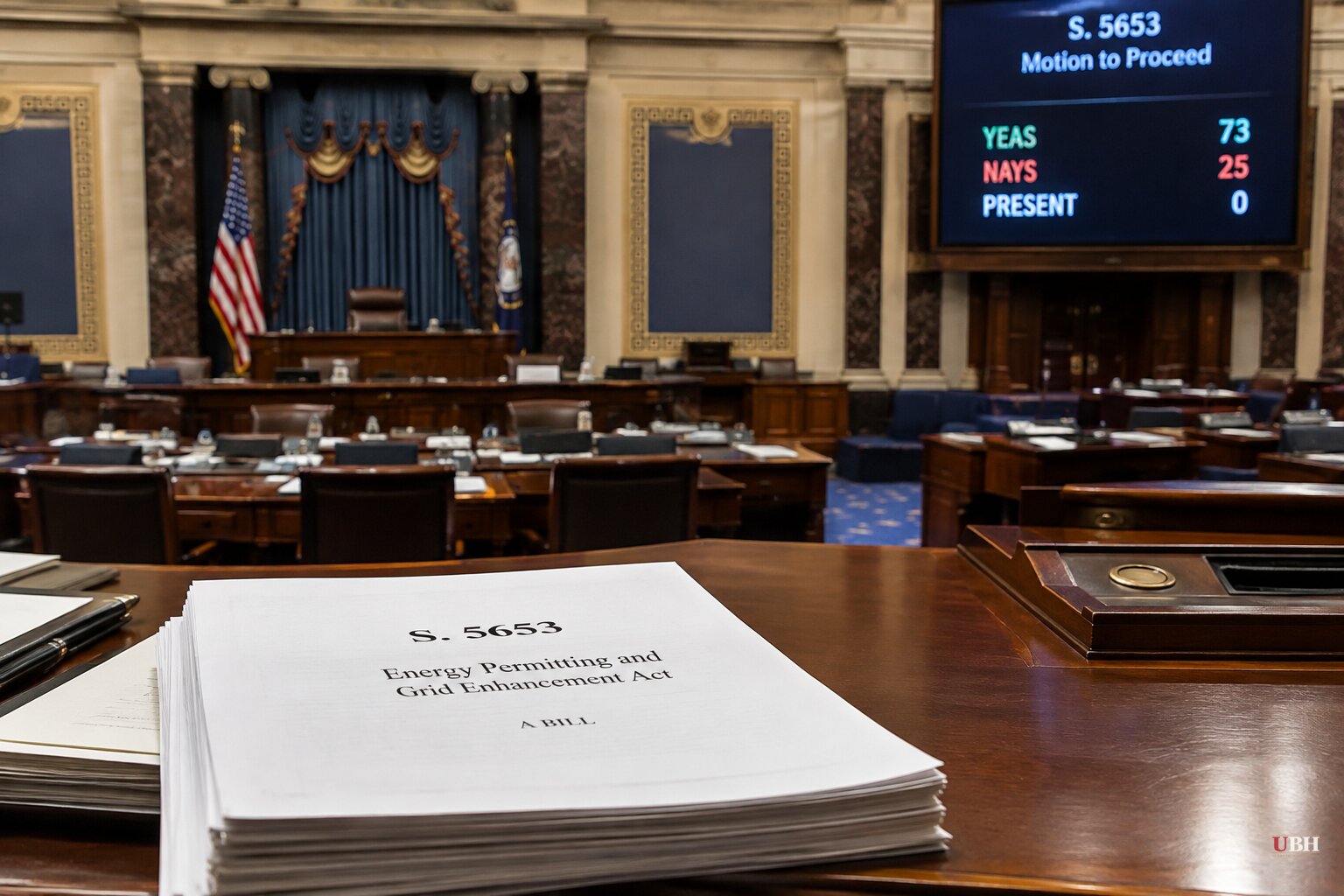
Six days after Democrats won the House and Senate in the midterms, the lame-duck Senate has cleared the first hurdle on its biggest bipartisan item: an energy permitting overhaul that Democratic-aligned environmental groups are fighting hard.
On Monday, Nov. 9, senators voted 73–25 to begin debate on the Bipartisan American Affordability and Jobs Act of 2026, or BAAJA, S. 5653. The threshold was 60. The bill was written by Republican Sens. Mike Lee of Utah and Shelley Moore Capito of West Virginia and Democratic Sens. Martin Heinrich of New Mexico and Sheldon Whitehouse of Rhode Island. Its sponsors want it passed before the current Congress ends in January.
This was a procedural vote, not final passage. The bill still faces debate and further votes.
What the bill does
BAAJA is meant to speed federal permitting for energy projects. That includes pipelines, mines and power plants, which Republicans wanted, and transmission lines and clean energy projects, which Democrats wanted.
It also contains a data center provision. Data centers would have to pay the full cost of grid upgrades their connections trigger. Trump said the bill requires builders of new data centers to pay for their own power and "help invest in their local communities."
Trump urged the Senate on Truth Social to pass what he called a "BIG WIN for U.S. ENERGY INDEPENDENCE and DOMINANCE." He added that "China will take any Data Center that we don't want."
Who is backing it
Consumer Reports CEO Phil Radford said about three in four Americans say rising electric bills have strained their household finances. He said the bill makes home energy upgrades cheaper and keeps consumers from being "on the hook to subsidize the enormous new energy demands of data centers."
Frank Macchiarola of the American Clean Power Association called the vote "a critical step toward modernizing our outdated permitting process." John Szoka, CEO of the Conservative Energy Network, said "Washington needs to get out of the way and make it easier to build." Labor leaders also back the bill, saying it will create thousands of jobs.
Many industry trade groups support it too, even though the data center cost requirement would likely make building more expensive.
The environmental objections
Hundreds of local and national groups, including the Sierra Club and the Natural Resources Defense Council, have signed letters urging Congress not to pass the bill as written.
Holly Bender, the Sierra Club's chief program officer, said the data center industry's need for speed is driving "a historic and alarming investment in gas and fossil fuels." She said the bill makes it easier to build gas pipelines "while making it harder for communities to have a say."
Allie Rosenbluth of Oil Change International said the bill "is a massive giveaway to the data center industry" and "creates a backdoor for fossil fuels to enter the grid through data centers." She argued it contradicts voters who backed candidates opposed to data centers in the midterms.
The data behind the gas concern is stark. Global Energy Monitor figures show U.S. gas projects powering data centers grew from roughly 4 gigawatts in early 2024 to 189 gigawatts in development by mid-2026. Many developers have built their own gas plants rather than wait for a grid connection.
Sen. Jeff Merkley, D-Ore., said he would vote against the bill because it speeds natural gas pipelines and LNG export facilities, weakens environmental protections and limits tools to challenge projects. He praised its transmission and data center provisions, and said he looks forward to working with colleagues "to get permitting reform right."
Public lands and future administrations
The Center for Western Priorities, a Denver-based conservation group, says the bill would give Trump and Interior Secretary Doug Burgum two years to approve data centers on public lands. It also says those approvals would be nearly impossible for a future president to undo, and that taxpayers would have to pay developers if a later administration slowed a whole category of projects.
The Trump administration already favors data centers on federal land. A July 2025 executive order directed the Interior and Energy departments to make federal sites available and streamline their environmental reviews. Burgum said in 2025: "We're going to 'mine, baby, mine' so we can 'build, baby, build' because we've got to build AI data centers."
One recent study found at least 17 active applications tied to data center campuses on public land, covering thousands of acres in Arizona, Idaho, Nevada and other states. Critics say the bill's provisions would limit judges' ability to halt construction over environmental review.
The Democratic split
The fight is a test for Democrats. They won the midterms on affordability, and now have to decide whether a bill that Trump wants, and that cuts into environmental review, is worth the transmission and ratepayer protections it carries.
Whitehouse and Heinrich have argued the benefits outweigh what Republicans demanded in return, and the Senate Democratic Caucus met Saturday, Nov. 7, to discuss managers' amendments aimed at winning votes. Some environmental groups say last-minute changes are not enough.
The next step is Senate floor debate and any amendments. The open question is whether the 73 votes to start debate hold for a final vote before the January adjournment.
Sources used for this briefing
8 links from 7 independent newsrooms (syndicated copies of the same report count once)
These are the sources it draws on, linked so you can verify.


