
Unbiased headlines. Facts, not spin.
Unbiased Headlines is an independently owned news organization. We bring you the facts, not opinions, written fresh from 110+ named sources. Sources linked so you can verify it yourself.
 energy
Major Story (8/10)
Brent Falls to Low $90s as Saudi Output Rebounds, While Aramco Tower and East-West Pipeline Are Hit
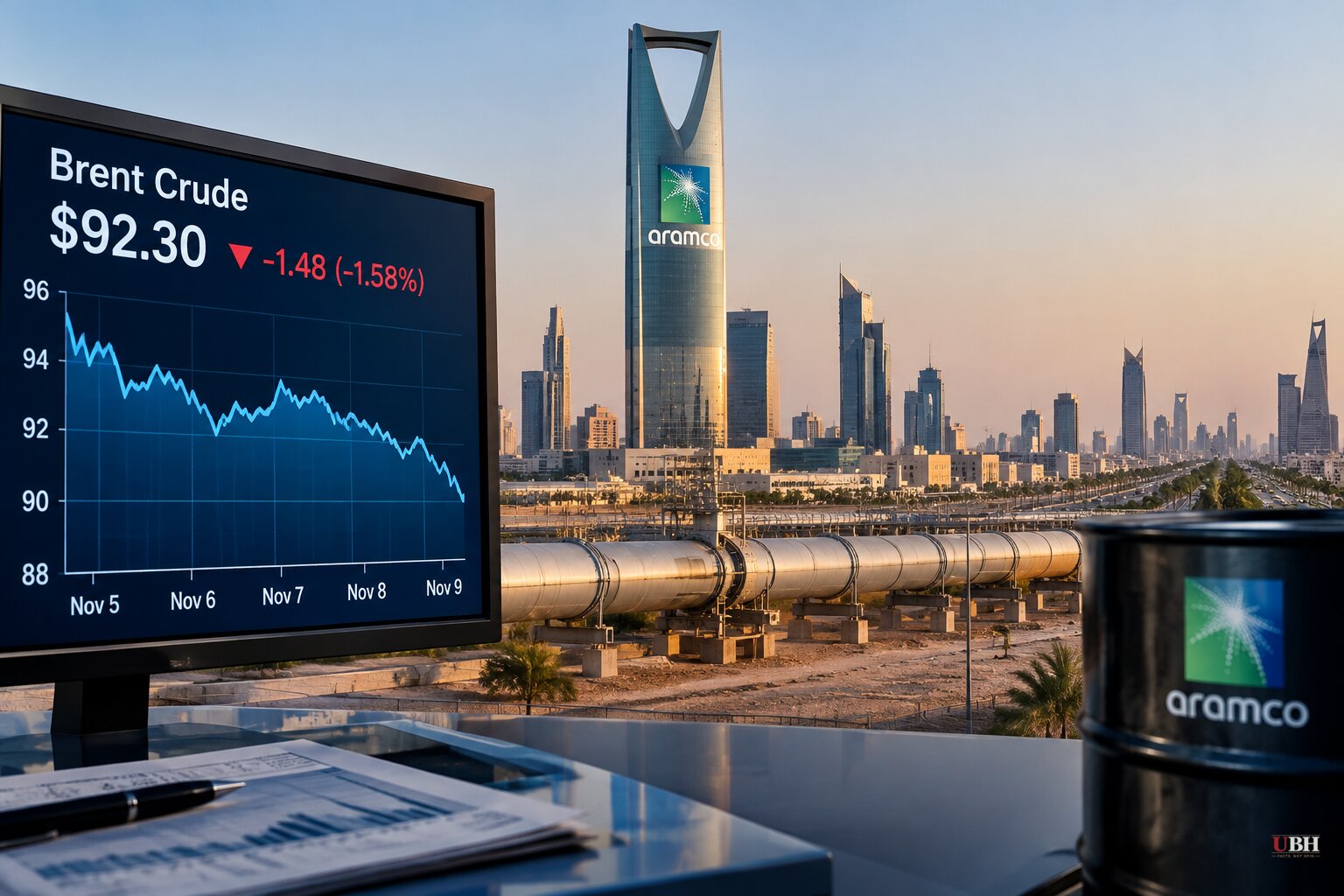
Oil has swung on every strike, ceasefire rumor and tanker fire during the Iran war. On Monday, Nov. 9, crude fell hard while attacks on Saudi energy sites continued.
Prices drop
Afternoon quotes showed Brent futures at $93.54, down 4.86%, with WTI at $87.63, down 3.52%. Another feed had Brent at $91.22, down 7.22%. Earlier in the week, Brent had traded near $98 a barrel, according to a Bloomberg-based report.
U.S. gasoline futures were down about 3.7% at $2.674 a gallon. Natural gas futures rose more than 7% to $3.212.
No source ties Monday's drop to a specific event. Bloomberg's survey points to growing supply and weak demand, and notes Trump flagged potential de-escalation after his party's midterm setback.
Saudi sites hit again
Saudi Arabia's energy ministry said the East-West pipeline in the Madinah region was targeted Monday. It reported a limited fire that emergency crews put out, no injuries or deaths, and no effect on the pipeline's operations.
On Sunday, debris from an attempted attack blew out windows across several floors of Aramco Tower in Riyadh's financial district. The energy ministry said the damage was limited and there were no casualties.
The Houthis claimed responsibility. Spokesman Yahya Saree said the group ran four operations with ballistic missiles, cruise missiles and drones. He listed King Khalid International Airport, Aramco storage tanks, Riyadh's financial district and Aramco facilities in Abqaiq as targets, and said two additional attacks hit Saudi military positions in Yemen. His claims could not be independently verified.
Saree said the strikes answered Saudi airstrikes that killed civilians in Yemen, including at Al-Hadara Market in Al-Wazi'iyah and homes in Bani Hashish. He said the Houthis have counted 4,369 Saudi airstrikes and missile attacks since the latest escalation began.
Saudi coalition spokesman Turki Al-Malki gave a different account. He said air defenses intercepted two cruise missiles aimed at Riyadh and the southern region, a ballistic missile aimed at the Eastern Province and a drone heading for the south. He said coalition forces destroyed a ballistic missile launch platform in Sanaa. The coalition statements gave no further details on damage or casualties.
Fighting between Saudi Arabia and the Iran-backed Houthis has intensified since July, after relative calm following the expiry of a U.N.-brokered truce in October 2022.
Rubio warns of spread
Speaking to reporters in Paris, Rubio said the Houthi-Saudi fighting "could spiral at any moment." He noted that Saudi Arabia has been hit not only from Yemen but also by attacks from Iraq launched by Iranian-backed militias.
"If this spreads or metastasizes to other countries and airports are shut down as an example. Now, we can't get our people out and now they're trapped," Rubio said. He said the State Department runs an internal security assessment whenever threats emerge, and that recommendations go to him for a decision on U.S. personnel and their families overseas.
Rubio also called Iran's IRGC a "deranged group of revolutionaries." His remarks came after French authorities formally accused the IRGC of orchestrating October cyberattacks that disabled commercial refrigerators and freezers at roughly 700 sites across France, mostly supermarkets.
On the war itself, Rubio said Iran has "no navy" and "no air force" and is "deeply degraded," though it "still retain[s] capabilities." He used that assessment to defend War Secretary Pete Hegseth, saying he has done "a very good job."
Supply is coming back
A Bloomberg survey found OPEC crude output rose 930,000 barrels per day in October to 22.8 million, about 88% of what the same members pumped in February.
Saudi Arabia supplied most of the gain. It added 970,000 barrels per day to reach 9.2 million, still about 800,000 below early-year rates. Bloomberg tanker tracking put Saudi exports at 7 million barrels per day, close to pre-war levels. The kingdom has sent more tankers through the Strait of Hormuz and increased loadings from its Red Sea coast. Iraq added 140,000 barrels per day, and Kuwait added 130,000.
Iran went the other way. Its output fell 120,000 barrels per day to 1.9 million, the lowest in Bloomberg's monthly data going back to 1989. Satellite imagery shows no tankers at Iran's main loading hubs, including Kharg Island, since late August, and the U.S. is still enforcing a blockade on the country's ports.
Physical crude prices across the Middle East, North Sea and Africa have slumped as supply grows and demand stays weak.
What to watch
The East-West pipeline carries Saudi crude to the Red Sea, the route that lets Riyadh bypass Hormuz. Aramco said when it reported third-quarter results on Nov. 3 that the pipeline continued to provide export flexibility and that it was exploring additional overseas storage capacity and alternative export routes. Saudi officials say operations were not affected Monday. Whether the Houthis can keep hitting Saudi energy infrastructure, and whether Iran-backed militias in Iraq widen their attacks, is the open question for the oil market.
OPEC and its allies are reviewing what each member can technically pump, with an eye to setting 2027 output targets when ministers meet on Nov. 29.
Turkey's parliament has ratified the Makkah defense pact, which clears the way for military support to Saudi Arabia, according to Arab News. No Turkish deployment has been announced.
Sources used for this briefing
7 links from 5 independent newsrooms (syndicated copies of the same report count once)
These are the sources it draws on, linked so you can verify.


