
Unbiased headlines. Facts, not spin.
Unbiased Headlines is an independently owned news organization. We bring you the facts, not opinions, written fresh from 110+ named sources. Sources linked so you can verify it yourself.
 energy
Major Story (7/10)
Event date: November 5, 2026 ·
China's Crude Imports Down Over 15% Through October as Beijing Burned Through Stockpiles
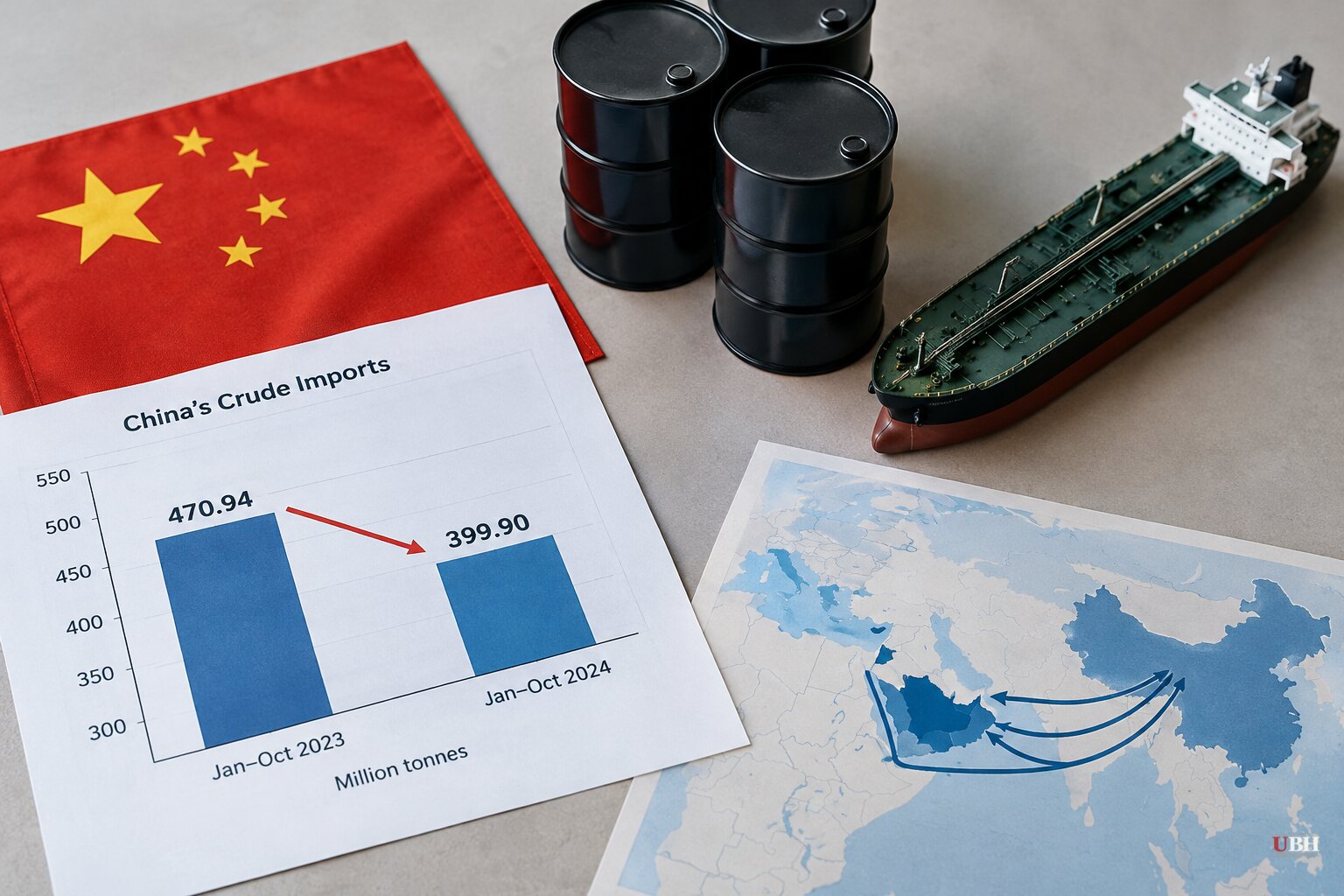
China's crude imports for the first ten months of 2026 totaled 399.90 million tonnes, down from 470.94 million tonnes in the same period last year. The drop in demand from the world's largest crude importer continues a trend seen through September, when imports were down by over 15% year-on-year.
The cut follows the US-Israeli war on Iran, which began in February and disrupted Middle Eastern shipments for months. The pullback is the demand side of the Gulf supply picture, in which exports have been climbing back toward pre-war levels.
How China absorbed the hit
Beijing did it with a stockpile. When the war began, China held an estimated 1.3 billion to 1.4 billion barrels of crude in commercial and strategic inventories. When Brent topped $100 a barrel, Chinese refiners cut purchases and ran down what they had already bought. In June alone, imports ran an estimated 4.4 million barrels a day below the 2025 average.
September shows the mechanics. Refiners processed about 13.99 million barrels a day. Domestic wells supplied 4.43 million and imports 9.03 million. The remaining 530,000 barrels a day, by analyst estimates, came out of storage. It was the fourth month in five that China tapped inventories.
The Centre for Research on Energy and Clean Air, an energy research group, put numbers on the adjustment for March through August. Changes in implied stock balances explained about 47% of the year-on-year fall in net crude imports. Refinery throughput dropped about 9.6%. Lower fuel exports offset roughly 29% of the decline in domestic petrol, diesel and jet fuel output.
The Gulf is coming back
Imports from the Middle East rose 25.7% in September from August, to 13.8 million tonnes, according to Chinese customs data. It was the third straight monthly increase. Xu Muyu, a senior crude analyst at Kpler, said demand for Middle Eastern crude was likely to stay strong amid record drawdowns, and pointed to renewed interest in Saudi cargoes.
The stockpile is not bottomless. Chinese onshore crude stocks stood at about 1.192 billion barrels in the week ending October 19. That is 162 million barrels below the early-May record, but only 13 million below the same week last year. The cushion is mostly intact. It is thinner than it was.
Beijing orders more domestic drilling
China's National Energy Administration has told PetroChina, Sinopec, CNOOC and other domestic producers to expand capacity, raise investment and speed up national oil and gas supply bases. The directive followed an October 21 meeting. It calls for steady growth in crude output and rapid growth in natural gas.
China has pushed for more domestic energy for years. Eight months of disrupted Gulf shipments, higher freight costs and the near disappearance of Iranian crude from the market have added urgency.
A disputed account of Iranian oil
Iran International, a Persian-language outlet, reported a different picture of Iranian barrels. It cites a confidential letter from Hamid Bovard, the former head of the National Iranian Oil Company and current acting oil minister. According to the outlet, the letter describes an arrangement under President Masoud Pezeshkian in which Iran gained port and terminal access in China and long-term leases on large storage facilities there. The aim, the letter says, was to keep sanctioned tankers delivering and sell crude directly into the Chinese market.
Two Iranian Oil Ministry sources told the outlet that Tehran controls terminals at three Chinese locations. One is in the Ningbo-Zhoushan free trade zone. The others are smaller docks at Qingdao and another Shandong port. The letter says tankers owned by Hossein Shamkhani, son of the late Ali Shamkhani, carry the crude. The US Treasury has sanctioned 51 vessels linked to him.
Those claims rest on one leaked document and anonymous ministry sources. They also sit awkwardly beside the account that Iranian crude has effectively vanished from the market. Iran International also notes that Iran has long sold through intermediaries to small independent "teapot" refineries, which shields China's major banks and its three largest oil companies from US sanctions.
What kept China steady
The Centre for Research on Energy and Clean Air argues that inventories were not the whole story. Its analysts say China's electric vehicle fleet displaced an estimated 38 million tonnes of oil equivalent in the six months after the Hormuz disruption, 52% more than in the same period of 2025. They also estimate that non-fossil power growth since 2020 avoided $9.1 billion in fossil fuel import costs, the largest savings of any country. The group says these measures redistributed the shock and did not necessarily remove underlying demand for oil.
The pace of the rebuild remains open. Gulf imports are rising and stocks are down 162 million barrels from their peak, while Beijing is simultaneously ordering more domestic output. How quickly Chinese refiners return to full buying will be visible in the monthly customs releases that follow.
Sources used for this briefing
5 links from 5 independent newsrooms (syndicated copies of the same report count once)
These are the sources it draws on, linked so you can verify.


