
Unbiased headlines. Facts, not spin.
Unbiased Headlines is an independently owned news organization. We bring you the facts, not opinions, written fresh from 110+ named sources. Sources linked so you can verify it yourself.
 energy
Major Story (8/10)
Event date: November 3, 2026 ·
IEA Says EU Gas Storage Entered Winter at 75%, Lowest Since 2013, as Hormuz Closure Cost Hits €127 Billion
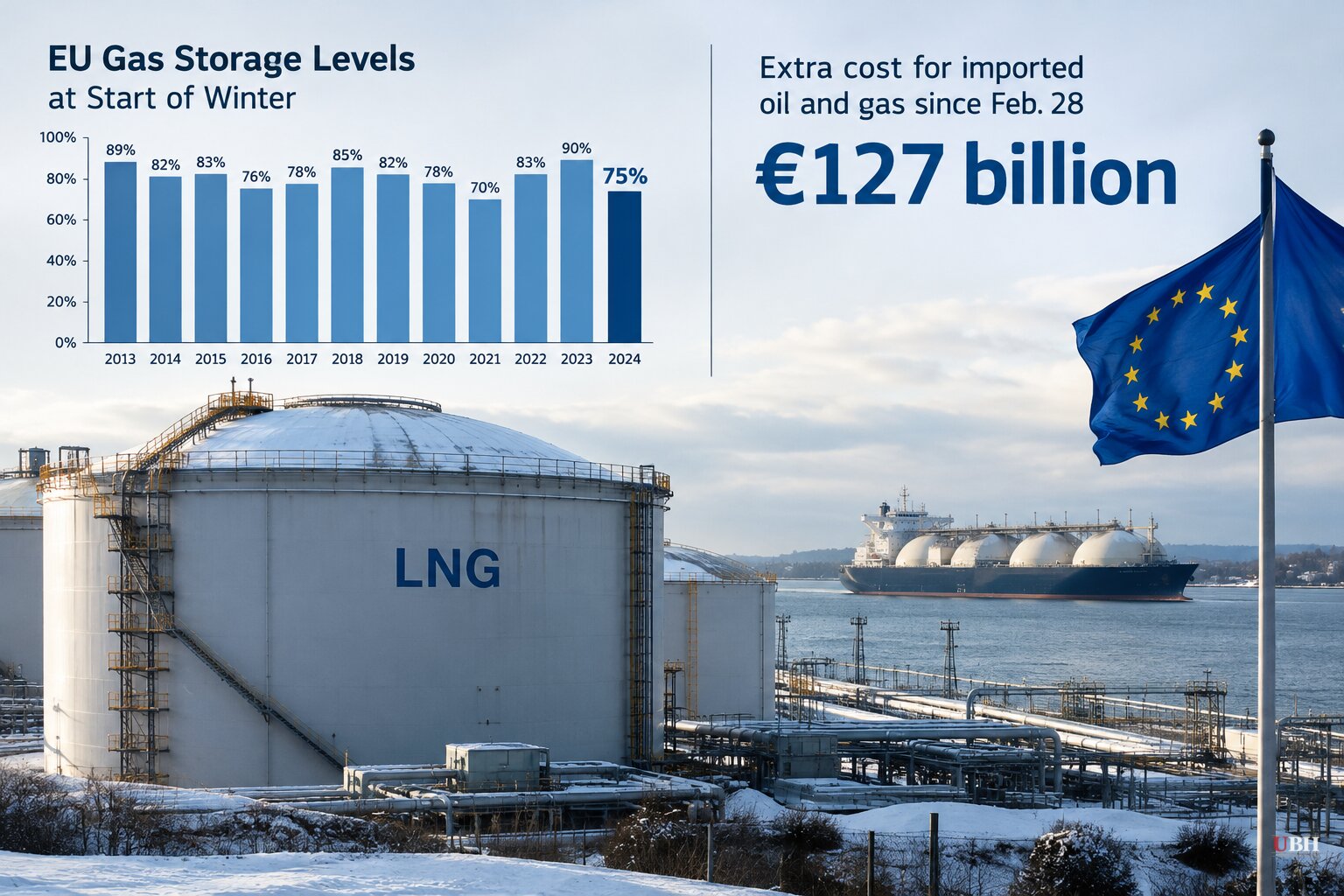
Since the Feb. 28 attacks that started the Iran war and the early-March loss of Qatar's Ras Laffan LNG hub, Europe has gone from a price shock to a storage problem. The numbers released in the past week show how thin the buffer is heading into the heating season.
The bill so far
Von der Leyen put the figure at €127 billion (a little over $142 billion) in a keynote at the WinWin Brussels Summit. "Since the closure of the Strait of Hormuz, imported fossil fuels cost Europe an additional €127 billion without a single molecule of energy in addition," she said.
The tally has climbed fast. The Commission put the extra cost at €24 billion in April, about seven weeks into the war. EU energy commissioner Dan Jørgensen said in late September it had passed €100 billion.
Pump prices followed. By September, drivers in some EU countries were paying nearly 50% more, or more than $11 a gallon. In Italy, a weeklong truckers' strike over diesel prices halted deliveries of milk to mozzarella makers, and Italian inflation hit 5.4%. EU officials expect oil and gas prices to stay above prewar levels until at least the end of 2027.
Storage at its lowest since 2013
The International Energy Agency said Tuesday, Nov. 3, in its Global Gas Security Review 2026 that EU storage stood at only 75% of capacity by the end of October. That is below the bloc's 80% minimum target and the lowest entering winter since 2013.
The agency's warning is conditional. According to The Independent's account of the IEA's quarterly gas report, if Hormuz remains closed and Europe suffers colder-than-average weather, storage could fall below 10% of working capacity by April 2027. Fortune's account of the same IEA warning puts the timing at the end of March. The IEA said the European market would be left "particularly exposed" to cold spells and other supply disruptions because the rate at which storage sites can deliver gas typically falls once reservoirs drop under 30% of capacity.
Germany is in the worst shape among the big players. Its storage sites, the largest in Europe, stood at 61.03% full on Nov. 1, a record low for the start of winter, against an EU average of 74.62%, according to Gas Infrastructure Europe data.
Prices reflect it. Europe's benchmark gas contract closed above €100 on Oct. 28, the first time since the 2022 energy crisis.
Why storage matters so much
Europe burns far more gas in winter than in summer. The EU consumed 17.4 billion cubic meters in July 2025 and 33.8 billion in November 2025. Storage supplies around 30% of the EU's gas consumption during the winter months.
The old flexibility is gone. Groningen in the Netherlands, once the seasonal swing producer, was capped and then closed after earthquakes tied to its output. Russian pipeline gas to the EU has shrunk to a residual flow. On very cold days, German demand could reach 6 TWh per day while import capacity delivers about 3 TWh, so storage has to cover the gap.
Policy under scrutiny
Pouyanné, speaking Nov. 2, said Europe will not face a gas shortage this winter but will pay more to secure supply. He blamed policy as well as the war. "Europe's mistake this year, specifically regarding gas, was unfortunately to have relaxed storage requirements a year too early, which left us entering the winter with lower reserves, thereby increasing the strain," he said.
He also said markets misjudged the conflict. "We assumed people would anticipate gas prices rising more rapidly; instead, the markets acted as if the war would end this summer." His conclusion: "We will pay more than others, it's simple."
The flexibility he criticized exists in EU rules. The regulators' agency ACER said in April that filling sites to 90% would be difficult given tight global supply, and that countries could instead target 80%, a flexibility allowed under EU rules during difficult market conditions.
Baringa analysts Josh Adamson and Harry Langford wrote on Oct. 23 that thin stocks, a shallow LNG pool and back-loaded weather risk mean "price will do the balancing this winter." They traced repeated false dawns in the market: the April 6 reopening proposal, the April 12 negotiations and a memorandum promising a return to full prewar marine traffic within 30 days. None of these resolutions held over the long term, and the market has shifted from pricing a temporary disruption to pricing a sustained one.
The Russian gas question
Europe's refill problem collides with its Russia phase-out. Russia's share of EU gas imports fell from about 45% before the 2022 invasion to about 13% in 2025. Fortune reports that EU members adopted a ban in January ending Russian LNG imports by the end of this year and pipeline gas by autumn 2027; The Independent describes the long-term bans on Russian LNG as arriving in 2027. Even so, the EU brought in a record 12.18 million tonnes of Russian Arctic LNG in the first nine months of 2026, according to an analysis of Kpler data by Urgewald.
The Wall Street Journal reported that U.S. envoys Jared Kushner and Steve Witkoff proposed restoring Russian natural gas sales to Europe via pipelines running through Ukraine, with a U.S. intermediary handling the gas to avoid EU sanctions. They proposed the idea during trips to Moscow and Kyiv earlier this year, as Washington looks to push for an energy truce ahead of the winter. Von der Leyen has called a return to Russian fuel a "strategic blunder."
No deal in sight on Hormuz
The IEA's worst case depends on Hormuz, and diplomacy has not delivered. The U.S. launched fresh attacks on Iran, including one on Qeshm Island, and Iranian supreme leader Mojtaba Khamenei warned in a rare statement that Tehran will wage war with "no geographical restrictions" if the U.S. resumes strikes. Trump has said he will order fresh strikes on Iran following the U.S. midterm elections, according to Reuters.
The open question is the weather. With EU storage at 75% and Germany near 61%, a mild winter likely means higher bills. A colder-than-average one, with Hormuz still shut, is the scenario in which the IEA says storage could drop below 10% of working capacity.
Sources used for this briefing
6 links from 6 independent newsrooms (syndicated copies of the same report count once)
These are the sources it draws on, linked so you can verify.


