
Unbiased headlines. Facts, not spin.
Unbiased Headlines is an independently owned news organization. We bring you the facts, not opinions, written fresh from 110+ named sources. Sources linked so you can verify it yourself.
 economy
Major Story (8/10)
Event date: February 20, 2026 ·
Section 301 Tariff Plan: China Faces 40% If Trade Truce Lapses Jan. 10, While India's 17% Offer Undercuts Asian Rivals
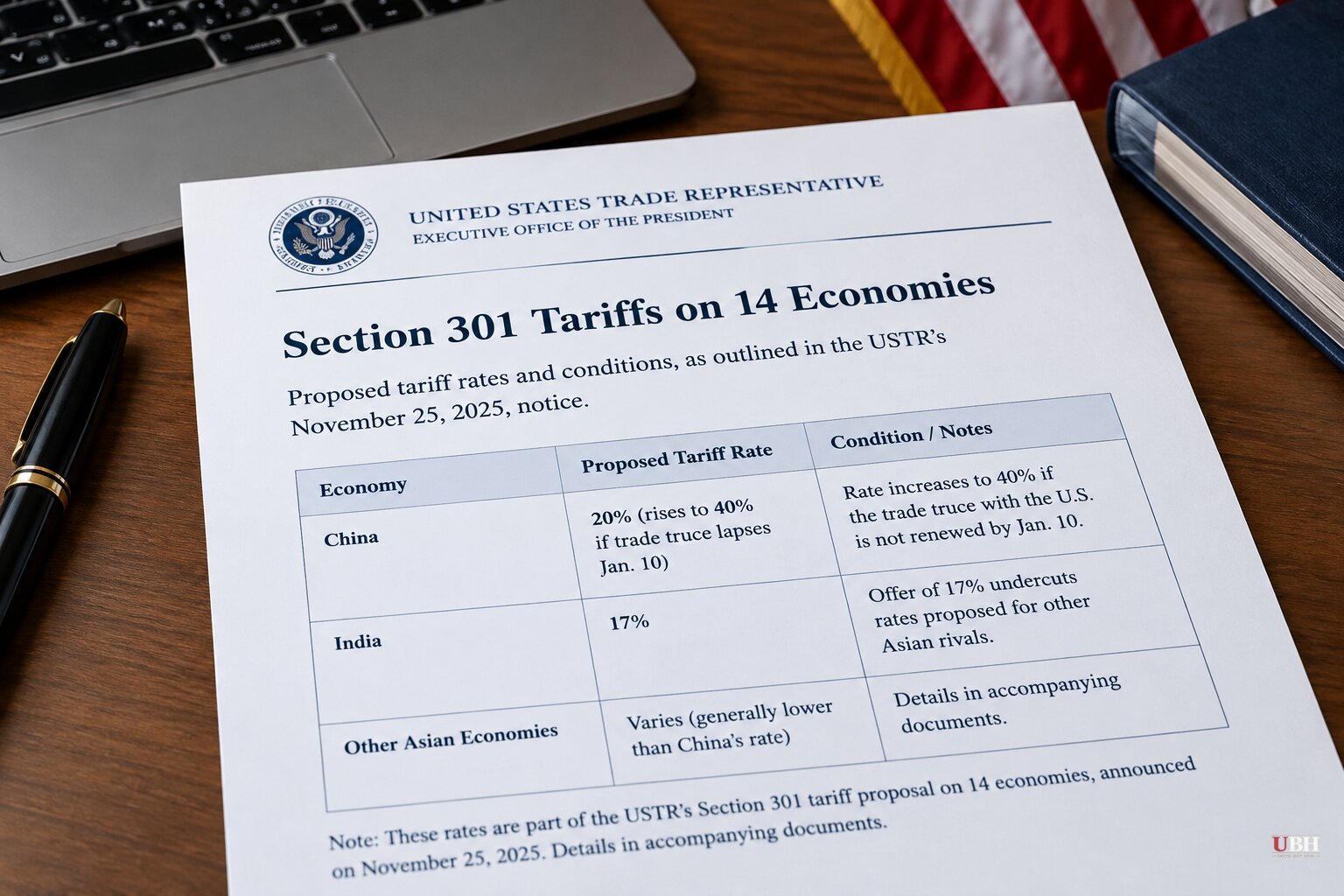
Since U.S. Trade Representative Jamieson Greer proposed Section 301 tariffs on 14 economies over industrial overcapacity on Wednesday, Nov. 25, the fine print has shown how much of the plan depends on deals that are still unsigned or about to expire.
China's rate has a deadline attached
China faces a proposed rate of 20%. Greer said that rate would rise to 40% if Beijing and Washington fail to extend their trade truce, which expires Jan. 10.
China's trade surplus in goods has passed $1 trillion in the first 10 months of this year. Beijing said it reserves the right to take measures against the new tariffs and that the two governments remain in close communication about extending the truce.
Foreign ministry spokesperson Guo Jiakun said at a Nov. 25 briefing that industrial overcapacity "does not really exist and should not be used as a pretext for political manipulation."
A December summit between Xi Jinping and Donald Trump is expected. It would be their fourth meeting this year, and trade is likely to be on the agenda.
India gets a discount if it signs
For India, the USTR proposed up to 25% without a deal and 17% if New Delhi reaches an Agreement on Reciprocal Trade with Washington. Bangladesh, Cambodia and Thailand are proposed at 18%. China and Vietnam are at 20%, subject to their own deals.
Vietnam would face a capped 20% if it reaches an agreement with Washington. If negotiations fail, the rate rises to 35%, the highest in the group.
Atman Trivedi, a partner at DGA Albright Stonebridge Group, told CNBC the U.S. expects the lower rate to push New Delhi to sign before the G20. India now has a "better bargain with Washington than its main competitors," he said, and that may be enough for the government "to declare victory and secure domestic backing for the deal."
Ronak Desai of the Hoover Institution told CNBC the announcement "increases the urgency of reaching an agreement." He cautioned that a 25% threat could stir the sensitivities of the Indian government, which "will be particularly sensitive to any perception that India is conceding under American pressure."
India's commerce ministry said it "does not have structural excess capacity in any sector." It also said it remains committed to "the early conclusion of the India-U.S. Bilateral Trade Agreement."
India's trade surplus with the U.S. rose to $57.3 billion in 2025 from $45.2 billion in 2024, even after U.S. tariffs on Indian goods were raised to 50%. Indian goods currently face a 10% tariff on top of regular customs duties. Steel, aluminium, autos, patented pharmaceuticals and semiconductors already face separate Section 232 duties.
Modi and Trump are likely to meet in December at the G20 leaders' meeting in Florida. Several experts believe the deal could be sealed on the sidelines.
The rest of the rate card
Rates for Cambodia, Indonesia, Malaysia, Thailand and Bangladesh are capped at 18%. For Japan, South Korea, Taiwan, the EU and Switzerland, the cap is 15% including existing most-favored-nation duties. Greer told CNBC the caps match trade agreements reached over the past year that also lowered barriers to U.S. exports.
The administration says the proposed duties account for existing tariffs and deals rather than stacking on top of everything already in place. Energy, critical minerals, fertilizers and some semiconductors and pharmaceuticals would be exempt.
"When it all nets out, it really will just top up a few percentage points," Greer said.
Greer's case is that other countries are building capacity the economics do not justify. "We have a very consumption-driven economy, and we should be producing more of that here in the United States," he told CNBC. He said foreign governments have supported manufacturing through subsidies, state-owned enterprises and other policies that tilt the trade balance.
Determinations on Mexico and Norway have not been made. Greer said talks with Mexico continue over its trade surplus and what he called an excess-capacity challenge there. Last year's U.S. goods deficit with Mexico was $197 billion.
Separately, the U.S. proposed new tariffs on Brazil, including a 10% duty on finished aircraft. Washington says Brasilia has failed to fix what it calls "unreasonable" trade practices.
Legal footing and next steps
The administration is using Section 301 of the Trade Act of 1974 after the Supreme Court ruled in February that the International Emergency Economic Powers Act does not authorize the president to impose tariffs.
The USTR is taking public comment until Jan. 5, 2027, and will hold a hearing on Jan. 25. The China truce expires Jan. 10, which falls between those two dates. Whether Beijing and Washington extend it before the hearing will determine whether the 20% or 40% proposal for China is the one in play.
Sources used for this briefing
7 links from 7 independent newsrooms (syndicated copies of the same report count once)
These are the sources it draws on, linked so you can verify.
More coverage: China


