
Unbiased headlines. Facts, not spin.
Unbiased Headlines is an independently owned news organization. We bring you the facts, not opinions, written fresh from 110+ named sources. Sources linked so you can verify it yourself.
 health
Notable (5/10)
Scientists Document 15 Seabird Colonies and Hundreds of Fish Groups on Two Remote Marshall Islands Atolls
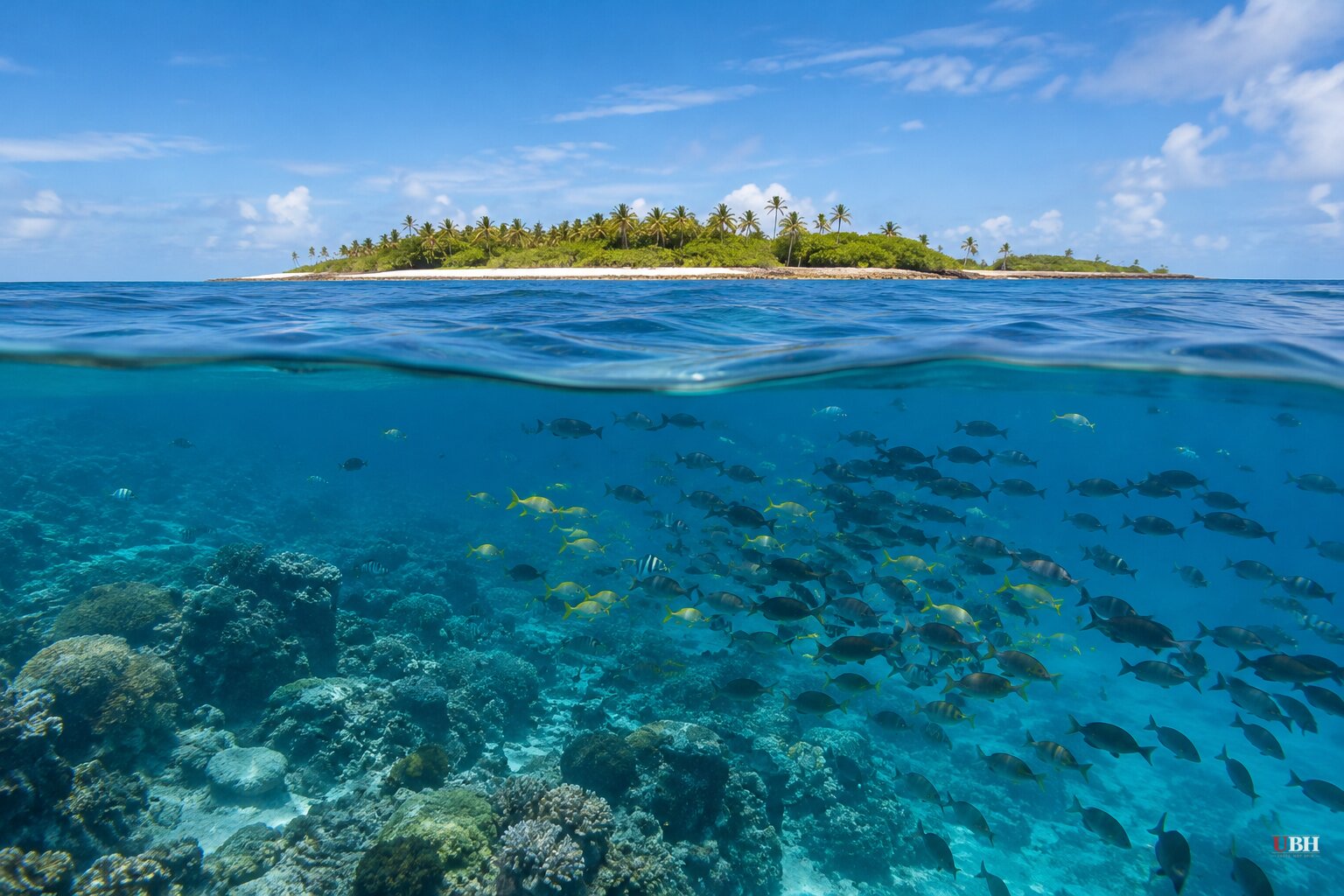
Two Pacific atolls that sit more than 100 kilometres from the nearest settled island now have a documented ecological baseline.
A new study in Frontiers in Marine Science describes Bikar and Bokak, the northernmost atolls in the Marshall Islands, as some of the most intact ecosystems remaining in the region and perhaps the world.
The first author is Dr Alan Friedlander, a marine ecologist at the University of Hawai'i. He served as chief scientist for Pristine Seas, the National Geographic program founded by Enric Sala, on a joint expedition with the Marshall Islands Marine Resource Authority.
What the team surveyed
The team did its fieldwork in 2023. It assessed sea- and shorebird populations, characterized the vegetation, and surveyed turtle nesting, coral reefs and fish.
The tools included scuba, underwater video, deep-sea camera deployments and a submarine.
Bikar lies about 116 kilometres (72 miles) from the nearest inhabited atoll. Bokak lies about 385 kilometres (239 miles) away.
The numbers
Across both atolls, researchers found 15 seabird colonies that were confirmed or likely to be breeding.
They recorded at least 266 groups of reef fish, 138 groups of fish living at greater depths, and 79 groups of deep-sea fishes.
Fifteen groups of open-water predators, including sharks, jacks and wahoo, were logged.
Fourteen of the observed groups had not previously been recorded in the Marshall Islands. Two might be species new to science. Nobody has confirmed that yet.
Friedlander also listed mature native vegetation, active turtle nesting, high reef-fish biomass, coral-dominated reefs at Bokak, structurally complex mesophotic habitats and "surprisingly diverse and poorly known deep-sea communities."
From survey to sanctuary
The survey fed directly into policy. In 2025, about 48,000 square kilometres (18,500 square miles) around the atolls were declared the country's first national marine sanctuary.
Friedlander said the work was meant to inform a highly protected area under Reimaanlok, the Marshall Islands' national, community-led conservation framework. The name means "looking toward the future."
The framework is designed, in Friedlander's words, to protect marine and terrestrial resources "while ensuring island life thrives for generations to come."
Local stewardship came first
The protection did not start with a government decree. The community of Utirik Atoll has looked after these atolls for decades, and high chiefs have set up 'mo,' or taboo, areas where human activity is restricted so nature can recover. That approach has been folded into the national framework.
Friedlander called Bikar and Bokak "a gift from the community of Utirik Atoll, which has traditionally and vigilantly safeguarded these fragile ecosystems for decades."
He also said the Marshall Islands government "should be applauded for their foresight in protecting these global biodiversity hotspots, where human activity is distant and habitats teem with life."
What "untouched" means here
The wording in the headlines runs hotter than the study's own. The Frontiers release says the atolls remain "essentially untouched by humans," yet the researchers' stated claim is narrower. They describe an ecosystem with "only minimal human influence," among the most intact in the region and perhaps the world.
That difference matters because the atolls are valuable as a yardstick. Friedlander said they are "among the best ecological reference systems we have to better understand what we have lost elsewhere and to provide fundamental insights needed for effective conservation and restoration efforts."
His argument is that places with little human impact serve as refuges. "As human activities increasingly threaten biodiversity, areas devoid of intense human impacts serve as vital refugia," he said.
The study's authors describe such sites as living laboratories. Reefs and fish populations elsewhere in the tropical Pacific can be compared against these baselines to show what recovery might realistically look like.
What comes next
The two possible new species are the clearest open item. Whether they hold up as new to science depends on further taxonomic work. The researchers have not said when that work will be finished.
Sources used for this briefing
7 links from 5 independent newsrooms (syndicated copies of the same report count once)
These are the sources it draws on, linked so you can verify.


