
Unbiased headlines. Facts, not spin.
Unbiased Headlines is an independently owned news organization. We bring you the facts, not opinions, written fresh from 110+ named sources. Sources linked so you can verify it yourself.
 health
Notable (6/10)
Lancet Psychiatry Analysis of 115 Trials Finds Lexapro, Cymbalta and Valdoxan Outperformed Prozac Over the Long Term
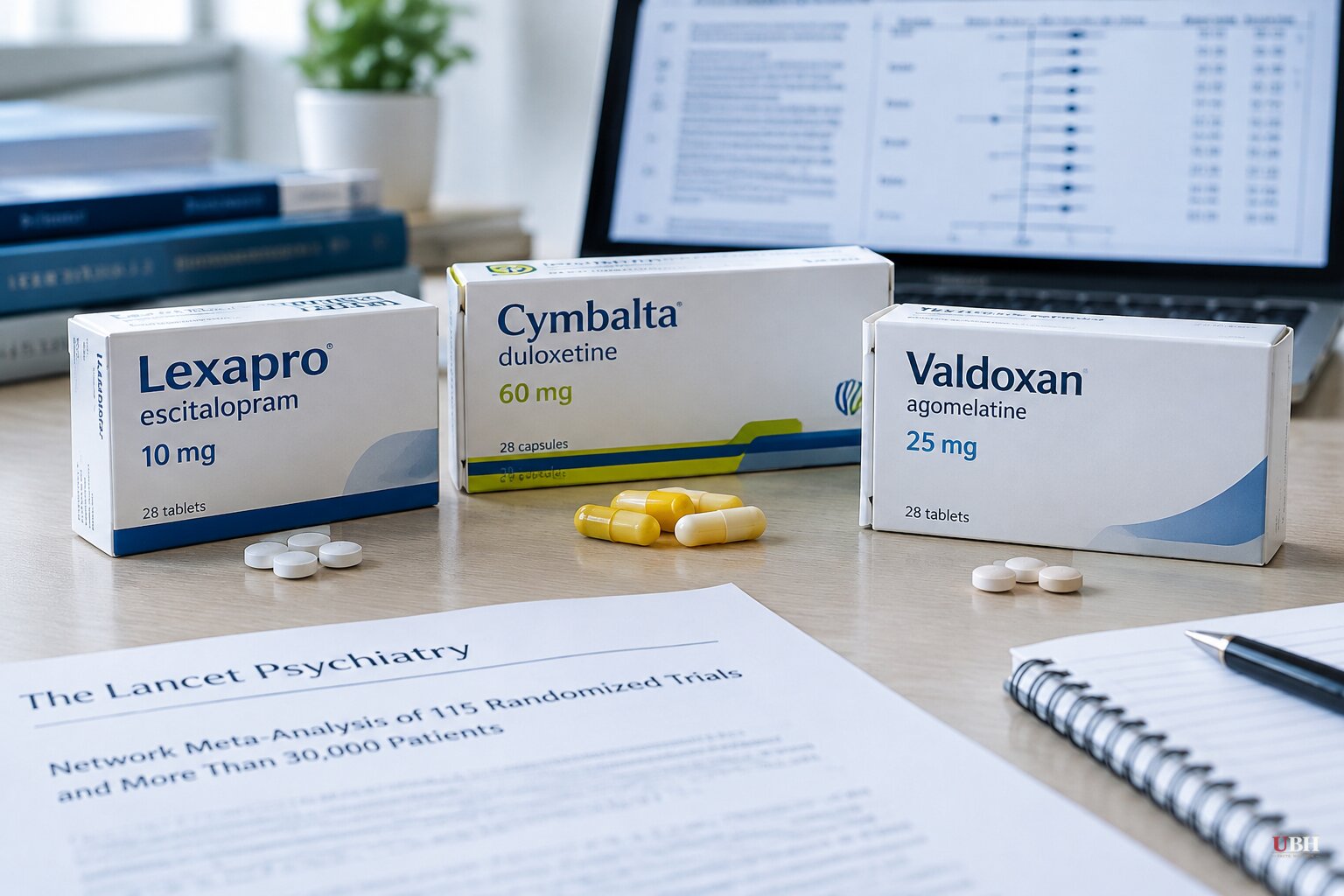
Most antidepressant research measures what happens in the first six to eight weeks. A study published Nov. 10 in The Lancet Psychiatry looked at what happens after that.
Researchers led from Radboud University Medical Center in the Netherlands pooled 115 randomized controlled trials covering more than 30,000 adults with major depressive disorder. It is the largest analysis focused on long-term maintenance treatment rather than short-term efficacy.
What the study found
The team compared 20 antidepressants against fluoxetine, sold as Prozac. Success was defined as sustained response: still meeting the threshold for treatment response at six months or longer. Stopping the drug for any reason, including side effects, was a secondary measure of how acceptable each drug was to patients.
Three drugs beat fluoxetine on sustained response: escitalopram (Lexapro, also sold as Cipralex), duloxetine (Cymbalta) and agomelatine (Valdoxan). Patients on escitalopram or duloxetine were also less likely to drop out of the trials than patients on fluoxetine.
Escitalopram came out strongest among drugs with substantial supporting evidence. Patients taking it had 62 percent higher odds of recovering and staying well than those on Prozac. The analysis also ranked it ahead of sertraline, the most commonly prescribed antidepressant in Britain.
Clomipramine initially looked like the winner, with 117 percent higher odds than Prozac. That result rested on 32 patients in a single trial, too thin to support firm conclusions. At the bottom of the rankings was bupropion (Wellbutrin, Zyban), which performed worst of the 20 drugs. Bupropion and reboxetine also showed lower sustained response rates than four other antidepressants in pairwise comparisons.
How the comparison was built
The main analysis drew on 35 trials that directly compared one antidepressant with another. The rest of the ranking relies on network meta-analysis. That technique links drugs through a web of direct and indirect comparisons, so two drugs can be ranked against each other even if no trial ever pitted them head to head.
The authors acknowledge the limit. "These findings can inform the shared decision-making for patients, prescribers, and carers in real-world practice," they wrote. "However, more head-to-head comparative studies are needed to provide reliable information about long-term effects of all licensed antidepressants."
What the authors say it does not show
Coauthor Henricus G. Ruhé, a psychiatry researcher at Radboud, told Everyday Health the study speaks to groups, not individuals. "Our publication addresses differences in response and acceptability rates on a group level, showing a clear benefit of different drugs compared to one another," he said. He added that the findings do not mean everyone with depression should take escitalopram: "Our results cannot predict that a certain drug will be effective in an individual."
That caution sits against a more skeptical reading of the Lexapro-versus-Prozac question. In a Nov. 8 post, two days before the study appeared, ANK Behavioral Health wrote that research had not named a clear winner and that the two drugs "seem to work about equally well" on average. The clinic said practical factors usually decide the choice. Prozac stays in the body for weeks and blocks liver enzymes, mainly CYP2D6, that clear many other medications. Lexapro clears faster and has fewer interactions.
Where the drugs are actually available
Agomelatine is not available in the United States, so American patients and doctors cannot act on that part of the ranking. In Australia it is not subsidized under the Pharmaceutical Benefits Scheme. Escitalopram is the most commonly prescribed antidepressant there, ranking 13th among all PBS-dispensed prescriptions in 2024-25. Duloxetine ranked 45th.
Why duration matters
Many people stay on these drugs far longer than the trial window. Clinical guidelines recommend continuing an antidepressant for at least six months, preferably 12, after an acceptable response. If the episode has resolved, doctors may then taper the drug gradually, because stopping can cause symptoms.
Prescribing data show many patients stay on far longer. NHS figures show more than a quarter of antidepressant patients in England have taken the drugs for at least five years. In England, 92.6 million antidepressant items were prescribed to an estimated 8.89 million patients. An Australian study found people take antidepressants for an average of four years.
The study's authors have not claimed that doctors should switch stable patients off their current medication. The open question is whether direct, long-term head-to-head trials of the leading drugs will confirm a ranking built partly on indirect comparisons. The authors themselves say that evidence is still missing.
Sources used for this briefing
7 links from 6 independent newsrooms (syndicated copies of the same report count once)
These are the sources it draws on, linked so you can verify.


