
Unbiased headlines. Facts, not spin.
Unbiased Headlines is an independently owned news organization. We bring you the facts, not opinions, written fresh from 110+ named sources. Sources linked so you can verify it yourself.
 health
Major Story (7/10)
Event date: November 9, 2026 ·
FDA Orders Eye-Risk Warning on All GLP-1 Drugs; Survodutide Passes Heart Safety Trial
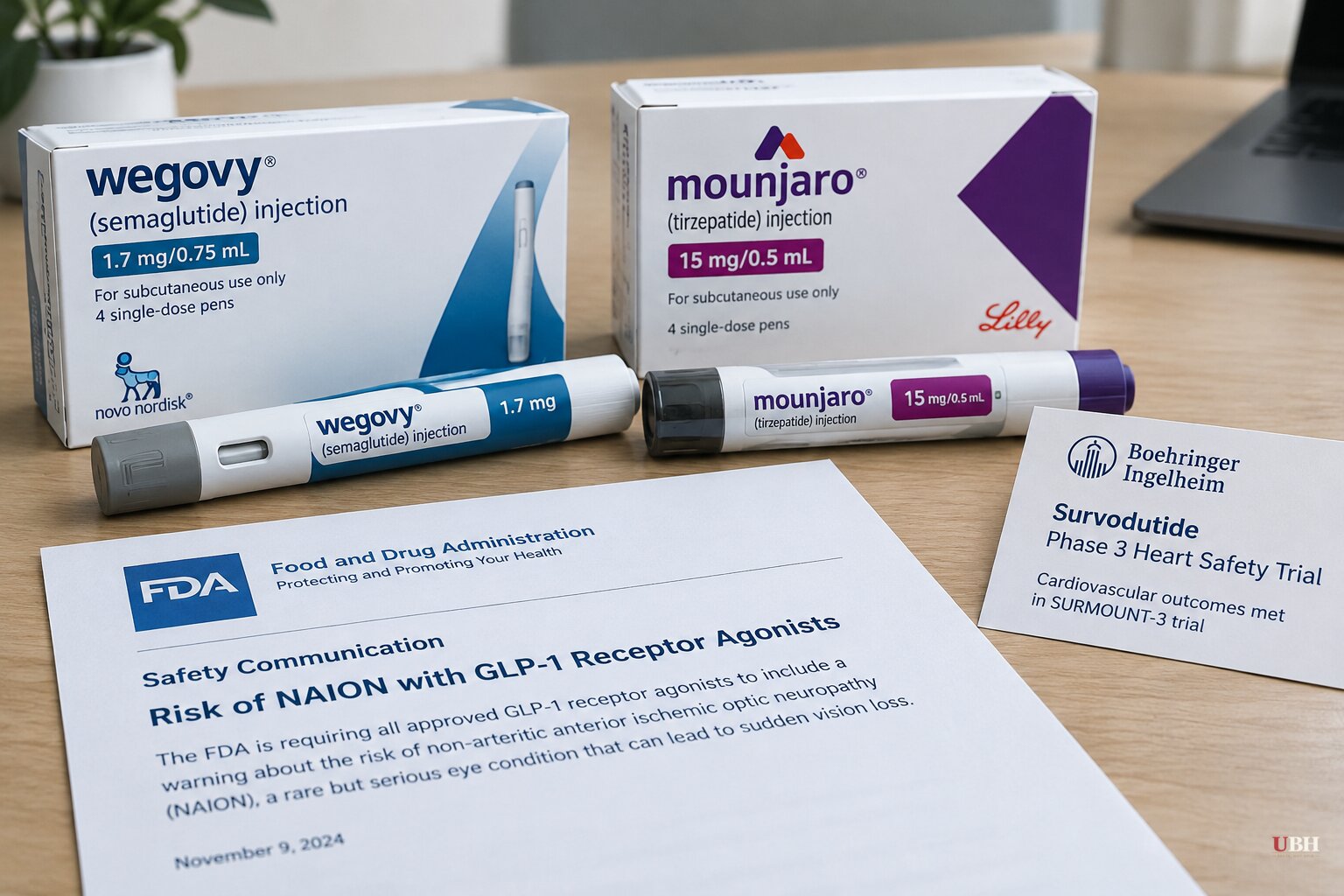
The Food and Drug Administration told drugmakers on Monday, Nov. 9, to add a new warning to every GLP-1 receptor agonist on the market. The risk is non-arteritic anterior ischemic optic neuropathy, or NAION.
NAION is caused by reduced blood flow to the front of the optic nerve. It produces sudden, painless vision loss that can be permanent, and it usually strikes one eye at a time.
What the FDA found
The order covers Eli Lilly's Mounjaro and Zepbound and Novo Nordisk's Ozempic and Wegovy, along with every other drug with GLP-1 activity. Companies must add NAION to the "Warnings and Precautions" section of their labels.
The agency said it reviewed clinical trial data, animal studies, and post-approval safety reports, including observational studies and case reports. The numbers it cited are small. Regulators found 6.4 probable NAION cases per 100,000 person-years among people on GLP-1s, versus 3.8 per 100,000 person-years in comparison groups that took a placebo or non-GLP-1 drugs.
Commercial network data showed a statistically significant increase against a drug class called DPP-4 inhibitors. Against SGLT-2 inhibitors, another type 2 diabetes drug class, the agency found no statistically significant increase. In animal studies, regulators could not identify a mechanism by which GLP-1 drugs would cause NAION.
The FDA acknowledged limits in the observational research that prompted its review. It required the label change anyway.
The companies push back
Novo Nordisk disputes that the data show causation. "Novo continues to believe the data do not establish a cause-and-effect relationship and we remain confident in the benefit-risk profile of our GLP-1 medicines," a Novo spokesperson said.
Lilly took a narrower line. Its spokesperson said the FDA communication "applies to all medicines with GLP-1 RA activity and does not reference any findings specific to Lilly medicines," and that the company is evaluating the update and will respond to the agency promptly.
Citi analyst Geoff Meacham said the action "may temporarily increase patient and investor concern," but argued the rarity of NAION and the drugs' weight, blood sugar, cardiovascular, kidney, and sleep apnea benefits "should preserve a favorable benefit-risk profile and limit changes to prescribing."
The FDA is not first on this. In 2025, the European Medicines Agency's safety committee said NAION may affect up to 1 in 10,000 people taking semaglutide for at least a year, the first time a regulator confirmed the side effect. The Danish Patient Compensation granted compensation last year to four Danish patients who lost vision after using Novo's GLP-1 drugs.
A new dual agonist clears the heart-safety bar
The same day, a different corner of the GLP-1 field produced better news. Boehringer Ingelheim's survodutide, which targets both the glucagon and GLP-1 receptors, met its primary endpoint in the phase 3 SYNCHRONIZE-CVOT trial. Results were presented at the American Heart Association's Scientific Sessions in Chicago and published in The Lancet.
The trial enrolled 5,530 adults with obesity or overweight and established cardiovascular disease, chronic kidney disease, or at least two weight-related complications or cardiovascular risk factors. The composite endpoint was cardiovascular death, nonfatal heart attack, nonfatal stroke, coronary revascularization, or heart failure events. It occurred in 3.7% of survodutide patients and 4.1% of placebo patients (HR 0.89; 95% CI 0.67 to 1.18; p<0.0001 for noninferiority).
A narrower three-point measure pointed the same way, with a hazard ratio of 0.84 (95% CI 0.60 to 1.18). At 72 weeks, patients lost up to 13.7% of body weight, cut systolic blood pressure by up to 6.68 mm Hg, and trimmed waist circumference by up to 11.96 cm.
Boehringer and its partner Zealand Pharma (Nasdaq: ZEAL) called it the first global cardiovascular safety trial of a glucagon/GLP-1 dual agonist. Boehringer said it is preparing regulatory submissions for obesity based on the full SYNCHRONIZE program.
What the trial does not show
The confidence intervals cross 1. That means safety was demonstrated and benefit was not. Stephen Nicholls of Monash University, the AHA discussant, said so directly: cardiovascular harm can be excluded, but "we cannot make any inference about cardiovascular benefit."
Nicholls also questioned the standard itself. "From a regulatory perspective, it would seem it's a relatively low bar to simply show that there's no cardiovascular harm," he said, and called for trials built around what matters to patients and clinicians.
Tolerability is the other problem. Discontinuation rates ran roughly 19% to 21% on survodutide versus 1.9% on placebo, mostly during dose escalation, with gastrointestinal events the main driver. Lead investigator Biykem Bozkurt of Baylor College of Medicine said the safety profile matched earlier phase 3 trials with no unexpected findings. Later trials use more flexible dose escalation to cut dropouts.
Prediabetes data, with a caveat
A third data point came out of the AHA meeting. A Mayo Clinic analysis of health records for 256,492 adults with prediabetes and obesity compared GLP-1 drugs with metformin. Over three years, the GLP-1 group had a 31% lower risk of developing type 2 diabetes and a 41% lower risk of death from any cause.
That group also had 20% fewer strokes, 15% fewer heart attacks, and 25% fewer cases of heart failure. Study author Vinicius de Sousa Barzon Serra said the mortality result surprised him most.
The work is observational and has not completed full peer review. Observational comparisons cannot prove the drugs caused the gap, a limit the FDA itself pointed to in the eye-risk research.
What comes next
Lilly has said it will respond to the FDA. Novo has not backed off its position that causation is unproven. Boehringer's survodutide filings for obesity are in preparation, and its phase 3 liver-disease trials, LIVERAGE and LIVERAGE-Cirrhosis, are still running. Whether the new NAION label changes how doctors prescribe a class of drugs this widely used is still unanswered.
Sources used for this briefing
7 links from 7 independent newsrooms (syndicated copies of the same report count once)
These are the sources it draws on, linked so you can verify.


