
Unbiased headlines. Facts, not spin.
Unbiased Headlines is an independently owned news organization. We bring you the facts, not opinions, written fresh from 110+ named sources. Sources linked so you can verify it yourself.
 energy
Major Story (7/10)
Saudi Arabia Tells OPEC It Pumped 10.563 Million Bpd in October, While Bloomberg Survey Puts Output Near 9.2 Million
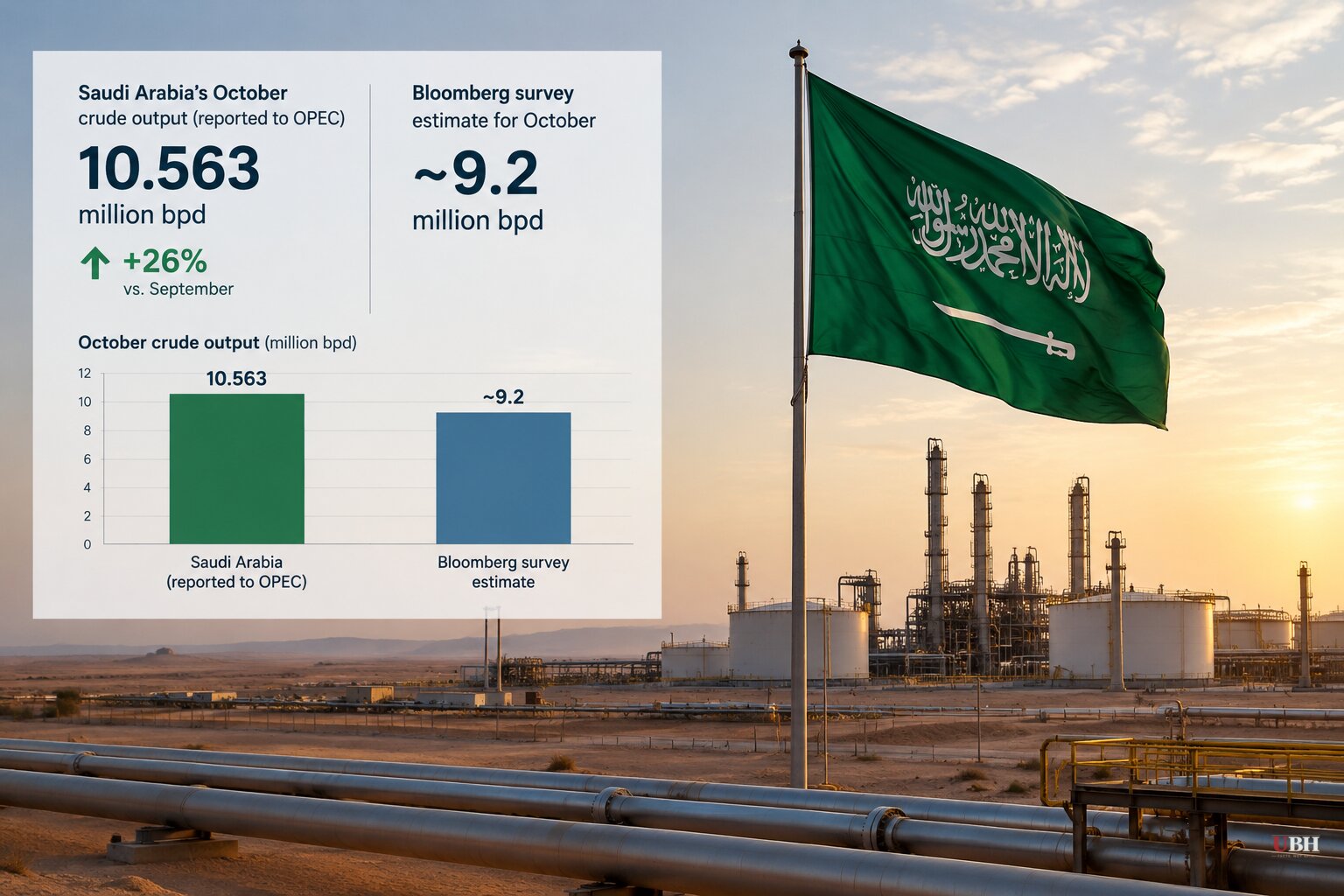
Since the Iran war began in February, Saudi crude output has swung from 10.882 million barrels per day that month to 8.372 million in September. According to the figure Riyadh gave OPEC, it is back to 10.563 million in October. That is a 26% jump in one month and the kingdom's highest reading since the war started.
OPEC's monthly report carries the number. It is what Saudi Arabia itself communicated to the cartel, not an outside estimate.
The OPEC+ totals
The wider OPEC+ group pumped 41.23 million bpd in October, up 2.04 million bpd from September, according to secondary sources cited in the same report. Total OPEC crude output rose 1.96 million bpd to 27.16 million bpd, with Saudi Arabia driving most of the increase.
OPEC left its demand growth forecasts for 2026 and 2027 unchanged at 2.55 million bpd. The cartel is adding supply without changing its demand outlook.
Two very different Saudi numbers
The self-reported figure does not match independent tallies. A Bloomberg production survey published November 7 put Saudi output at 9.2 million bpd in October, up 970,000 bpd from September. That is roughly 1.36 million bpd below what Riyadh told OPEC.
Bloomberg put total OPEC output at 22.8 million bpd. A Reuters survey published November 9 came in at 22.87 million bpd. Both are far below the 27.16 million bpd in OPEC's own report, and the two datasets measure different things. Why the gap is this wide has not been explained by the Saudi Energy Ministry.
The Bloomberg survey also puts Iraq at 4.15 million bpd and Kuwait at 2.0 million bpd, gains of 140,000 and 130,000 bpd respectively. By that count Saudi Arabia is still about 1.28 million bpd below its OPEC quota of 10.478 million bpd. The self-reported 10.563 million would sit slightly above that quota. The quota figure comes from the House of Saud Daily Briefing's account of the survey.
Exports are harder to pin down
Production is only half the question. Bloomberg's survey estimated Saudi exports at 7 million bpd in October. Tanker trackers disagree sharply: Kpler estimated 5.72 million bpd, while TankerTrackers.com put it at 7.9 million bpd.
The spread reflects how hard it is to track crude leaving the country. The Strait of Hormuz is running at roughly 20% of its pre-war traffic, according to The National. A tanker was reported on fire off Khasab, Oman, on November 7-8, according to Critical Threats' Iran update.
Saudi Arabia has two main workarounds. The East-West pipeline carries crude to the Red Sea port of Yanbu, and a U.S.-protected corridor near Oman's coast now moves Saudi oil through the strait.
The pipeline was attacked September 10 and has resumed flows. The House of Saud Daily Briefing reports it was hit again November 9. The Houthis have denied striking the Medina section, and the Saudi Energy Ministry said flows were unaffected.
Aramco's quarter
Saudi Aramco reported Tuesday that third-quarter net profit rose 35% to $36.3 billion from $26.9 billion a year earlier. Adjusted net profit, which excludes the sale of its stake in PRefChem to Malaysia's Petronas, rose 9% to $31.2 billion.
The company said it sold oil at an average of $95.20 a barrel in the quarter, against $70.10 a year earlier. It also cited strong refining margins on products such as diesel.
The war pushed prices up and Aramco's per-barrel take with them. That is the cushion for a company whose volumes have been squeezed.
Prices and what comes next
December WTI futures settled at $86.04 on November 10, down 0.93%. The U.S. Energy Information Administration's November Short-Term Energy Outlook forecasts Brent near $100 a barrel through the end of 2026. It cites falling global inventories, tanker attacks in the Persian Gulf and constrained shipping capacity.
More Saudi barrels, if they reach the water, would pull against that forecast. OPEC+ has kept its December output targets steady.
The next decision point is the OPEC ministerial meeting on November 29, according to the House of Saud Daily Briefing. Ministers are to set 2027 output targets for the first time since the war upended the cartel's production framework. Whether they anchor to Saudi Arabia's reported 10.563 million bpd or to the roughly 9.2 million bpd that surveys show is the open question.
Sources used for this briefing
6 links from 6 independent newsrooms (syndicated copies of the same report count once)
These are the sources it draws on, linked so you can verify.


