
Unbiased headlines. Facts, not spin.
Unbiased Headlines is an independently owned news organization. We bring you the facts, not opinions, written fresh from 110+ named sources. Sources linked so you can verify it yourself.
 energy
Major Story (7/10)
Event date: November 9, 2026 ·
Copernicus Says 2026 Will Top 1.5°C Warming as October Hits 1.75°C and COP31 Opens in Turkey
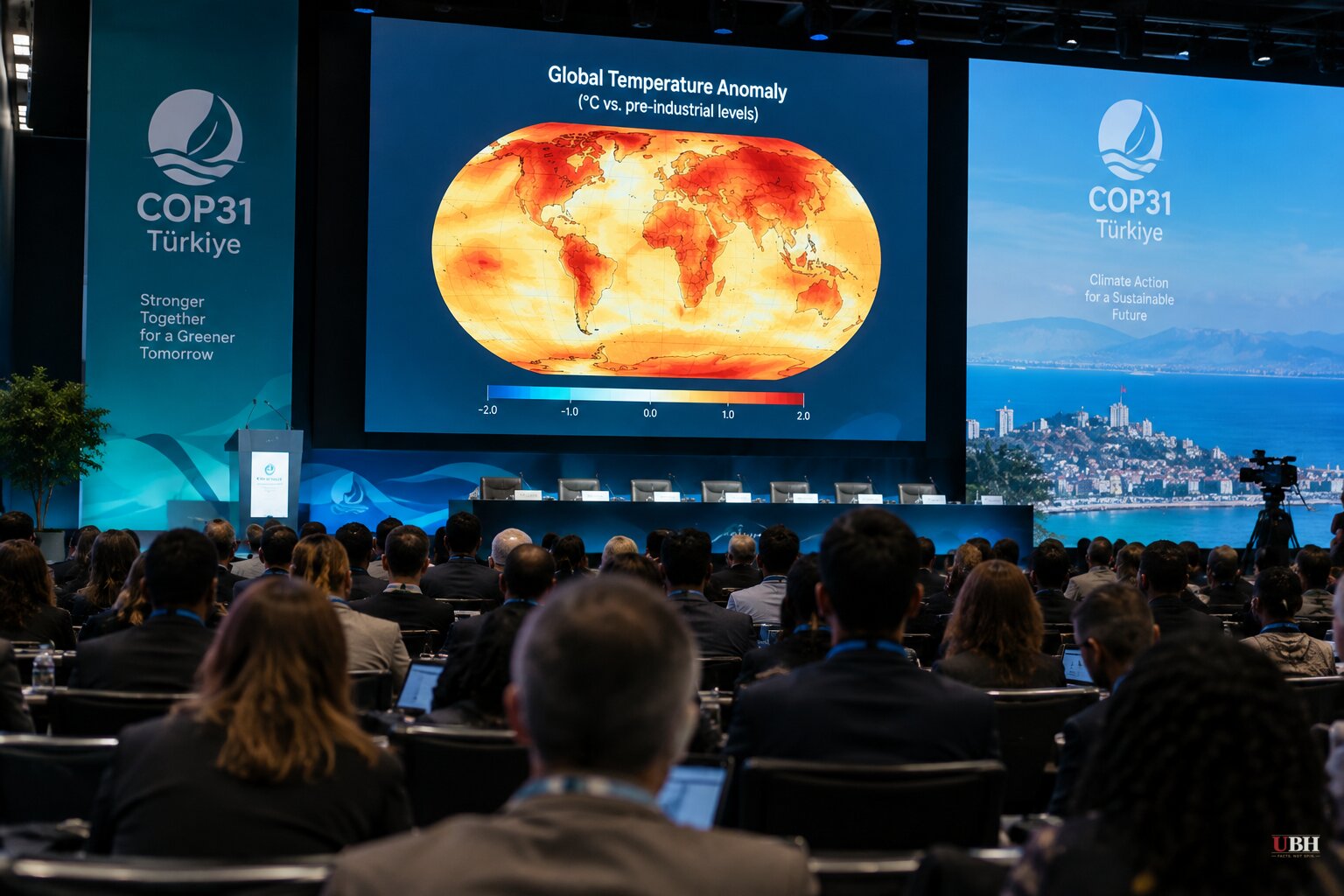
Since El Niño began intensifying in August, the temperature data has come in hotter each month, and the past week produced the clearest picture yet.
On Friday, Nov. 6, the EU's Copernicus Climate Change Service said October was the warmest October on record. Global surface air temperatures ran 1.75°C above the 1850-1900 pre-industrial baseline. It was the third straight month above 1.5°C.
Copernicus said 2026 is now "virtually certain" to exceed 1.5°C. It also expects the four-year average for 2023 through 2026 to top that mark.
Second-hottest year, with a 20% shot at first
Copernicus says 2026 is most likely to finish as the second-warmest year on record. It gives the year a 20 percent chance of tying or beating 2024, the current record.
"October has continued the pattern of remarkable global warmth, with record global and surface ocean temperatures," said Samantha Burgess, strategic lead for climate at the European Centre for Medium-Range Weather Forecasts, which operates Copernicus. She said an exceptionally strong El Niño is adding heat to a climate already warmed by human activity.
On Monday, Nov. 9, the first day of the COP31 summit in Turkey, the World Meteorological Organization released its State of the Climate Update 2026. It found that the global average temperature from January through September ran about 1.47°C above pre-industrial levels.
The past 12 years are each among the hottest on record, with 2023 through 2026 holding the top four spots. Sea level is the highest on record, and freshwater storage has been declining for about a decade.
The summit runs from Nov. 9 to Nov. 20.
What El Niño does and does not do
WMO Secretary-General Celeste Saulo was blunt about the mechanism. "El Niño doesn't add new heat to the planet. It releases heat from the ocean, which is the warmest ever measured," she said. "There is simply more heat available to release."
The WMO expects the event to continue into early 2027 and says it is expected to be the strongest on record by December. Saulo told reporters in Geneva to prepare for another record-breaking year in 2027.
Climate scientists quoted by Scientific American describe an event with no precedent in the instrumental record. Zeke Hausfather of Stripe and Berkeley Earth says sea surface temperatures in the central Pacific passed a daily record set in November 2015 by September, well ahead of the usual peak.
Those temperatures currently sit around 3.4°C above normal, and models project they could reach 4°C at the peak. The previous direct-measurement record dates to an 1877 El Niño.
Daniel Swain of the University of California Agriculture and Natural Resources says there will eventually be a year that does not dip below 1.5°C on average. "Based on what I'm seeing here, it might be this year," he said.
Paris target: a single year is not a breach
There is a technical distinction here. The Paris goal is measured against long-term averages, not single years. The UN uses temperatures averaged over a few decades, so by that yardstick the world has not formally crossed 1.5°C yet.
Still, the U.N. Environment Programme concluded in September that the long-term 1.5°C target will be missed within a matter of years. "Decades of insufficient climate action makes exceedance of 1.5°C unavoidable," the UNEP report states. "Whether it will be temporary crucially depends on decisions taken today."
UNEP's new goal is to limit how long and how far temperatures overshoot. That would require deep emissions cuts now and removal of hundreds of gigatonnes of carbon dioxide from the atmosphere before 2100.
UNEP also says countries have still not aligned their policies with their own 2030 targets. The Trump administration has pulled the U.S. out of the Paris Agreement a second time, and UNEP's gap between pledges and policy would look worse with the U.S. counted.
Health and weather risks
U.N. officials said the World Health Organization has, for the first time, classified the anticipated health impacts of extreme heat and this El Niño as a health emergency. The WMO calls El Niño a "risk multiplier" for heat illness and deaths from heat, drought and heavy rain.
Saulo said hundreds of millions of people were exposed to unbearable extreme heat this year. She also pointed to the ice and rock collapse and flash floods in Nepal.
UN Secretary-General António Guterres said: "We have entered a new age of climate extremes. A supersized El Niño is colliding with a planet already superheated by manmade climate change."
The weather effects are already visible. Andrea Thompson, Scientific American's senior editor for Earth and environment, says the Atlantic hurricane season has been quiet, with a flurry of storms in the Pacific. That is the typical pattern for El Niño.
What comes next
It is unclear whether negotiators at COP31 will produce anything beyond the pledges that countries have already failed to meet. Scientists say the length of the overshoot above 1.5°C depends on how quickly fossil fuel emissions fall.
Copernicus will publish its next monthly bulletin in early December. By then the El Niño that forecasters expect to peak that month will be close to its height, and the 20 percent chance of a new annual record will be easier to judge.
Sources used for this briefing
7 links from 6 independent newsrooms (syndicated copies of the same report count once)
These are the sources it draws on, linked so you can verify.


