
Unbiased headlines. Facts, not spin.
Unbiased Headlines is an independently owned news organization. We bring you the facts, not opinions, written fresh from 110+ named sources. Sources linked so you can verify it yourself.
 energy
Notable (5/10)
Saudi Arabia and Turkey Sign Memorandum for 3,000 MW Wind Phase at COP31
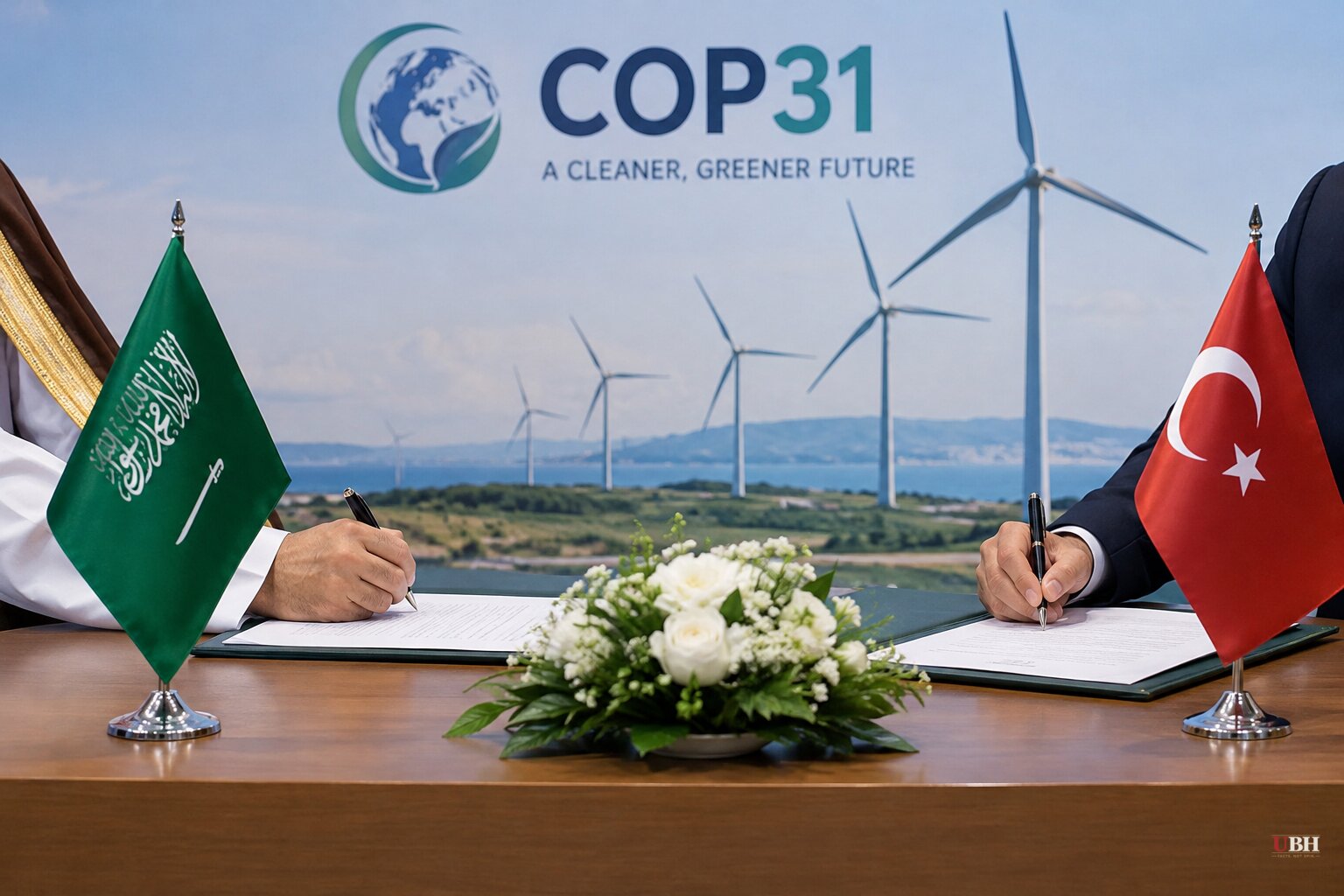
Saudi Arabia and Turkey signed a memorandum of understanding Tuesday, Nov. 10, to push forward the wind-power phase of a joint renewable energy program, with Turkish President Recep Tayyip Erdoğan looking on.
The signing took place in Antalya, host city of the COP31 climate summit, which opened Monday and runs through Nov. 20. Prince Abdulaziz bin Salman signed for Saudi Arabia. Alparslan Bayraktar signed for Turkey.
What was actually signed
The document advances the second phase of a program that Riyadh and Ankara agreed in a government-to-government deal signed in Riyadh on Feb. 3. That agreement took effect Oct. 21.
The framework covers 5,000 megawatts of renewable capacity in Turkey, all to be built by Saudi company ACWA Power.
The Turkish Energy Ministry said the wind phase totals 3,000 MW. That is the equivalent of one-fifth of Turkey's existing installed wind capacity.
Bayraktar said the wind plants will be supported by high-voltage direct current transmission infrastructure and battery energy storage systems.
"We are deepening our strategic energy cooperation with Saudi Arabia," Bayraktar said. He said the investments are meant to strengthen grid infrastructure and boost system flexibility.
Phase one: solar
The first phase is 2,000 MW of solar in the provinces of Sivas and Karaman. Bayraktar said work there is progressing and that he is satisfied with the pace.
Saudi Arabia committed roughly $2 billion to the two solar plants when that phase was announced earlier this year. Once running, they are expected to supply electricity for about 2.1 million households.
At that announcement, Bayraktar described the project as one of the most important examples of direct foreign investment in Turkey's energy sector. He said it would be financed entirely through external financing, with credit also coming from international financial institutions.
What is still missing
The wind phase has no price tag in the public record. Neither government has disclosed a dollar figure, a construction schedule, or the sites for the wind farms.
The agreement is also a memorandum, not a finished build contract. It advances a phase that was already planned rather than adding new wind capacity beyond the February framework.
Neither government has said when ACWA Power will announce wind sites, financing, or a construction start. Without those, the 3,000 MW remains a planned capacity figure, not a project under construction. COP31 continues through Nov. 20.
Turkey's coal problem
The deal lands at a summit that has put Turkey's own energy mix under a spotlight. Energy think tank Ember calls Turkey Europe's largest coal power generator.
The Turkish Energy Ministry says coal remained the country's largest power source at 33% of generation, with solar and wind at nearly 23%.
Bayraktar has laid out a National Energy Plan 2040 that targets 36% electrification and net zero emissions by 2053. He put the price at $500 billion, about $210 billion of it from Turkish public-sector companies and much of the rest from foreign investors.
He has also said Turkey is not abandoning coal quickly. "We are looking for a just transition from coal to relatively cleaner sources of energy... but we need coal for security of supply," he said. He noted that coal mining employs at least 30,000 to 40,000 people.
That is the tension in Turkey's own position. The government is courting foreign capital for wind and solar while saying it still needs coal to keep the lights on.
Scale against the target
Government plans show Turkey needs to install an average of 10,000 MW of new wind and solar capacity every year to meet its long-term targets.
The full 5,000 MW Saudi program, if built, would cover about half of one year's required additions.
Saudi Arabia has its own targets. It aims to generate about half its electricity from renewables by 2030 and reach net zero by 2060, under the Vision 2030 program led by Crown Prince Mohammed bin Salman.
Broader ties
The energy deal comes as the two governments are also drawing closer on security. Turkey's parliament has approved the Mecca Joint Defense Agreement, a mutual defense pact among Turkey, Saudi Arabia and Pakistan that was originally signed in August. Its collective defense clause treats an attack on one signatory as an attack on all.
Sources used for this briefing
7 links from 6 independent newsrooms (syndicated copies of the same report count once)
These are the sources it draws on, linked so you can verify.


