
Unbiased headlines. Facts, not spin.
Unbiased Headlines is an independently owned news organization. We bring you the facts, not opinions, written fresh from 110+ named sources. Sources linked so you can verify it yourself.
 energy
Notable (6/10)
India Approves $7.34 Billion Power Corridor to Carry Western Solar to Eastern Industry
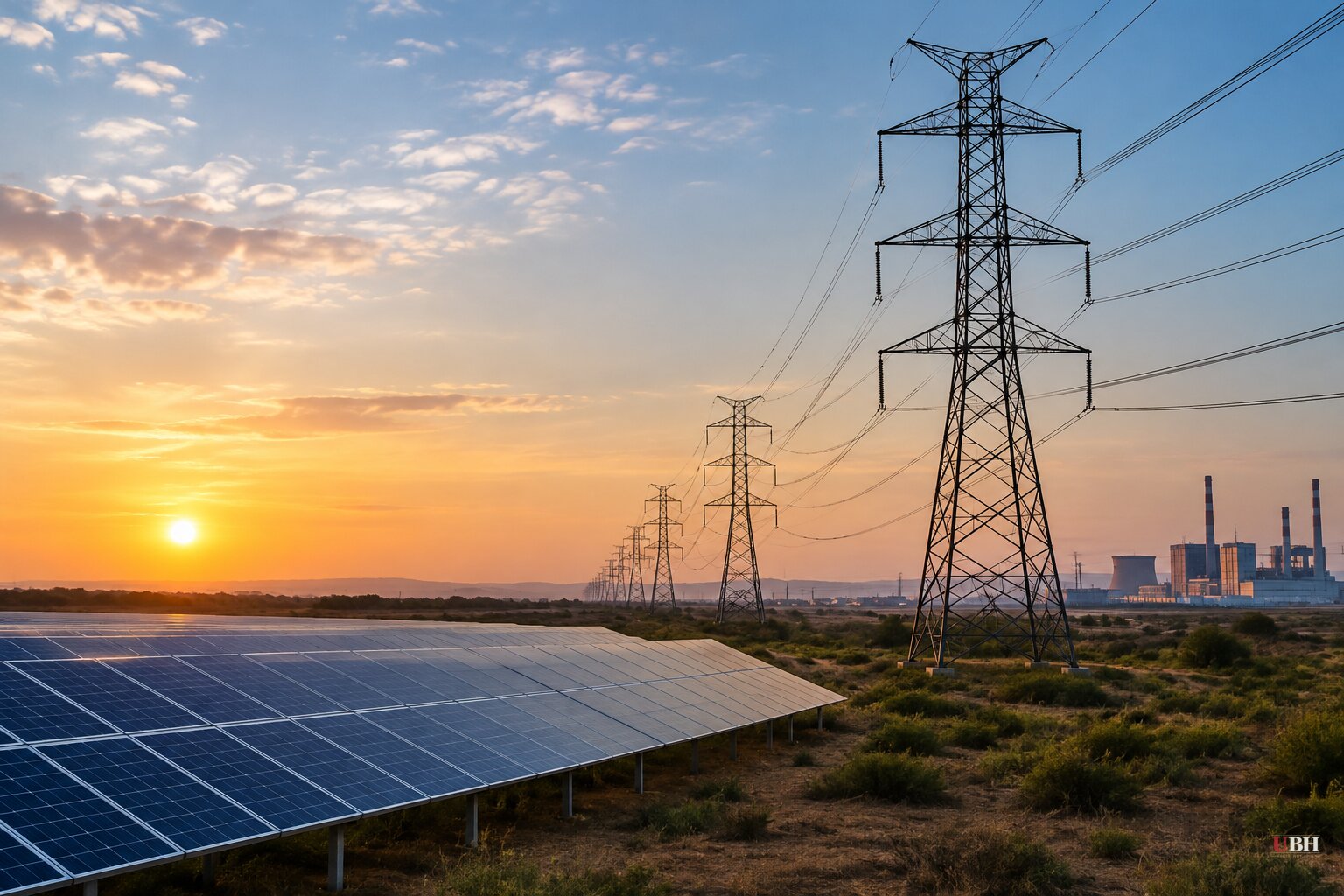
India has approved a ₹68,800 crore ($7.34 billion) transmission corridor to haul clean electricity from its western generation hubs to industrial and urban demand centers in the east. Construction is expected to take about six years.
The approval came from India's national transmission panel, according to minutes of its meeting released late Tuesday, Nov. 10.
The 1,150-kV jump
The line would run at 1,150 kilovolts. That makes it India's highest-voltage network, above the 765-kV lines that carry the bulk of long-distance power today.
The pitch is simple physics and real estate. A 1,150-kV system moves substantially more electricity along fewer lines, on less land, with smaller transmission losses. Matching that volume on 765-kV lines would mean more corridors and more land acquisition.
Land is the part that matters in India. Acquiring right-of-way for long transmission lines is one of the slower, messier parts of any grid project.
Where the power goes
Renewable capacity is booming in western states such as Rajasthan. Electricity demand is climbing in eastern industrial hubs such as Odisha. The corridor is meant to connect the two.
The first phase will link Chhattisgarh, Odisha and West Bengal. It will tie into a 6,000-megawatt high-voltage system that carries renewable power from Rajasthan's Bhadla solar region.
India is adding renewable capacity and battery storage at a record pace. It is targeting 500 gigawatts of non-fossil capacity by 2030, up from more than 300 GW now.
Government data show non-fossil sources accounted for more than half of installed electricity capacity as of July 2026. India had about 171 GW of installed solar capacity by September.
Storage approved a day earlier
The corridor follows a separate approval on Nov. 9. Prime Minister Narendra Modi's cabinet cleared a ₹14,500 crore (about $1.5 billion) scheme to develop 92 gigawatt-hours of grid-scale storage between fiscal 2026-27 and 2030-31.
The plan includes 60 GWh of pumped hydro, 30 GWh of batteries and 2 GWh from emerging technologies. The government says that equals about 170 percent of India's existing grid-scale storage. It expects roughly $10 billion in total investment.
Modi said on X that the push would mean "more reliable power, greater renewable energy integration and stronger energy security."
The coal reality
The build-out sits on top of a system that still leans on coal. India remains heavily dependent on it to supply a population of more than 1.4 billion.
The country is the world's third-largest greenhouse gas emitter after China and the United States, according to the UN Environment Programme. Its emissions reached about 4.5 billion tonnes of CO2 equivalent in 2025, excluding land use and forestry, per UNEP's Emissions Gap Report 2026.
Per capita, India emitted 3.1 tonnes against a global average of 6.4. The government is targeting a 45 percent cut in emissions intensity by 2030 from 2005 levels, and net zero by 2070.
The grid question is not unique to India. At the COP31 climate talks in Antalya, Turkey, Bruce Douglas, CEO of the Global Renewables Alliance, said of a new rooftop solar pledge: "The pledge is a pledge. We now need to see national policies and frameworks in place." Experts at the talks said grid upgrades and subsidies for panels and batteries would have to follow quickly for such goals to make a dent in emissions.
What remains open
The price tag is large for a project that will not carry a single megawatt for years. A six-year build means the full corridor would not be finished until after the 2030 deadline for the 500 GW goal.
Neither the panel nor the government has named a developer or a financing structure for the corridor. Those are the details that will decide whether ₹68,800 crore holds up over six years of construction.
The first-phase links across Chhattisgarh, Odisha and West Bengal will be the first test of whether the project's schedule holds.
Sources used for this briefing
7 links from 7 independent newsrooms (syndicated copies of the same report count once)
These are the sources it draws on, linked so you can verify.


