
Unbiased headlines. Facts, not spin.
Unbiased Headlines is an independently owned news organization. We bring you the facts, not opinions, written fresh from 110+ named sources. Sources linked so you can verify it yourself.
 economy
Notable (6/10)
Retail Sales Rise 0.2% in October as Car and Furniture Spending Falls
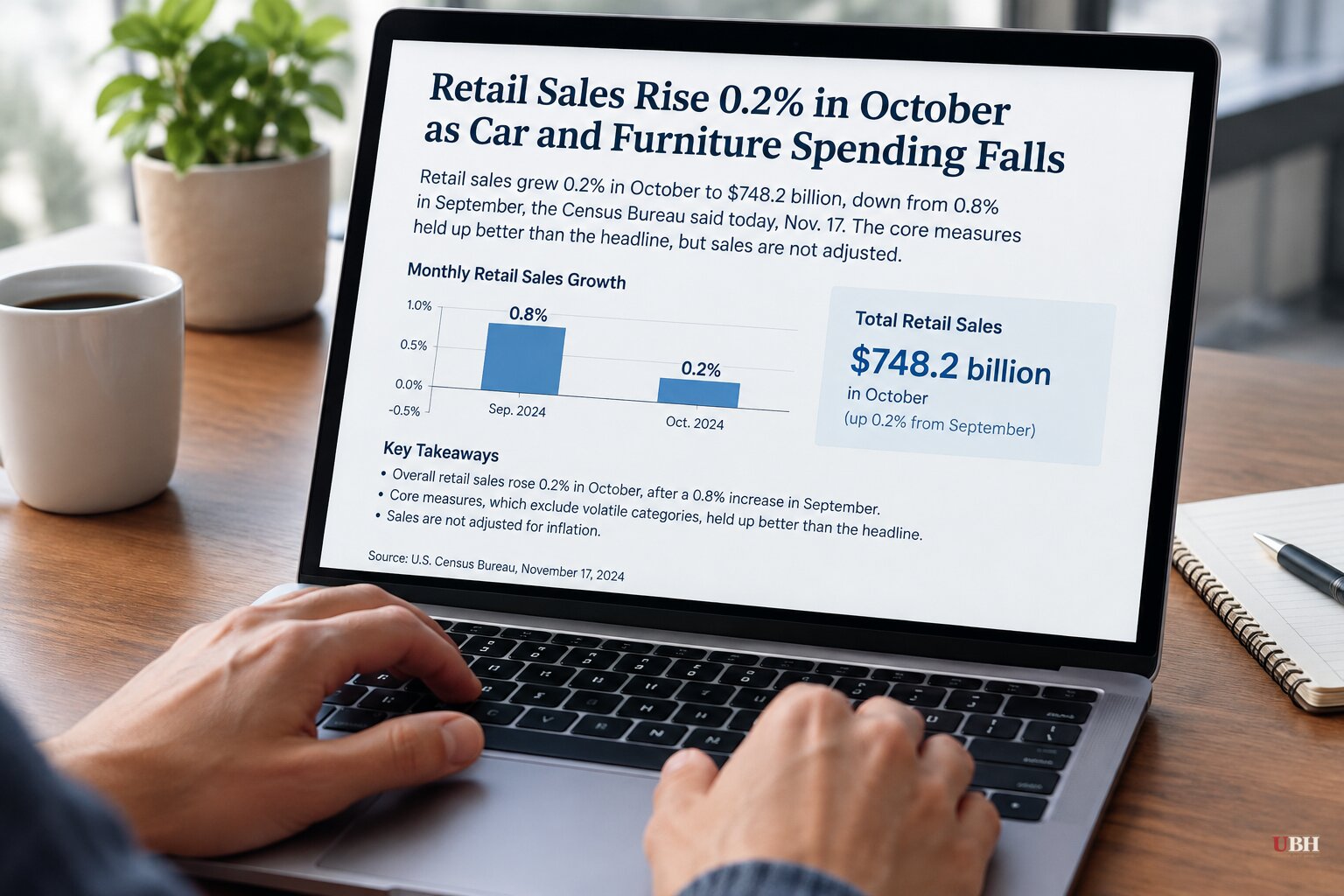
U.S. retail and food services sales rose 0.2% in October to $748.2 billion, the Census Bureau reported today, Nov. 17. That is a sharp slowdown from the 0.8% gain in September, which the agency left unrevised on growth and put at $746.6 billion in level terms.
Compared with October 2025, sales are up 6.8%. The figures are adjusted for seasonal swings and trading days. They are NOT adjusted for prices.
Where the money went
The drag came from big-ticket items. Sales at motor vehicle and parts dealers fell 1.6%. Furniture and home furnishings stores dropped 2.3%, and clothing stores slid 0.7%. Grocery stores and sporting goods, hobby and book retailers also posted declines.
The gainers were miscellaneous store retailers, up 4.7%. Health and personal care stores and gas stations each rose 1.5%. Online retailers climbed 1.2% and are up 11.8% from a year ago.
Restaurants and bars, the only services category in the report, rose 0.2%.
Strip out autos and gasoline and sales rose 0.5%, the same pace as September. The so-called control group, which excludes food services, autos, building materials and gas stations and feeds into the GDP calculation, rose 0.6%.
Gas prices and the inflation gap
Gas station sales rose only 1.5% after a huge jump in September, as fuel prices eased. The average price of regular gasoline has dropped to $3.78 a gallon from $4.31 a month ago, according to AAA. A gallon still costs nearly 20% more than a year ago.
The nominal numbers look better than the real ones. The Consumer Price Index rose 0.4% in October, hotter than expected. Annual retail sales growth of 6.8% compares with inflation of nearly 4%.
Heather Long, chief economist at Navy Federal Credit Union, argues the inflation-adjusted picture is weak. "Adjusting for higher prices, consumer spending was 'negative,'" she wrote Tuesday. "The cautious consumer is back. October retail sales were tepid. Budgets are tight for many households." She said middle-class and moderate-income households are "feeling the strain."
Other economists read the same data as resilience. Michael Pearce, chief U.S. economist at Oxford Economics, told CNN the consumer "looks solid and is bending, not breaking, under the weight of higher energy prices." He said a stronger labor market this year has offset the damage from inflation.
Mike Reid, head of U.S. economics at RBC, pointed to a split in the data. Falling grocery sales in a nominal report, he said, suggest a real pullback in volume as food inflation outpaces spending, but "upper income households continue to drive consumption."
A pause or a pullback
The Census Bureau included a caution of its own. The 90% confidence interval for October's 0.2% monthly gain includes zero, so the agency's data cannot rule out that sales were flat. The advance estimate rests on a sample of about 4,800 firms.
Timing may also be distorting the month. Matthew Shay, president and CEO of the National Retail Federation, said Halloween and early Christmas promotions likely "pulled demand forward." Amazon held a two-day sales event in early October, which helped online numbers.
Elizabeth Renter, lead economist at Life360, said many of the categories that fell are purchases families can delay, and "savvy families may be saving those purchases for holiday sale deals."
Bank of America's card data points the same direction. Aggregated credit and debit card spending per household rose nearly 6% from a year earlier in October, and household finances were "broadly healthy," the bank said. Holiday item spending is running well above last year's levels, led by online purchases, while average transaction values are declining.
The next test
Almost two-thirds of consumers say they will likely wait until Thanksgiving to finish most of their holiday shopping. Retailers are preparing for a surge in business over the Thanksgiving weekend, which makes that weekend the first real read on whether October's softness was a pause or a pullback.
November's retail sales report will also be the first to show the full effect of falling pump prices on household budgets. Whether that cushions middle-income shoppers, as Long expects, or gets spent elsewhere is the open question.
Sources used for this briefing
6 links from 6 independent newsrooms (syndicated copies of the same report count once)
These are the sources it draws on, linked so you can verify.


