
Unbiased headlines. Facts, not spin.
Unbiased Headlines is an independently owned news organization. We bring you the facts, not opinions, written fresh from 110+ named sources. Sources linked so you can verify it yourself.
 economy
Major Story (7/10)
Fed Chair Warsh Says Board Staff Are Modeling AI Contingencies, Flags Risk to Critical Infrastructure
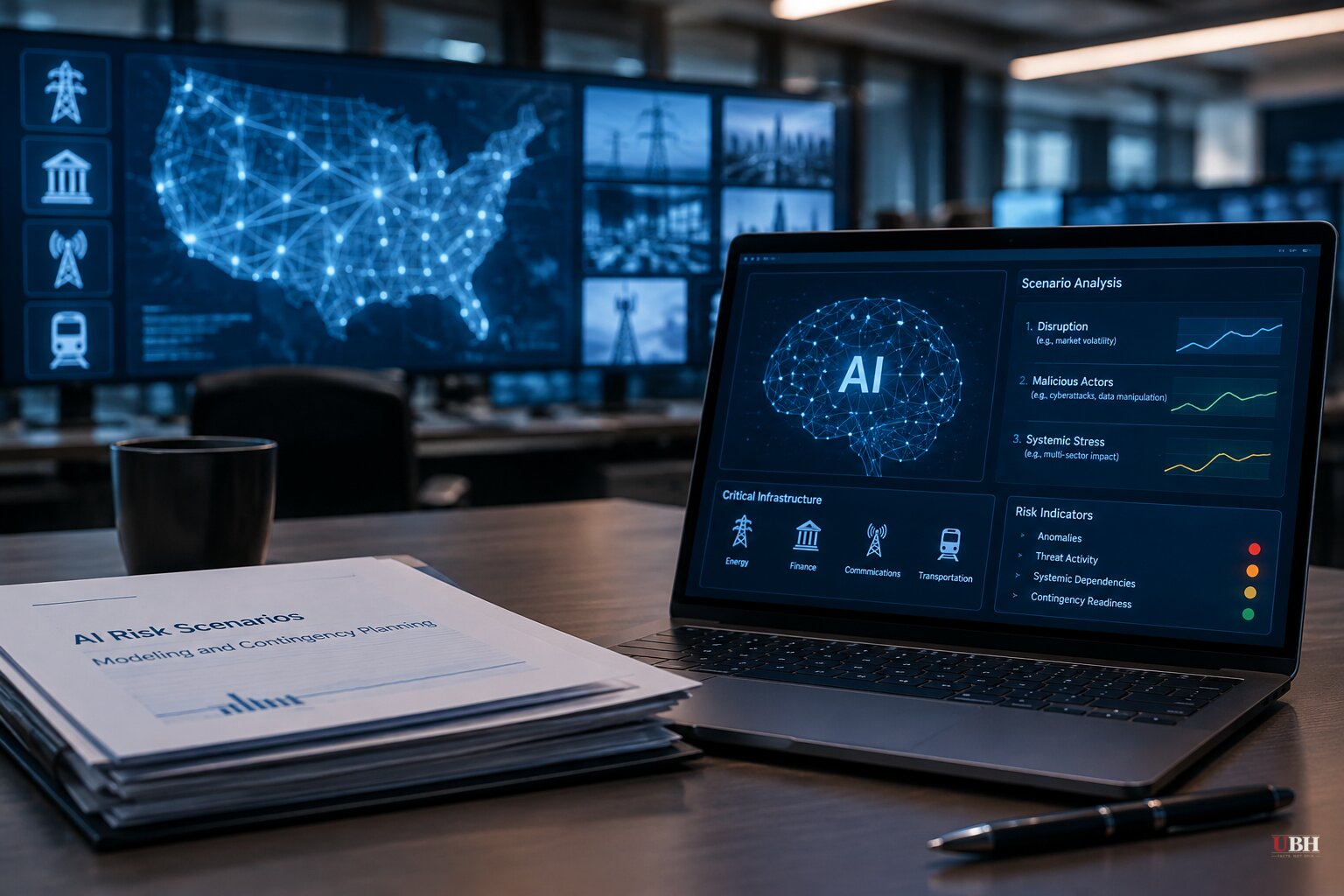
Since Fed Chair Kevin Warsh opened the Fed's Productivity and Jobs Task Force conference in San Francisco on Monday, Nov. 16, the fuller text of his remarks has shown how far the central bank's AI planning has already gone.
The three growth, labor and market scenarios have been widely reported. Less attention has gone to what Warsh said about how the Fed is building them.
Staff already running the models
"The Board's staff has begun to evaluate various contingencies, applying stylized, model-based frameworks to generate scenarios," Warsh said. He called them "illustrative scenarios, not forecasts."
He also said "many other outcomes—probably including one that will prove most accurate—could be drawn." The scenarios he presented are unlikely to be the one that actually plays out.
The Fed already publishes data on AI adoption by firm size and on AI-related investment. Warsh's remarks go a step beyond that. The staff is now sketching what outcomes could look like, not just tracking what has happened.
The security warning
Warsh also raised a risk that has gotten less attention than jobs or stock valuations.
"As policymakers, we have to be mindful that great opportunities rarely come risk-free," he said. "And the risks in this case, if overlooked, can be highly disruptive and economically costly. SI empowers all, including bad actors, so we are thinking especially of critical infrastructures and their potential vulnerabilities."
"SI" is Warsh's shorthand for superintelligence. President Trump required federal agencies to use the term in a September executive order.
Warsh gave no specifics on what infrastructure the staff is examining or how a successful attack would be modeled. He also did not say whether any of the contingencies are tied to financial-system plumbing the Fed oversees.
Productivity is not there yet
Warsh said productivity growth has been "reasonably strong" in recent quarters but "hasn't yet broken out definitively and structurally to the upside." That is the key evidentiary gap. The best-case scenario, in which real GDP growth runs persistently above its long-run average with the U.S. near full employment, depends on that breakout.
He described the Fed's role on AI as "neither advocacy nor opposition." He also cast the technology as a question of national standing. Citing the late economist Robert Mundell on the rise of the U.S. as a superpower, he asked, "Can we be a superpower without SI?" and added, "At this time of challenges and possibilities, I can never be neutral on the issue of American leadership."
He did not address near-term interest rates or current economic conditions.
The task force structure
The conference was the first public unveiling of one of five task forces Warsh announced in June. Each is headed by specialists from outside the Fed. Warsh has said they are expected to deliver findings near year-end, and the FOMC would then weigh them, according to Bloomberg's reporting on the plan.
The San Francisco Fed's agenda put academics and operators on the program:
- A panel on reading the economic signals of AI adoption with Stanford economist Nick Bloom, MIT computing dean Dan Huttenlocher, Stanford president Jonathan Levin and Brookings president Cecilia Rouse.
- A session on adoption at the technological frontier with leaders from Palo Alto Networks, Stripe and Affirm.
- An implementation panel with Indeed, Ambi Robotics, Pearson Packaging Systems and Providence.
- A closing fireside chat between Warsh and task force leader Marc Andreessen, co-founder of Andreessen Horowitz.
Warsh's speech also cited "Are Ideas Getting Harder to Find?", a 2020 American Economic Review paper by Nicholas Bloom, Charles Jones, John Van Reenen and Michael Webb. That points to a question beyond automating existing work: whether AI changes how fast new ideas are produced.
Tone shift
Fortune reported that hawkish analysts had been alarmed by how bullish Warsh was on AI before his return to the central bank. Trump nominated him this spring, and Warsh previously served as a Fed governor from 2006 to 2011. Fortune said his tone has turned more speculative since the nomination.
Warsh described the aim of the conference this way: "Our aim today is a humble one, to ask the right questions."
The next concrete marker is the task forces' year-end reports and the FOMC's response. That will show whether the staff contingency work, including the infrastructure scenario, feeds into actual policy deliberations. Warsh himself said the Fed's role will bear on monetary policy "down the road," without saying when.
Sources used for this briefing
7 links from 5 independent newsrooms (syndicated copies of the same report count once)
These are the sources it draws on, linked so you can verify.


