
Unbiased headlines. Facts, not spin.
Unbiased Headlines is an independently owned news organization. We bring you the facts, not opinions, written fresh from 110+ named sources. Sources linked so you can verify it yourself.
 economy
Notable (6/10)
Event date: November 9, 2026 ·
1,156 U.S. Schools Closed Last Year, and Enrollment Is Falling Faster Than Campuses Shut
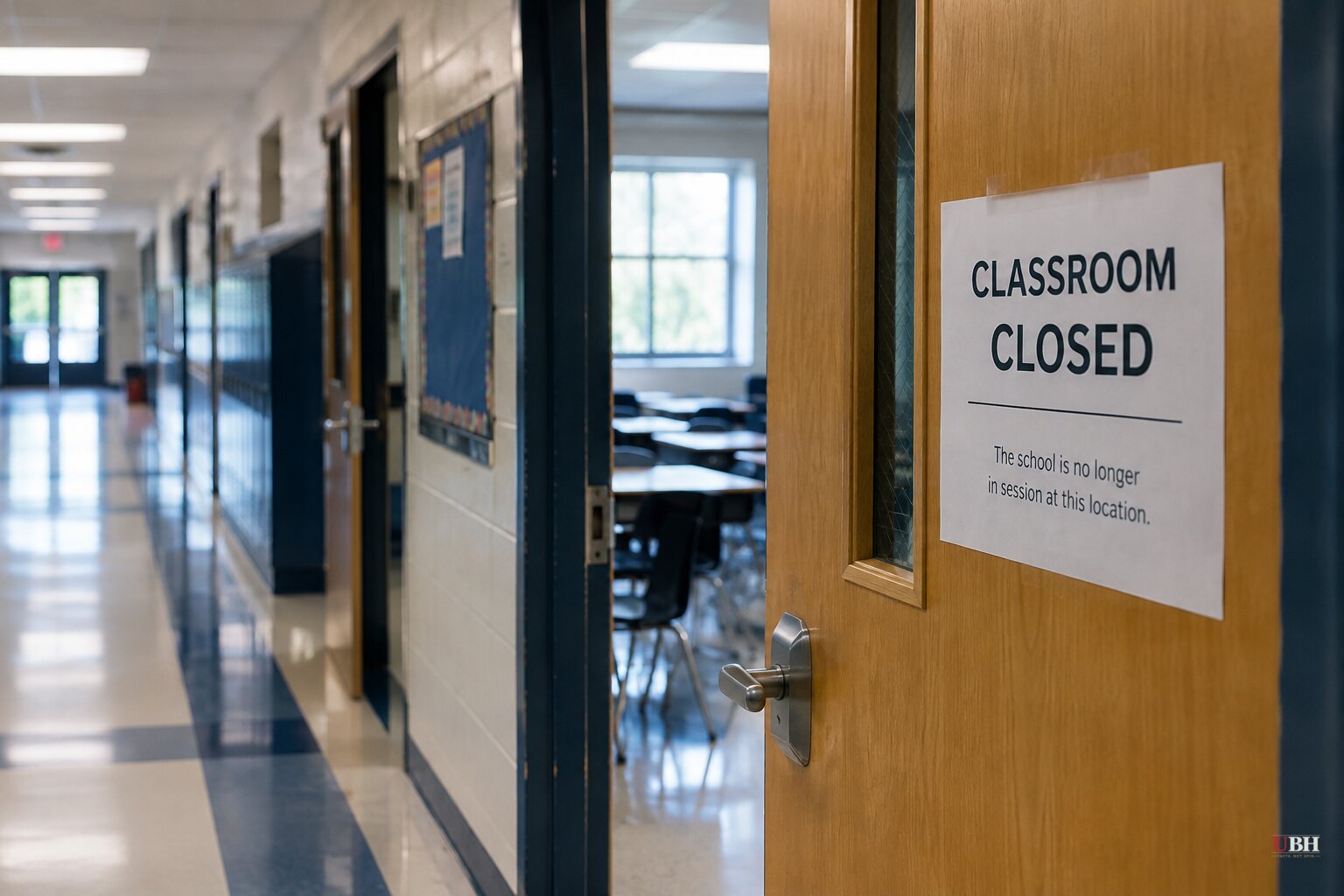
Since U.S. public school enrollment peaked in 2019, the country has lost roughly 1.5 million students, and the buildings are only now starting to follow them out the door.
A total of 1,156 schools closed during the last academic year, the highest number since the pandemic, according to an analysis of federal data by Big Local News at Stanford University. Stanford economist Thomas Dee and sociologist Jaymes Pyne found enrollment fell by more than 1.4 million students, roughly 3%, between fall 2019 and fall 2024. The total number of schools has dropped only back to about pre-pandemic levels. Closures are lagging enrollment.
Vallejo shows the math
The Vallejo City Unified School District near San Francisco serves about 9,300 students, down from nearly 18,000 in fall 2006, according to the district. Five campuses have closed since 2025, a quarter of its schools. Up to a third of staff positions are on the chopping block to help close a $36 million deficit.
Superintendent Rubén Aurelio defends the cuts. "We're not just closing schools to close schools," he said. "We're right-sizing a district that was built for significantly more kids."
Parents see something else. Kimberly Núñez-Brandão moved her older son to a charter school and said her daughter's new fifth-grade teacher has 32 students in his first-ever class. "Who's winning here?" she said.
It is not just one district
Pittsburgh is preparing to close 12 schools. Tulsa voted to close or consolidate 17. Five are closing around Tampa Bay and three in Little Rock. In Portland, Ore., 10 schools have been recommended for closure. In Colorado, the Adams 12 district near Denver voted to close one middle school and five elementary schools.
New York City's enrollment has fallen from nearly 1 million to about 767,000 over the last decade, and two small Harlem schools are on a potential closure list. Los Angeles Unified, the nation's second-largest district, has lost more than 300,000 students over two decades.
Lori Goldstein, president of the Adams 12 board, said the vote was hard but needed. "People just aren't having kids," she said. "Every year, our kindergarten class is getting smaller and smaller."
What is driving the decline
Lower birth rates are the primary reason, according to the AP's analysis. U.S. Census data show the under-18 population has fallen by about 2.1 million since 2010. Pandemic-era losses never fully reversed, and more families have moved to charters, homeschooling and voucher-funded private schools.
The Trump administration's immigration crackdown is an added factor. The Migration Policy Institute estimated as many as 1.9 million people left the U.S. in the first 18 months of Trump's second term. LAUSD board member Kelly Gonez said the district projected a 2% enrollment drop after ICE enforcement escalated in 2025. "It was double that," she said.
Dee told NPR that "to stop or slow immigration really exacerbates those problems." He also said the effect comes from both families leaving and from the inflow that would normally have occurred not arriving.
Breitbart reads the numbers differently. It argues that funding tied to enrollment is working as designed and that a drop in migrant students means a budget "bubble" is bursting. "Schools should be shut down and teachers and administrations culled if there are not enough kids there to justify the costs and salaries," the outlet wrote. That is an opinion, not a finding. The research above puts shrinking families first, with immigration enforcement as one contributor.
The savings are not guaranteed
Research cited by the Hechinger Report says closing schools rarely delivers the financial relief districts hope for. Busing for reassigned students, severance for laid-off staff and security for empty buildings often eat the savings. Closures can also set students back academically and make it harder to recruit teachers.
They can also feed the decline. In Vallejo, some parents said they would homeschool or sell their homes and move to neighboring districts.
Lydia Rainey of the Center on Reinventing Public Education sees no rescue coming. "States aren't about to open the coffers and swoop in with additional funds to save schools," she said.
Politics is catching up
The issue drew little attention in the midterms compared with gas prices and the war in Iran. Parents, liberal and conservative, have packed school-board meetings anyway.
In the states that just elected Democratic governors, Ohio, Iowa, Georgia and Texas, the incoming governors largely avoided cultural flashpoints, according to Fox News. They focused on attacking GOP-backed private school voucher programs and calling for more public school funding. Three of the four will face Republican-controlled legislatures.
The larger number is still ahead. Bellwether and WestEd estimate declining enrollment could cost schools $11.5 billion in state revenue every year by 2030-31. Enrollment has already dropped faster than schools have closed, so districts like Vallejo, Portland and Pittsburgh are unlikely to be the last to decide which buildings stay open.
Sources used for this briefing
6 links from 6 independent newsrooms (syndicated copies of the same report count once)
These are the sources it draws on, linked so you can verify.


