
Original briefings. Zero spin.
Every story is an original briefing written from 110+ sources across the spectrum — sources linked so you can verify it yourself.
 energy
Major Story (8/10)
Event date: August 28, 2026
energy
Major Story (8/10)
Event date: August 28, 2026
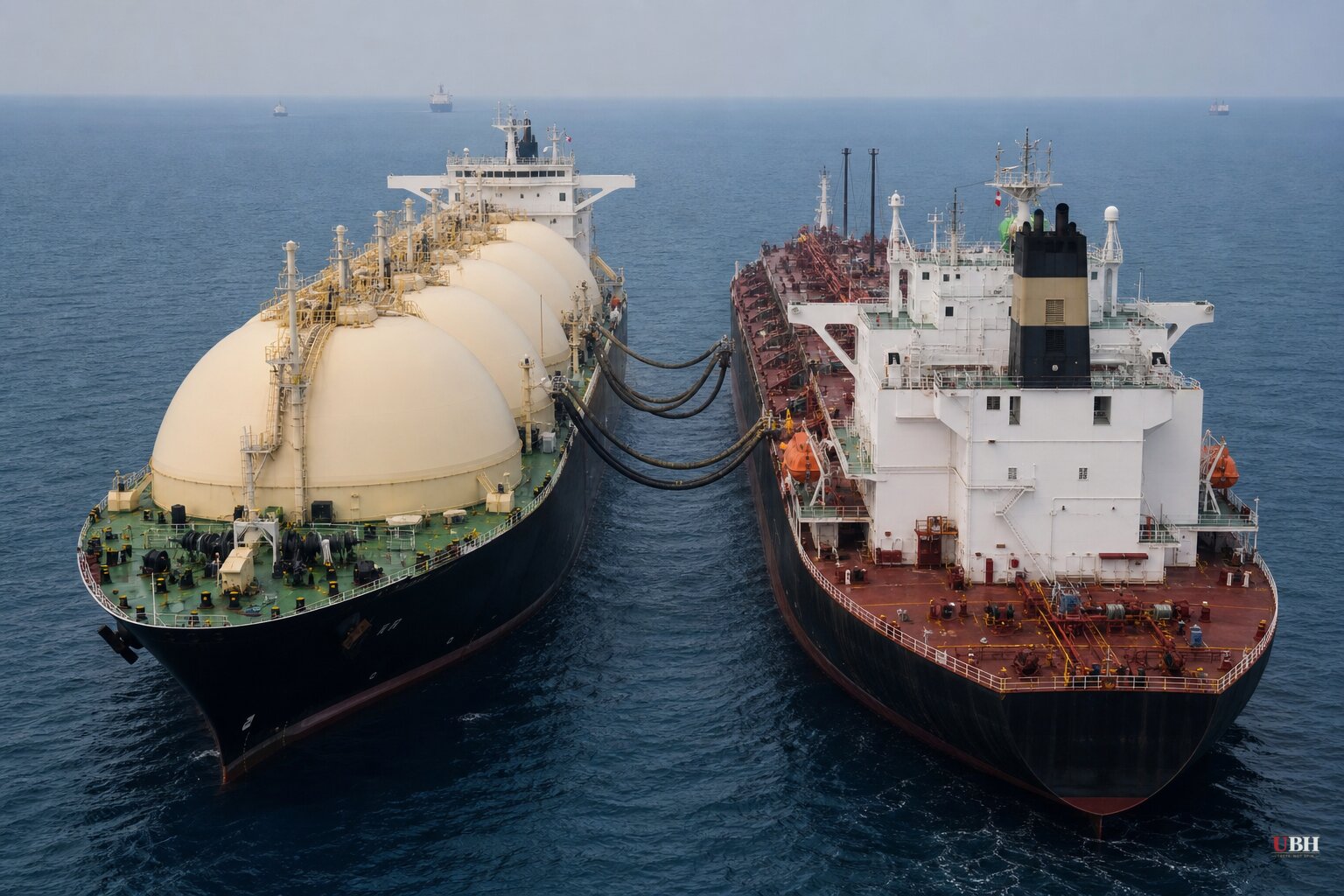
Qatar and UAE Turn to Ship-to-Ship LNG Transfers as Hormuz Standoff Drags Into Its Seventh Month
Since the U.S. and Israel struck Iran in February 2026, the Strait of Hormuz has functioned as a war zone for the roughly one-fifth of global oil supply that normally passes through it, according to NPR's Jane Arraf. Six-plus months in, commercial oil and fuel stockpiles have shrunk sharply and U.S. emergency reserves are smaller than they've been in decades, according to CNN.
OilPrice.com reported Wednesday, September 2, that Qatar and the UAE have begun conducting ship-to-ship LNG transfers to route natural gas exports around the strait. Gulf oil producers adopted the same tactic for crude months earlier.
How the crude version works
CNN traced the tactic through the supertanker Kiku, which loaded crude at Qatar's Mesaieed terminal on July 25, then switched off its AIS transponder near Dubai on July 31 before reappearing on the far side of the Strait of Hormuz the next morning. Saudi, Kuwaiti, Qatari and Emirati oil companies have chartered tankers to go dark and cross the strait at night, escorted by the U.S. Navy, before transferring crude ship-to-ship in the Gulf of Oman to tankers bound for China, Taiwan, South Korea, the Philippines, Vietnam and Thailand.
The U.S. Department of Energy says the tactic has kept Hormuz traffic averaging 8 million to 9 million barrels per day, roughly double what shipping trackers like Kpler estimate using transponder data alone, per CNN. It shifts the insurance risk and physical danger of Iranian attacks off commercial shippers and onto the U.S. government and the producers themselves.
Oil & Gas Journal's Tom Seng reported that crude fell the week of August 24-28 as flows out of the Persian Gulf increased via these ship-to-ship transfers and Saudi Arabia's East-West pipeline to the Red Sea, even as new U.S. sanctions on Iran and its counterparties had no visible price effect. WTI hit a weekly high of $84.70 a barrel Monday and a low of $78.55 Wednesday that week; Brent ranged from $93.80 down to $85.40, according to Oil & Gas Journal. Some estimates put total Gulf outflows at 7-8 million barrels per day, roughly half of pre-war levels.
Tankers are still getting hit
None of this has made the strait safe. The Epoch Times reported that an unidentified projectile struck a commercial tanker in the Strait of Hormuz on August 27, sparking a fire that was brought under control with no crew injuries. That came two days after Iran and Oman announced a tentative deal, detailed by Iranian Deputy Foreign Minister Kazem Gharibabadi on state television, routing inbound vessels through Iranian waters temporarily and outbound traffic through a mix of Iranian and Omani waters, with a 30-to-60-day window to negotiate a permanent arrangement. That puts a rough deadline of late September to late October 2026 on whether the temporary corridor becomes permanent. President Trump told Fox News on August 17 the U.S. would bomb Oman "if it gets in the way," and posted on social media August 25 that U.S. forces had cleared "all mines" from the waterway, warning any vessel caught laying new ones would be "immediately and systematically destroyed." Kpler data cited by the Epoch Times showed transits still running below normal, at 10 vessels on August 26 versus a 10-day average near 15.
The pipeline argument, and the pushback
Bessent has told an NBC affiliate that within two years "the strait is going to become irrelevant," projecting that 50% to 70% of energy products currently shipped through Hormuz will instead move by underground pipeline, calling it eventually "just another body of water," according to NPR.
The International Energy Agency disagrees with the scale of that claim. IEA senior oil market analyst Rebecca Schulz told NPR that even after major pipeline expansions are finished, Gulf exports would still need more than 10 million barrels a day to pass through the strait to return to pre-war levels, about half of what flowed before the conflict. The UAE's $3 billion pipeline expansion to Fujairah is expected online next year, but a larger Saudi expansion is likely years away, the IEA says. Former State Department special envoy David Goldwyn told NPR he expects the Hormuz constraints to be "a somewhat permanent feature" for years, since Iran wants to keep getting paid for its own exports and the U.S. has been unable to force open navigation militarily. Analyst Robert McNally called Bessent's "irrelevant" framing "way too strong and overstated."
The wider pressure campaign
Adm. Brad Cooper, commander of U.S. Central Command, said in a video update that international shipping lanes through the strait are open and that U.S. forces have assisted nearly 1,500 commercial vessels carrying close to 750 million barrels of crude, according to Fox News. Treasury Secretary Bessent is scheduled to host G20 finance ministers in Asheville, North Carolina, to press allies on cutting Iran's economic lifelines, a senior Treasury official told Fox News. Separately, the Department of Justice is reportedly planning to reactivate maritime prize courts to make it easier to formally claim seized Iranian tankers and their cargo as U.S. property, according to a Bloomberg Law report cited by Fox News; no court has yet processed such a case.
Fox News also reported that Iran's top security official, Mohsen Rezaei, dismissed as a lie an Iranian state TV report alleging a plot and $10 million bounty against Barron Trump, while the Secret Service said it is investigating the video as a potential threat.
None of these workarounds resolve the core dispute: whether Iran and Oman's temporary transit corridor, due for renegotiation within the next one to two months, hardens into a lasting arrangement, or whether the region reverts to the dark transits and sporadic tanker strikes that have defined the past six months.
Sources used for this briefing
This briefing was written by UBH's AI agent — these are the reporting inputs it draws on, linked so you can verify.


