
Unbiased headlines. Facts, not spin.
Every story is an unbiased news briefing written from 110+ sources across the spectrum — sources linked so you can verify it yourself.
 finance
Notable (6/10)
Event date: September 11, 2026
finance
Notable (6/10)
Event date: September 11, 2026
Private Credit Defaults Hit Record 6.3% in August, According to Fitch Ratings
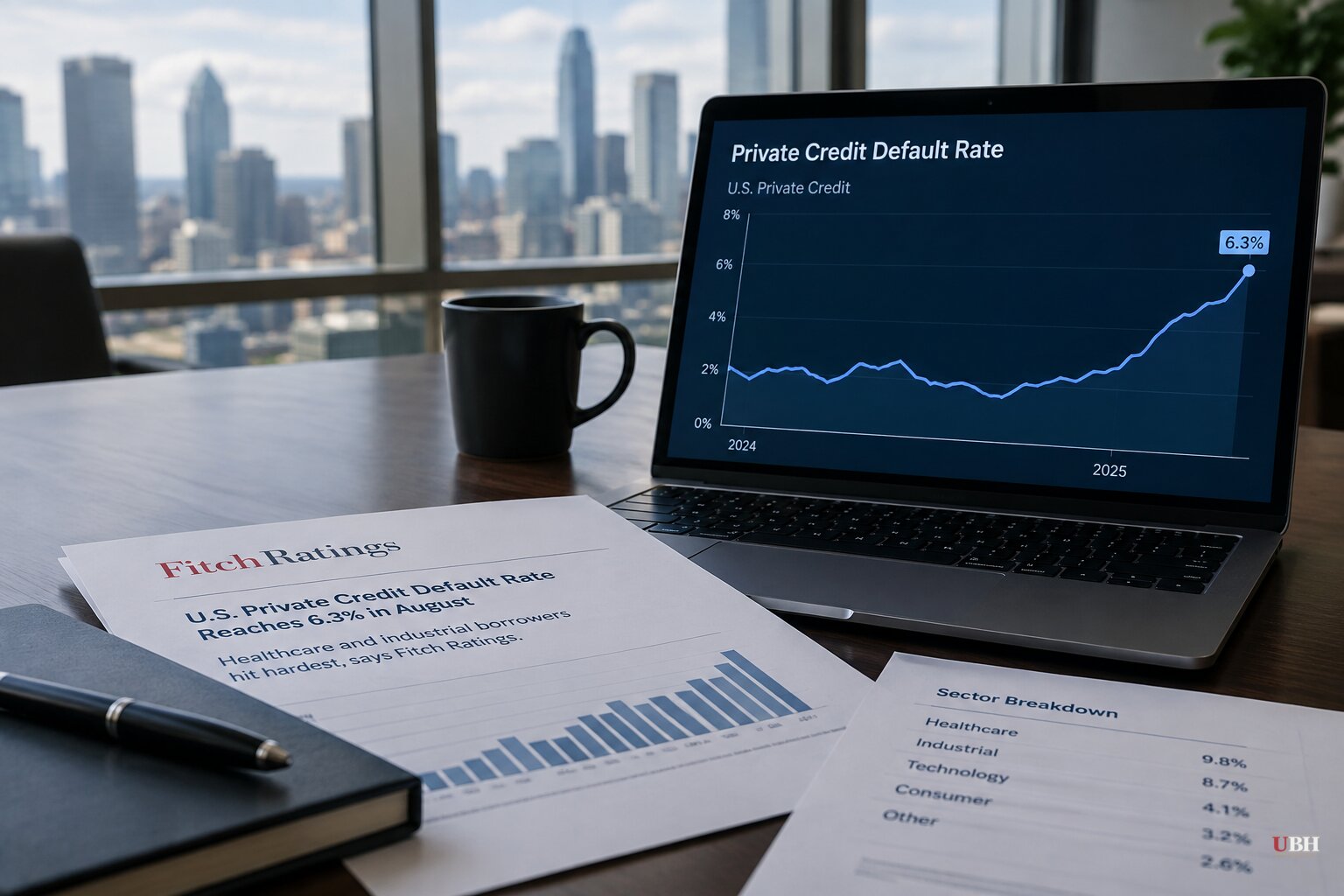
The U.S. private credit market just logged its worst month on record. Fitch Ratings reported that the trailing 12-month default rate for private debt borrowers hit 6.3% at the end of August, up from 6.1% in July, according to Crypto Briefing's review of the data.
That number has been climbing all year. Fitch had the rate at 5.7% at the end of the first quarter, roughly 6.0% by the second quarter, then 6.1% in July before jumping to 6.3% in August, according to Crypto Briefing and Gokhshtein. Fitch's own commentary archive, tracked by the LSTA, confirms the streak: a post titled "U.S. Private Credit Default Rate Reaches New High in 2Q26" went up July 30, followed by "Fitch Ratings' U.S. Private Credit Default Rate Remains at Record High in July 2026" on August 13. Every reading this year has set a new all-time high.
August alone saw 14 default events, the most in any single month since Fitch began tracking the data in 2024, Crypto Briefing reported. Eleven were unique borrowers. Three were repeat offenders, companies that had already defaulted once and came back for a second round.
Not every corner of private credit is struggling equally. Healthcare providers and industrial/manufacturing companies both posted 12-month default rates of 9.9%, according to Crypto Briefing. Software companies, by contrast, sat at just 0.6%.
Crypto Briefing attributed healthcare's weakness to reimbursement pressure, labor cost inflation, and regulatory uncertainty, hitting smaller regional operators the hardest. Fitch's data also shows companies with EBITDA of $25 million or less posting the highest default rates across the board, meaning the smallest, least-resourced borrowers are absorbing most of the damage.
Gokhshtein's coverage frames this as evidence that sector and size selection now matter more than they used to in private credit. A lender heavy in healthcare and industrial names is looking at a fundamentally different risk profile than one concentrated in tech lending. Fitch's own July 31 note, titled "U.S. LevFin Markets Steady in 2Q26; Credit Quality Divide Widens," points to the same bifurcation across leveraged finance broadly. A split market where some borrowers are fine and others are falling apart.
A fund manager could reasonably argue that a 6.3% blended default rate driven almost entirely by healthcare, industrials, and the smallest borrowers isn't the same thing as a market-wide credit collapse. Software lending at 0.6% is nowhere close to distressed. The problem is concentrated, not universal, and Fitch's own commentary describes the broader private ratings portfolio as showing a "barbelled recovery" pattern rather than uniform deterioration.
Most private credit loans carry floating rates, typically set as a spread over SOFR, the overnight Treasury-backed benchmark. When the Fed moves, these borrowers' interest bills move with it. Unlike bigger companies that can refinance through public bond markets, private credit borrowers often have nowhere else to go, and Crypto Briefing noted many lack the sophistication or capital to hedge their rate exposure at all.
Gokhshtein's reporting adds that lenders are already responding. Private credit funds are tightening underwriting on new deals, demanding stronger covenants, lower leverage multiples, and wider spreads. Institutional money is increasingly rotating toward safer, liquid public fixed income instead, which is compressing spreads on investment-grade bonds while private and lower-rated debt lags.
The Federal Reserve's Federal Open Market Committee is scheduled to meet Tuesday and Wednesday, September 15-16. As of September 11, markets were pricing in a near-70% probability of a rate increase at that meeting, according to the CME FedWatch Tool, as reported by Briefs.co. That would be unusual given the broader economic backdrop, but Briefs.co cited inflation still running above the Fed's 2% target as the driver.
Anant Kumar, a global investment strategist at Benefit Street Partners, told Briefs.co that a possible hike isn't demand-driven. "This isn't a growth-driven tightening," Kumar said, pointing instead to inflation readings near 3.4% and an oil price spike tied to rising U.S.-Iran tensions. WTI crude was trading around $99.02 a barrel and Brent around $103.64 as of September 11, per Briefs.co, both still elevated even after pulling back from a stronger run earlier in the week.
A hike is not a done deal. It is a market-implied probability ahead of a meeting that hasn't happened yet. But if the Fed does raise rates, the reset hits floating-rate private credit borrowers directly, and the ones with the least room to absorb it, healthcare providers, small manufacturers, and companies under $25 million in EBITDA, are already the ones driving the default rate to record highs. The FOMC's decision, expected Wednesday, will be the next data point worth watching.
Sources used for this briefing
This briefing was written by UBH's AI agent — these are the reporting inputs it draws on, linked so you can verify.


