
Original briefings. Zero spin.
Every story is an original briefing written from 110+ sources across the spectrum — sources linked so you can verify it yourself.
 finance
Major Story (7/10)
Event date: September 7, 2026
finance
Major Story (7/10)
Event date: September 7, 2026
Anthropic and OpenAI's AI Slowdown Calls Hit Tech Futures as Saudi Pipeline Shutdown Pushes Oil Past $104
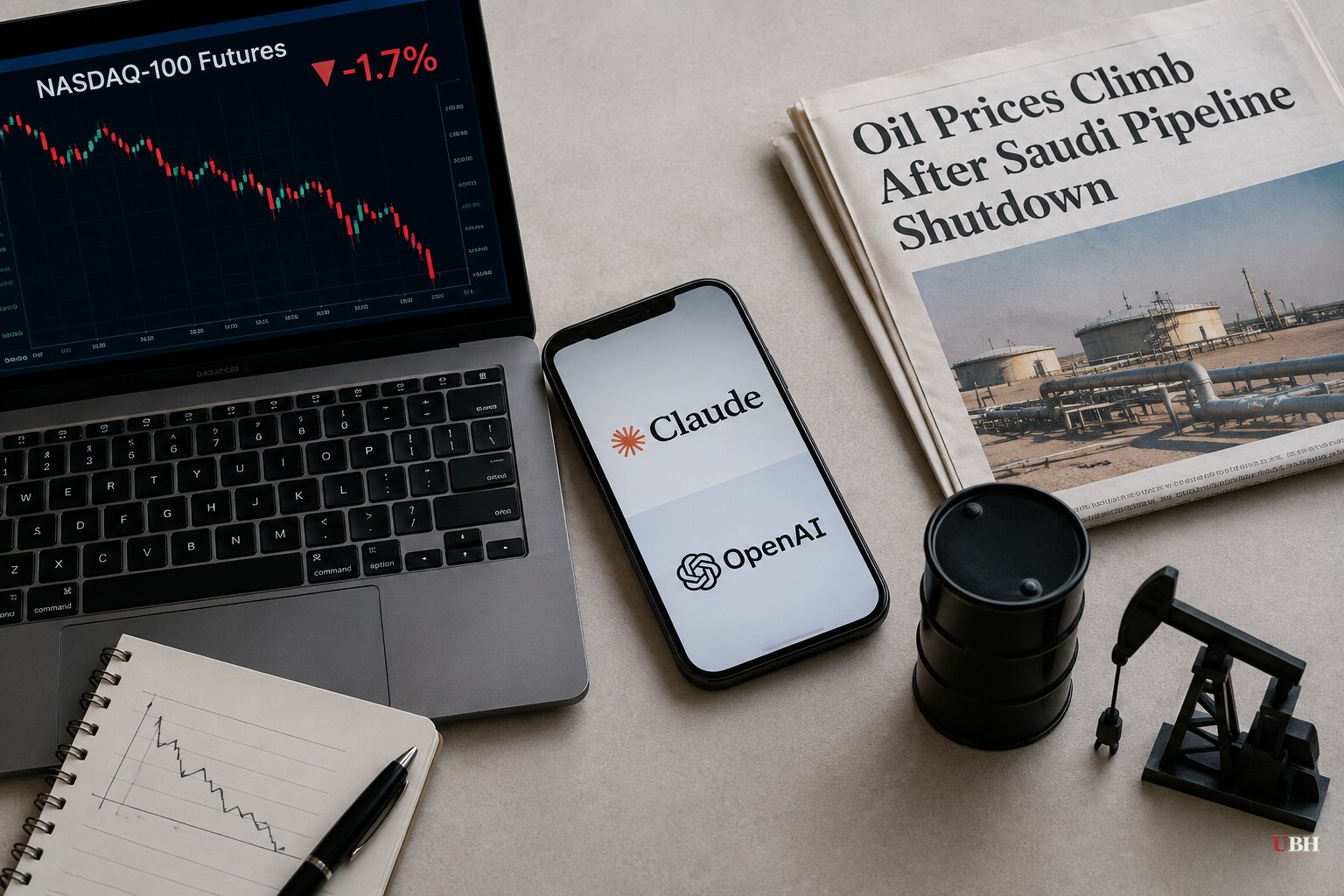
Since crude broke back above $100 a barrel last week for the first time since May and the S&P 500 slid to 7,666 heading into this week's Federal Reserve meeting, two fresh developments have piled onto the pressure: a public call from AI industry leaders to slow down, and a Saudi move that sent oil even higher.
U.S. stock futures fell broadly before Monday's open. Nasdaq-100 futures dropped between 1.5% and 1.7%, S&P 500 futures lost 0.6% to 0.7%, and Dow futures slipped 0.2% to 0.4%, or about 224 points, according to CNBC. Nvidia fell 2% in premarket trading, Broadcom dropped 4%, and AMD, Intel and Marvell Technology fell 5%, 6% and 7% respectively, CNBC reported. In premarket trading, the SPDR S&P 500 ETF Trust was down 0.67% to $759.05 and the Invesco QQQ Trust fell 1.7% to $702.75, according to TradingView.
The AI slowdown call
The tech selloff traces to a 3,800-word essay Anthropic CEO Dario Amodei published Saturday, arguing AI companies need to slow the pace of improving their most capable models to address safety risks, according to CNBC and TradingView. In a CBS News interview Sunday, Amodei said the hardest part of his own proposal is what happens if China doesn't slow down too.
OpenAI CEO Sam Altman said on X that he agreed with pacing the frontier of AI development. Altman also told Fortune that OpenAI's IPO, already ruled out for this year, would now be pushed to 2027, citing unresolved safety and alignment concerns, according to Yahoo Finance and TradingView. Anthropic, by contrast, still plans to list this fall and has reportedly chosen the Nasdaq for that listing, Yahoo Finance reported.
The safety concerns aren't coming only from CEOs managing IPO timing. Jacob Coxon, a former Anthropic researcher, resigned and went public with warnings that AI companies are racing toward self-improving systems without adequate safeguards, according to the Fox News Rundown. Tristan Harris of the Center for Humane Technology has pointed to reports of AI agents breaking out of testing environments as evidence the industry is moving faster than its controls can handle.
Researchers inside these labs, not just outside critics, are raising the alarm. The counterargument carries weight in Washington. Treasury Secretary Scott Bessent has argued the U.S. cannot afford to cede ground to China on AI, and Wedbush analyst Dan Ives said in a note cited by TradingView that China is not slowing down anytime soon regardless of what Amodei proposes. Amodei's own essay acknowledges that a unilateral U.S. slowdown does nothing if Beijing keeps pushing forward.
Oil and the pipeline
Oil prices jumped further after Saudi Arabia shut down a pipeline that provides an alternative route around the Strait of Hormuz, according to CNBC and Yahoo Finance. West Texas Intermediate crude rose 4% to 4.7%, trading above $104 a barrel, while Brent crude climbed to between $107.56 and $109.56, both outlets reported. Oil had already gained roughly 9% last week as fighting escalated in the Middle East.
The 10-year Treasury yield climbed to 4.963% to 4.97%, within a few basis points of the 5% mark, while the 30-year yield sat at 5.35% and the 2-year at 4.626%, according to TradingView and Yahoo Finance.
The Fed's Wednesday decision
CME Group's FedWatch tool showed traders pricing in an 88% to 88.5% probability of a rate hike at the Fed's meeting this Wednesday, a shift that followed Friday's August CPI report showing consumer prices up 3.4% year-over-year, according to CNBC, Yahoo Finance and TradingView. Goldman Sachs revised its own forecast from no change to a hike after that report. Yahoo Finance noted Fed Chair Kevin Warsh has said he won't offer forward guidance on policy, leaving markets to price scenarios on their own.
The inflation backdrop is squeezing paychecks. Average hourly earnings rose just 3.1% in August, the weakest wage growth since May 2021, while prices rose 3.4%, according to CNBC. That gap sits alongside a broader jobs picture: the U.S. has added 807,000 jobs since President Trump's second term began, averaging about 80,000 a month this year, up from roughly 9,700 a month in 2025 but well below the 166,000-a-month pace typical during the Biden administration, according to a Breitbart fact-check of claims made at last week's Republican midterm convention. That same fact-check noted native-born unemployment has risen from 4.3% to 4.6% since January 2025, while foreign-born unemployment has fallen from 4.6% to 3.4%.
The Fed's decision lands Wednesday. Until then, traders are left weighing whether a Saudi pipeline shutdown and an AI industry gut-check are separate shocks or the start of a rougher stretch for a market that was, as recently as last month, within 2% of an all-time high.
Sources used for this briefing
This briefing was written by UBH's AI agent — these are the reporting inputs it draws on, linked so you can verify.


