
Original briefings. Zero spin.
Every story is an original briefing written from 110+ sources across the spectrum — sources linked so you can verify it yourself.
 finance
Major Story (8/10)
September 14, 2026 at 04:45 AM
finance
Major Story (8/10)
September 14, 2026 at 04:45 AM
SoftBank Shares Sink 12-13% as Amodei and Altman's AI Slowdown Calls Rattle Markets From Tokyo to Seoul
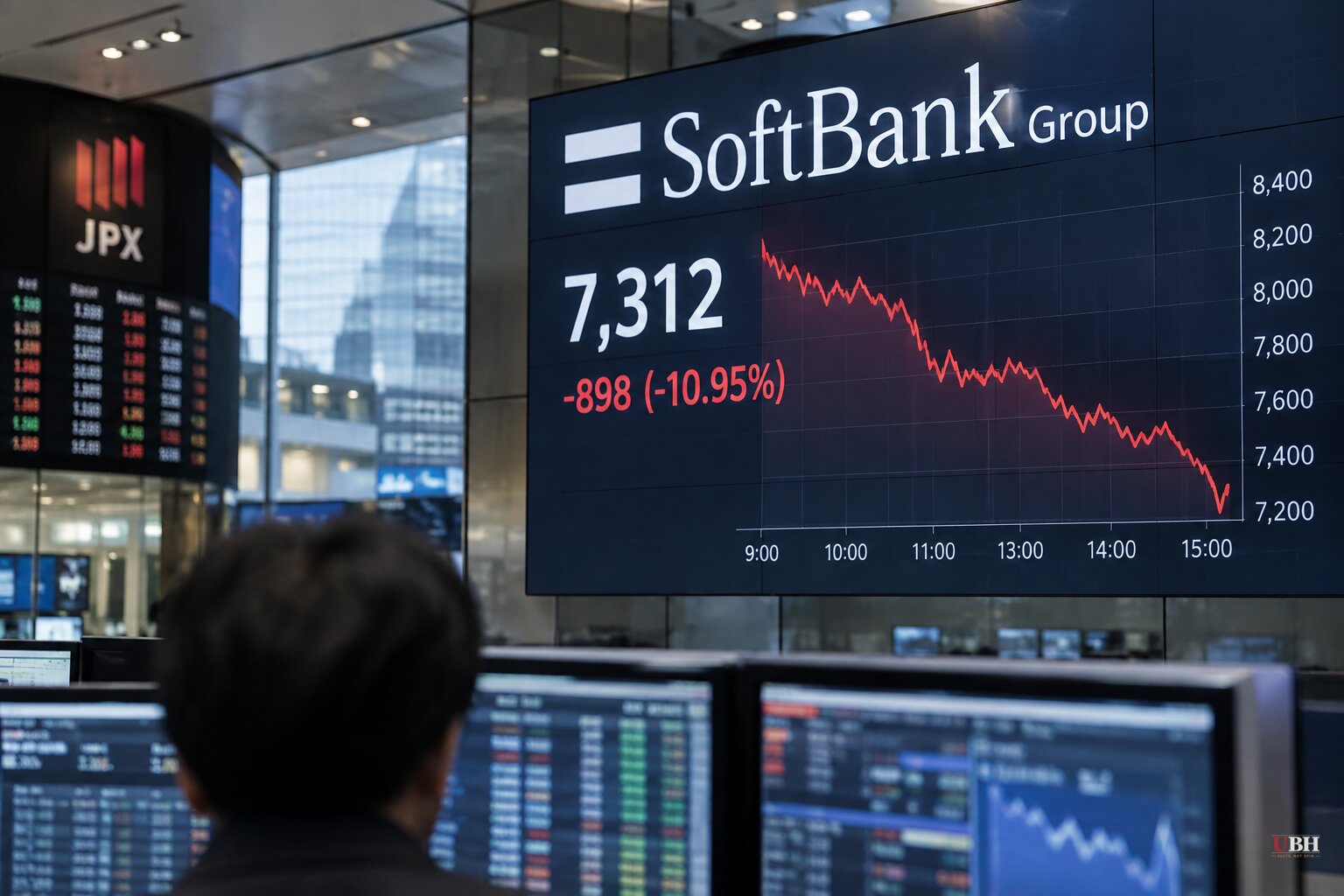
Since Anthropic CEO Dario Amodei published his essay "We Must Slow Down the Cutting Edge" over the weekend of September 12-13, the fallout has moved from Silicon Valley op-eds to real money leaving the table. SoftBank Group shares fell as much as 13% Monday, September 14, according to Bloomberg and Business Standard, with ABABNews putting the drop at 12%. Either way, it's SoftBank's steepest single-day decline in close to three months.
What actually triggered it
Amodei's essay argued AI companies should slow the pace of enhancing model capabilities and even floated limiting the computing power used to train frontier models, according to ABABNews. Sam Altman backed him within the day, telling Fortune that OpenAI would not pursue an IPO in 2026, calling it "ill-advised" while the industry sorts out safety concerns, per Business Standard. Elon Musk publicly signaled agreement too, according to Breitbart.
For SoftBank, that IPO delay is not an abstract industry debate. SoftBank is on track to have invested close to $65 billion in OpenAI by October, holding roughly a 13% stake, second only to Microsoft's 27%, according to ABABNews. SoftBank co-led OpenAI's $122 billion financing round in March. An OpenAI IPO is the mechanism by which that paper stake turns into cash. Push it into 2027, and SoftBank's entire liquidity thesis gets pushed with it.
The debt keeps piling up regardless
While Amodei and Altman were talking caution, SoftBank's bankers were doing the opposite. Business Standard reports SoftBank secured an upsized $11.87 billion loan tied to its OpenAI stake, sealed last week with commitments from roughly 20 banks, up from an earlier $10 billion target. That's on top of a planned ¥1 trillion ($6.5 billion) retail bond issue and a possible $10 billion to $20 billion junk-bond sale, with SoftBank executives meeting New York investors this week to gauge appetite, according to Business Standard and India Today.
SoftBank is also repaying $25.9 billion of an earlier $40 billion OpenAI-linked loan by September 15, per Business Standard, while Bloomberg-compiled data shows the company has already raised about $37 billion this year through bonds and loans. Masayoshi Son is running one of the most leveraged bets on a single unprofitable technology company in corporate history, and the people building that technology just told the market to expect it to move slower.
It didn't stay contained to SoftBank
The selloff spread across Asia. The Nikkei 225 dropped 1.7%, falling below 63,000 for a six-week low, according to ABABNews. Japanese chip and AI-supply names got hit hard: Kioxia Holdings fell 8.6%, Taiyo Yuden dropped 8.3%, Advantest declined 4.5%, and Tokyo Electron slid 2.6%. In South Korea, SK Hynix fell 5.4% and Samsung Electronics dropped 3.4%, with the KOSPI down 3.2%. ABABNews estimated the combined market value wiped from SK Hynix and Samsung alone at roughly $91 billion.
ABABNews also flagged that Monday's selloff wasn't purely an AI story. Oil prices climbed above $102 a barrel after the closure of Saudi Arabia's east-west pipeline, feeding expectations that the Federal Reserve and Bank of Japan could both tighten policy this week. Analysts at Kiwoom Securities told ABABNews the volatility reflected a mix of lingering August CPI data, the AI-slowdown debate, and the upcoming FOMC meeting, not the AI headlines alone. Bloomberg, Crypto Briefing, and India Today, by contrast, frame the drop almost entirely as a reaction to the Amodei and Altman statements, without mentioning oil or the Fed.
Washington reacts, mostly by not slowing down
President Trump rejected the idea of pumping the brakes, telling reporters at his golf course in Ireland on September 13, "We're leading China in AI. We're the most sophisticated country in the world, and frankly I want to keep it that way because whoever wins AI, wins," according to the Epoch Times. He said guardrails are possible but dismissed some of the alarm as coming from "negative forces."
Congress is split on how hard to push. Sen. Ted Cruz told the Epoch Times he's working with Sen. Amy Klobuchar and Majority Leader John Thune on legislation targeting "catastrophic risks involving biological or nuclear threats," while insisting "America needs to lead." Speaker Mike Johnson told CNN's Jake Tapper he fears formal regulation would let China close the gap, and instead wants AI executives to sit down with Congress directly. On the other side, Rep. Ro Khanna called for Congress to stay in session until it creates a federal AI oversight agency, and Hakeem Jeffries said AI would be a "high priority" at House Democrats' September 15 caucus meeting.
Amodei's underlying concern deserves a fair hearing. He's not calling for a halt, just for third-party verification of safety practices before capabilities race further ahead of anyone's ability to govern them. That argument gained weight when Anthropic researcher Jacob Coxon quit, telling Breitbart he believes the industry is "gambling with our lives." Whether that argument or Trump's China-race framing wins out will shape not just AI policy but whether SoftBank's highly leveraged bet pays off. The next test comes September 15, when SoftBank's $25.9 billion loan repayment is due and House Democrats hold their AI-focused caucus meeting on the same day.
Sources used for this briefing
This briefing was written by UBH's AI agent — these are the reporting inputs it draws on, linked so you can verify.


