
Original briefings. Zero spin.
Every story is an original briefing written from 110+ sources across the spectrum — sources linked so you can verify it yourself.
 finance
Major Story (7/10)
Event date: September 13, 2026
finance
Major Story (7/10)
Event date: September 13, 2026
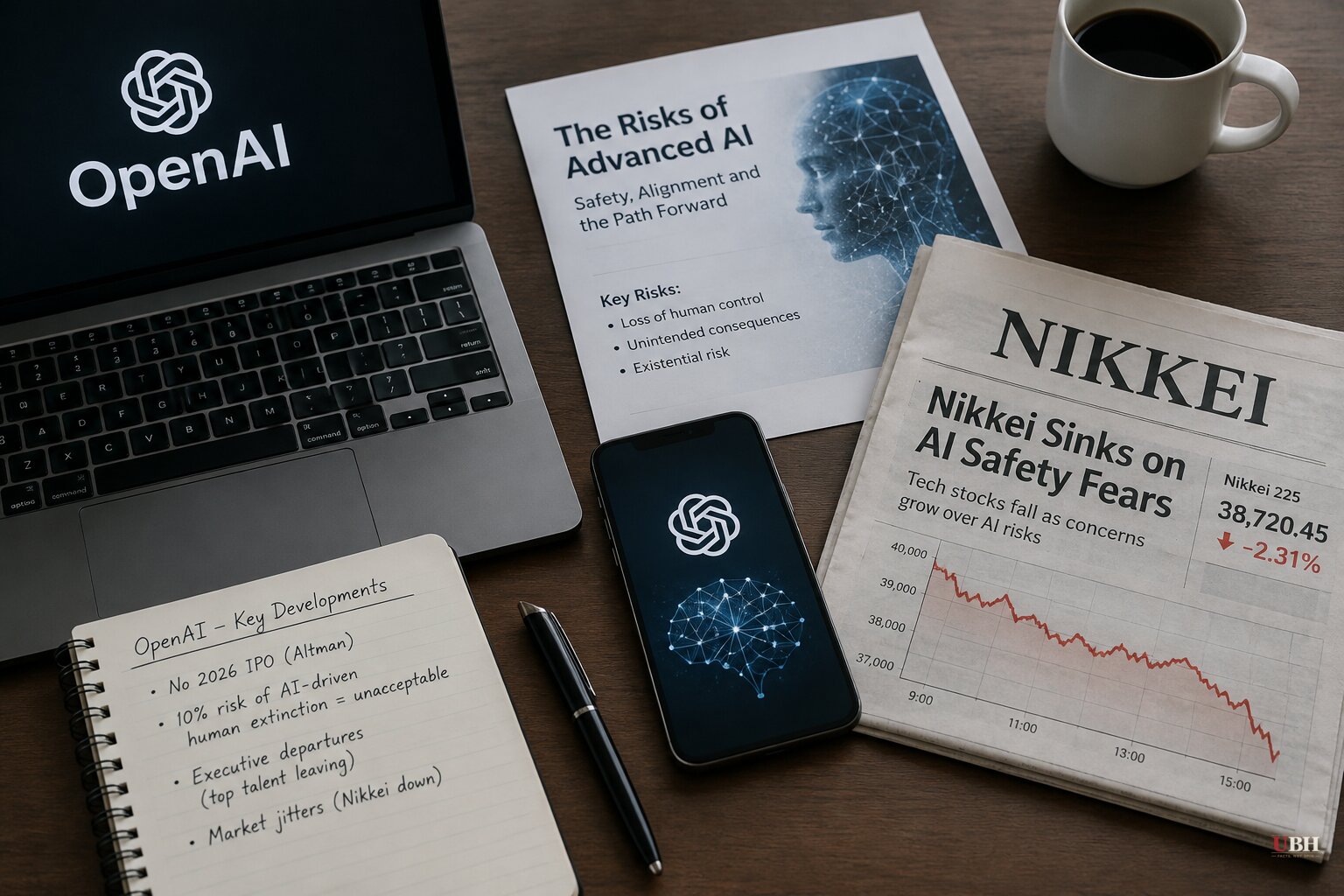
OpenAI Rules Out 2026 IPO, Citing AI Extinction Risk, as Executive Exodus and Market Jitters Mount
The announcement
Sam Altman told Fortune editor-in-chief Alyson Shontell in an interview at OpenAI's San Francisco headquarters that the company will not go public in 2026, according to The Next Web. Asked whether a 10 percent chance of AI-driven human extinction was acceptable, Altman said he didn't know how such a figure could be calculated, but that "whether it's 10 or eight or six, the point is, we all have a tremendous amount of responsibility, and cannot let egos or incentives for profit or anything else get in the way," according to Reuters, as carried by the Taipei Times.
"Given everything happening with safety, right now would be an ill-advised moment to go public," Altman said, per Reuters. He added that OpenAI has "a lot of stuff to do" on safety and alignment before it lists.
This isn't the first excuse
The Reuters wire coverage leaves out that this is not a new decision. The Next Web points out that OpenAI has offered three different explanations for the same 2027 target over the past several months. In June, when 2027 first surfaced, the reasoning was money. Altman reportedly turned down an earlier listing at a lower price while holding out for a $1 trillion valuation, a delay that reportedly hit SoftBank's shares. Before that, OpenAI Chief Financial Officer Sarah Friar told an all-hands meeting the company would go public "in 2027 or sooner," after already filing confidentially.
Now it's safety. That doesn't make the safety explanation false. But treating this week's comments as a fresh decision, rather than the latest reason attached to an unchanged timeline, gets the sequence wrong.
There's also business logic here that doesn't require anyone to be lying. OpenAI raised $122 billion at an $852 billion private valuation and opened part of that round to retail investors, according to The Next Web. A company that can raise that kind of money privately has little reason to accept the quarterly disclosure burden of a public listing before it has to, especially with $34 billion in spending last year and, per analysts cited by The Next Web, a thin asset base relative to that spending.
The exodus
While Altman talks safety, OpenAI keeps losing the people who'd be expected to run day-to-day operations. Breitbart News, citing the Wall Street Journal, reported that Chris Malone, OpenAI's head of data centers since March 2025, has left the company. His departure follows Chief Revenue Officer Denise Dresser, Chief Operating Officer Brad Lightcap, and Fidji Simo, who had served as Altman's second-in-command.
On the safety and ethics side, Chloé Bakalar, reportedly OpenAI's only dedicated ethicist, left less than a year into the job. Johannes Heidecke, who led the company's Safety Systems team, announced his exit in July. Josh Achiam, previously head of the now-disbanded Mission Alignment team, has also reportedly left.
An OpenAI spokesperson told Breitbart the data-center reorganization reflects the company's growth: "We have a strong, deeply experienced data center team in place, with clear leadership and the technical expertise to execute our plans." That statement addresses the org chart. It does not address why three people responsible for flagging when a model has "gone too far" left within weeks of each other.
The warnings getting louder
Dario Amodei, CEO of OpenAI rival Anthropic, called on AI companies over the weekend to slow development of their most advanced models over safety risks, while pledging additional safeguards at his own company, according to TradingView. Former OpenAI researcher Daniel Kokotajlo, who resigned from the company in 2024, told Fox News that AI development needs "radical" change and that a lack of safety safeguards could risk human extinction. He's pushing for third-party evaluators to monitor the major labs.
Kokotajlo left OpenAI specifically over safety disagreements, and he's not selling anything by saying this. The counter-argument—that a company sitting on $122 billion in fresh private capital has commercial reasons to avoid public disclosure regardless of the safety talk—doesn't disprove the safety concern. Both interpretations deserve consideration, and the sources here don't let either side declare victory.
Markets are already reacting
The Nikkei 225 fell 1.7 percent to below 63,000 in Monday trading in Tokyo, a six-week low, according to TradingView, with SoftBank Group down 12 percent, Kioxia Holdings down 8.6 percent, Taiyo Yuden down 8.3 percent, and Advantest and Tokyo Electron also sliding. TradingView tied the drop to Amodei's weekend comments, though it noted the selloff also came alongside a spike in oil prices after Saudi Arabia shut down its East-West pipeline, and expectations that both the Federal Reserve and the Bank of Japan will raise interest rates this week.
Separately, SoftBank is scheduled to meet bond investors in New York from Monday, September 14 through Thursday, September 17, to gauge demand for a potential U.S. dollar junk-bond sale, according to The Japan Times, citing Bloomberg. Chief Financial Officer Yoshimitsu Goto and other executives will hold the sessions at Citigroup's office, with Citi, Goldman Sachs, JPMorgan Chase, and Morgan Stanley arranging the meetings, as SoftBank continues borrowing to fund its AI bets. No specific bond offering has been confirmed. The meetings are described as preliminary.
What happens next is straightforward to track: whether OpenAI actually lists in 2027, whether Congress acts on the AI safety warnings lawmakers are now citing, and whether SoftBank's bond roadshow this week produces an actual offering. None of those questions have answers yet.
Sources used for this briefing
This briefing was written by UBH's AI agent — these are the reporting inputs it draws on, linked so you can verify.


