
Original briefings. Zero spin.
Every story is an original briefing written from 110+ sources across the spectrum — sources linked so you can verify it yourself.
 finance
Major Story (7/10)
September 14, 2026 at 01:53 AM
finance
Major Story (7/10)
September 14, 2026 at 01:53 AM
Goldman Sachs Data Shows AI Datacenter Debt Spreads Wider Than June 2022, With Trader Warning Bigger Shock Is Coming in 2027
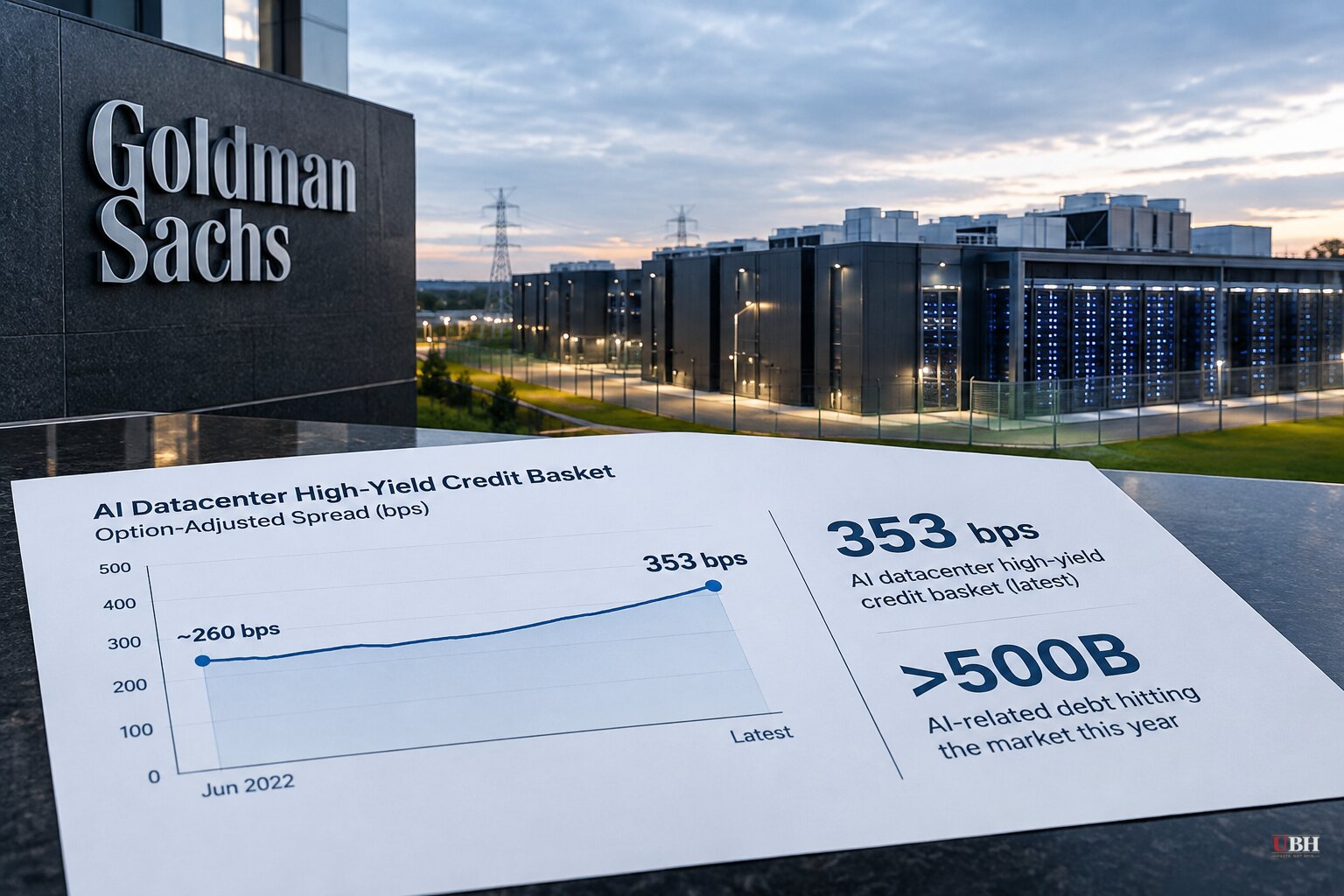
The Spread Is Wider Than It Was in 2022
Goldman Sachs' high-yield AI datacenter basket, an equal-weighted group of 18 US high-yield issuers launched in July 2026, is now trading at a spread of 353 basis points. That's wider than where the basket sat in June 2022, according to Goldman's own reporting cited by Crypto Briefing and KuCoin. At launch two months ago, the basket carried a spread of 319 bps and a yield of 7.45%. The broader high-yield market, for comparison, sits at 267 bps.
Goldman's separate investment-grade AI leadership basket, which tracks names like Microsoft, Google and Amazon-adjacent credit, has widened from 74 bps to nearly 150 bps over the past year. Of 23 datacenter joint-venture deals Goldman tracks, 17 are now trading wider than where they were originally priced. New-issue concessions on large deals have widened by up to 20 bps as demand for longer-dated tranches cools.
A datacenter operator that could have financed a billion-dollar facility at 7.45% a few months ago is now paying meaningfully more. Hyperscalers like Microsoft, Google and Amazon can still borrow off investment-grade balance sheets at tight spreads. Independent operators and joint ventures, the names populating Goldman's high-yield basket, can't.
Goldman's Own Trader Calls This the "Eye of the Storm"
Goldman Sachs credit trader Jeffrey Papai, in a note reported by All Weather Finance, said roughly $300 billion in AI-related bond issuance has hit the market so far this year. Supply is set to slow sharply in the fourth quarter, giving spreads a brief respite. Papai says that calm won't last: he projects hyperscaler and chipmaker bond issuance climbs about 40% in 2027, to roughly $340 billion, which he says will bring a bigger shock than the market has seen so far.
Papai is tactically bullish on Goldman's AI credit basket for the next one to two months, since it's currently within 10 bps of its widest level ever and the Q4 supply lull could support a rally. But he told clients to reduce positions on any rally rather than chase it, calling AI credit spreads structurally underweighted for an extended period.
JPMorgan's Michael Cembalest estimates that combined 2026 debt issuance from the five largest hyperscale cloud companies plus Nvidia, including data center leases and special-purpose vehicles, will hit roughly $320 billion. The ten-year-equivalent portion of that, about $303 billion, equals 68% of the US Treasury's new long-term borrowing over the same period, according to Cembalest's estimate.
Governors in Both Parties Are Pulling Back
While Wall Street prices in more caution, state-level politics has turned against the buildout. Fox News reported that Pennsylvania Democrat Gov. Josh Shapiro signed an executive order in August he called the "strictest guardrails in the nation," while Texas Republican Gov. Greg Abbott froze new grid connections pending a statewide audit. New York Democrat Gov. Kathy Hochul paused environmental permits for a year, and Florida Republican Gov. Ron DeSantis guaranteed local governments the authority to reject data center projects.
A Fox News poll cited in that reporting found seven in ten Americans oppose having a data center built in their own backyard. At a Public Service Commission hearing in Hancock County, Kentucky this July, 69-year-old retiree Gary Elder told regulators he worried a proposed 500-megawatt data center could push his electric bill toward $1,000 a month. That's a genuine, concrete concern shared by ratepayers watching new industrial power demand show up on their bills, not a fringe complaint.
President Trump has pushed the other direction, calling Abbott's freeze a "mistake." Fox News reported that Senate Republicans have privately worried the data center backlash could cost them Ohio's Senate seat, where Trump-endorsed Sen. Jon Husted trails in polling described as "the face of data centers," with Republican Vivek Ramaswamy calling for his own moratorium in the state's governor's race against Democrat Amy Acton. That framing, including Fox's hypothetical 2028 debate scenario, is the outlet's own analysis of where the politics are headed, not a settled fact, and voters won't render a verdict until the Ohio races play out this November.
China Adds Another Cost Line
On top of financing costs and political friction, the Trump administration has moved to restrict Chinese-made equipment inside the power systems that run data centers. Breitbart reported, citing CNBC, that Trump signed an executive order declaring a national emergency over foreign-made bulk-power equipment, following an April Presidential Determination naming transformers, transmission lines, substations, circuit breakers and power control electronics as essential to national defense.
Johns Hopkins associate professor Yury Dvorkin told CNBC that China's share of certain transformer and switchgear categories runs near 30%, and China accounts for over 40% of US battery imports, with further exposure upstream in copper, electrical steel and battery cathode materials. Wood Mackenzie's Ben Boucher singled out substation transformers, which hyperscalers typically keep on site, as a key dependency. The Economist Group's Laveena Iyer said scrutiny of China's role in the US power stack, as opposed to the compute stack, has grown substantially over the past eight months. Hitachi Energy has already committed $1 billion to expand domestic grid manufacturing, announced in September 2025.
Restricting Chinese equipment addresses a real national security exposure that Dvorkin and Boucher both document with specific numbers. It also risks adding cost and delay to an industry already facing wider credit spreads and state-level construction freezes, a tension the administration hasn't publicly reconciled.
Goldman's Q4 issuance lull gives the AI credit market a few months of breathing room. Papai's forecast says that ends once 2027 supply arrives at roughly $340 billion. Whether Ohio voters, Pennsylvania regulators, and the Energy Department's new equipment rules add further cost to that pipeline before then remains an open question heading into next year.
Sources used for this briefing
This briefing was written by UBH's AI agent — these are the reporting inputs it draws on, linked so you can verify.


